


Pistachio is one of those flavors customers think they know—until they try a version that’s either bitter, oddly watery, or separated into layers.
This SOP is built for bubble tea shops that want a pistachio milk tea that’s:
consistent (anyone on staff can make it)
fast enough for a rush
easy to price and scale
safe to serve (with clear allergen controls)
What you’ll need (ingredients + tools)
Keep this drink simple on purpose. Pistachio flavor is expensive, and “more ingredients” often makes the flavor muddier—not better.
Core ingredients
Pistachio flavor base (choose one): pistachio paste, pistachio powder, or pistachio syrup
Milk: whole milk is the easiest default for mouthfeel (see dairy-free notes below)
Sweetener: simple syrup or sugar syrup
Pinch of salt: optional, but helps the pistachio taste “round” instead of flat
Ice
Optional boba: classic tapioca pearls pair well with pistachio
Tools
Cocktail shaker or milk tea shaker
Jigger/portion cups (or a measured squeeze bottle system)
Fine mesh strainer (optional; useful for powders)
Standard boba equipment (if serving with pearls)
Pro Tip: Consistency comes from portions, not “better shaking.” If you don’t have a measured system, pistachio drinks will drift—especially across different staff.
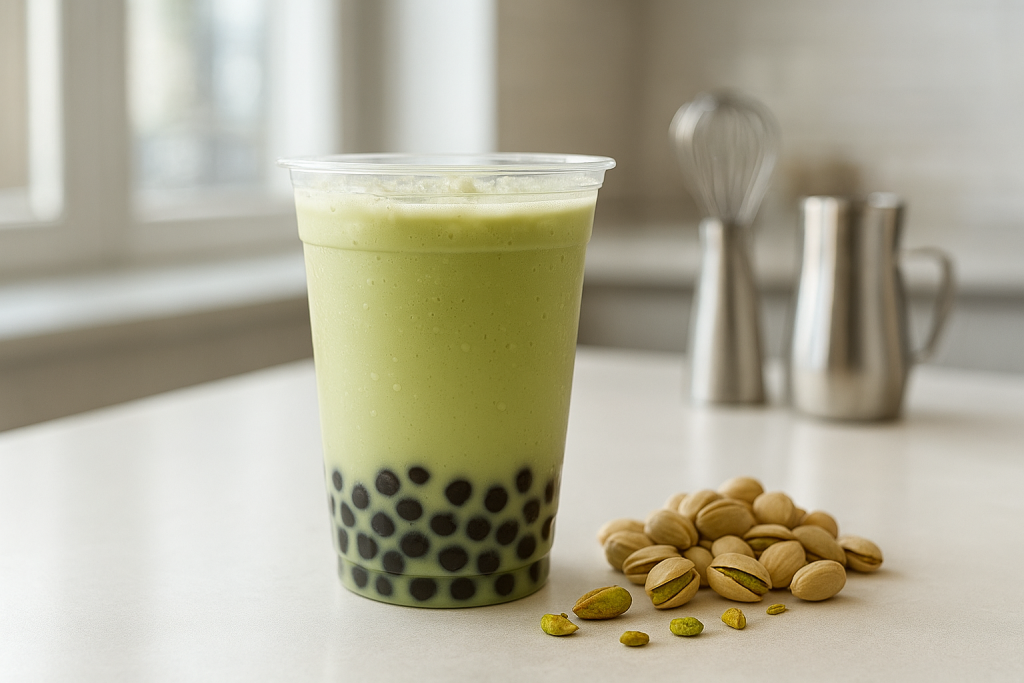
Choose your pistachio base: paste vs powder vs syrup
If you’re building this drink for a real shop (not a one-off home recipe), your pistachio ingredient choice matters as much as the recipe. It drives:
speed on the line
consistency across staff
how often the drink separates
your cost of goods (COGS)
If you’re still deciding, treat this as a quick decision tree: paste = premium flavor, powder = speed and training, syrup = simplest workflow.
There isn’t one “right” pistachio ingredient—there’s the one that fits your shop’s workflow.
Pistachio paste (best flavor, most finicky)
Use it when: you want a premium taste and you can commit to good mixing discipline.
Pros: rich, true pistachio flavor; great aroma
Cons: can separate; can clump; usually higher cost
Best for: premium menu positioning, smaller batch prep, shops that can train staff well
Pistachio powder (fast, consistent, can be chalky)
Use it when: you want speed and repeatability.
Pros: easy portioning; stable inventory; quick to train
Cons: can taste dusty/chalky if not fully dissolved; quality varies widely
Best for: high-volume lines where you need fast assembly
Pistachio syrup (easiest, but often “candy pistachio”)
Use it when: you need the simplest workflow and a sweet, approachable flavor.
Pros: fastest; easy portioning; rarely separates
Cons: can taste artificial; may not read as “real pistachio” to some customers
Best for: entry-level seasonal specials or shops prioritizing speed
⚠️ Warning: If your pistachio base contains nuts or nut extracts, treat it as a major allergen ingredient in your shop. You’ll want clear cross-contact controls (see below).
Base recipe (16 oz / ~500 ml) — pistachio milk tea
This is a “works in most shops” pistachio milk tea recipe. You’ll dial it in for your specific ingredient brand.
Starting ratios (pick one base)
Choose one of these starting points based on your pistachio ingredient type:
Option A (paste): 1–1.5 Tbsp pistachio paste
Option B (powder): 1.5–2 Tbsp pistachio powder
Option C (syrup): 1.5–2.5 Tbsp pistachio syrup
Then add:
6–8 oz milk
0.5–1 Tbsp sugar syrup (adjust to your customer sweetness level)
tiny pinch of salt (optional)
ice to fill the shaker
Done when: it tastes like pistachio first, sweetness second—and there’s no gritty mouthfeel.
Dairy-free version (easy swap)
Use oat milk for the closest “milk tea” mouthfeel.
If using nut-free policies, do not assume “dairy-free” equals “allergen-safe.” Pistachio is still a tree nut.
The step-by-step SOP (with “done when…” checks)
This SOP assumes an iced drink. If you sell hot milk tea, use the same ratio but heat your milk separately and skip shaking with ice.
Step 1: Decide your default sweetness level
Input: your shop’s standard sweetness scale (e.g., 0/25/50/75/100).
Action: pick the default sweetness for pistachio (most shops land around 50–75%).
Output: a standard syrup amount for “default pistachio.”
Done when: staff can make pistachio milk tea without asking, “How sweet is this one?”
Step 2: Portion the pistachio base
Input: pistachio paste/powder/syrup and a measured tool.
Action: add your starting portion to the shaker.
Output: pistachio base is in the shaker before milk and ice.
Done when: the portion is always the same for the same cup size.
Step 3: Dissolve (this prevents clumps and bitterness)
Input: pistachio base + a small splash of warm water (or room-temp water).
Action: add 1–2 Tbsp water and stir/swirl to loosen the base.
Output: a smooth pistachio concentrate.
Done when: no visible clumps remain (especially important for paste and powder).
Step 4: Add milk + sweetener
Input: milk and sugar syrup.
Action: add milk first, then sweetener, plus a tiny pinch of salt if you use it.
Output: a fully assembled liquid base ready to shake.
Done when: you can smell pistachio clearly before shaking.
Step 5: Shake hard with ice
Input: shaker filled with ice.
Action: shake for 10–15 seconds.
Output: cold, well-mixed pistachio milk tea.
Done when: the drink looks uniform in color (not streaky), and the shaker feels frosty.
Step 6: Build the cup (boba version)
Input: cooked tapioca pearls.
Action:
add boba to the cup (standard portion)
pour in the shaken drink
Output: a ready-to-serve pistachio boba drink.
Done when: pearls are warm and soft, and the drink is cold—without turning the boba hard.

Step 7: Taste-check rule (the fastest quality control)
Input: a single sip test once per batch/shift or when a new bottle/bag is opened.
Action: taste for these three markers:
pistachio-forward (not “sweet milk”)
no bitterness on the finish
no grit on the tongue
Output: quick adjustments (see troubleshooting).
Done when: you can tell staff exactly what to tweak if it’s off.
Troubleshooting: the 5 most common pistachio failures
1) It separates into layers
This is also where operators often ask about pistachio milk tea powder vs paste—because separation issues usually show up first with paste (rich, but finicky) and less with syrup (easy, but less “real pistachio”).
What’s happening: paste/fat and liquid aren’t staying emulsified.
Fixes:
loosen the base first (Step 3) before adding full milk
shake longer (aim for a full 15 seconds)
consider a small amount of a creamier milk (or a barista-style oat milk) for stability
2) It tastes bitter
What’s happening: pistachio concentrate is too strong, or you’re getting roasted/nut-skin bitterness.
Fixes:
reduce pistachio portion slightly and keep sweetness steady
add a tiny pinch of salt (it can smooth bitterness)
avoid over-concentrating paste/powder without enough milk
3) It’s chalky or gritty
What’s happening: powder isn’t dissolving.
Fixes:
dissolve the powder with a small splash of water before milk
strain once if needed (especially during R&D)
consider switching to a higher-solubility powder or to paste
4) It tastes weak (customers say “I don’t taste pistachio”)
Fixes:
increase pistachio portion in small steps
reduce milk slightly before adding more sugar
make sure staff isn’t defaulting to higher sweetness (sweetness can hide pistachio)
5) Boba texture gets weird fast
What’s happening: pearls are overcooked, held too long, or shocked by very cold liquid.
Fixes:
use your standard hold-time rules and discard schedule
keep pearl portions consistent so “cold shock” is predictable
if needed, serve with an alternate topping for this drink (pudding, grass jelly, or a lighter gel topping)
Allergen + cross-contact controls (non-negotiable)
If your pistachio base contains tree nuts, treat this as a serious allergen menu item.
Minimum controls to implement
Labeling: mark the drink clearly as containing tree nuts (menu + POS)
Dedicated tools: separate scoop/spoon/jigger for pistachio ingredients
Wipe protocol: sanitize the prep area after making nut-based drinks
Staff script: “This contains tree nuts. If you have a nut allergy, we can’t guarantee zero cross-contact in a shared environment.”
⚠️ Warning: “Nut-free” is a promise you can’t safely make in most shared-prep bubble tea shops. Use careful language and consistent procedures.
Pricing: a simple way to set a profitable menu price
Pistachio tends to be higher COGS than classic milk tea. Don’t guess—do a quick back-of-napkin cost build.
Step 1: Estimate your per-cup COGS
Add up:
pistachio base portion cost
milk cost
sweetener cost
boba cost (if included)
cup/lid/straw
Step 2: Pick a margin target
Many shops set a menu price that gives comfortable room for labor, waste, and promos.
Step 3: Position it like a premium flavor
Pistachio reads as “special” to customers. If your quality is high and consistent, it can justify:
a slightly higher price than classic milk tea
a limited-time “seasonal” label for urgency
an upsell pairing (extra topping, cheese foam, or a premium boba)
Next steps: standardize it, then scale it
Run a one-week test: track daily pistachio sales and waste.
Lock the portion system (paste/powder/syrup + sweetness default).
Train staff using the “done when…” checks.
If you want a central place to build out your ingredient standards and menu basics, start with the Bubble Tea Supplier guide to bubble tea ingredients and basics.
(If you’re training staff, you can also add a quick “nut allergy bubble tea shop” note to your SOP binder: label the drink clearly, use dedicated tools, and never promise “nut-free” in a shared prep environment.)