


Mango milk tea is one of the easiest drinks on a boba menu to sell and one of the hardest to keep consistent. It tastes familiar enough to order without hesitating, but a mango base that swings between bright and watery — or a cup that splits and looks curdled mid-shift — will cost you repeat orders fast.
The good news: you don’t need to reinvent the drink every day. A repeatable, staff-trainable mango milk tea comes down to three decisions — your tea base, your mango base format, and how you handle the creamy component. This guide walks you through each one, gives you exact 16 oz and 22 oz build specs, and shows you where the margin lives so you can price it with confidence.
The three decisions that control your results
Before you write a recipe card, decide three levers. They drive about 90% of how the drink tastes, how fast staff can build it, and how stable it holds in a sealed cup.
- Tea base — black or jasmine green.
- Mango base — puree, syrup, or powder.
- Creamy component — non-dairy creamer, oat milk, or dairy milk.
Change any one of these and you have a different drink on your hands. Lock them as defaults, then treat everything else as a controlled variation.
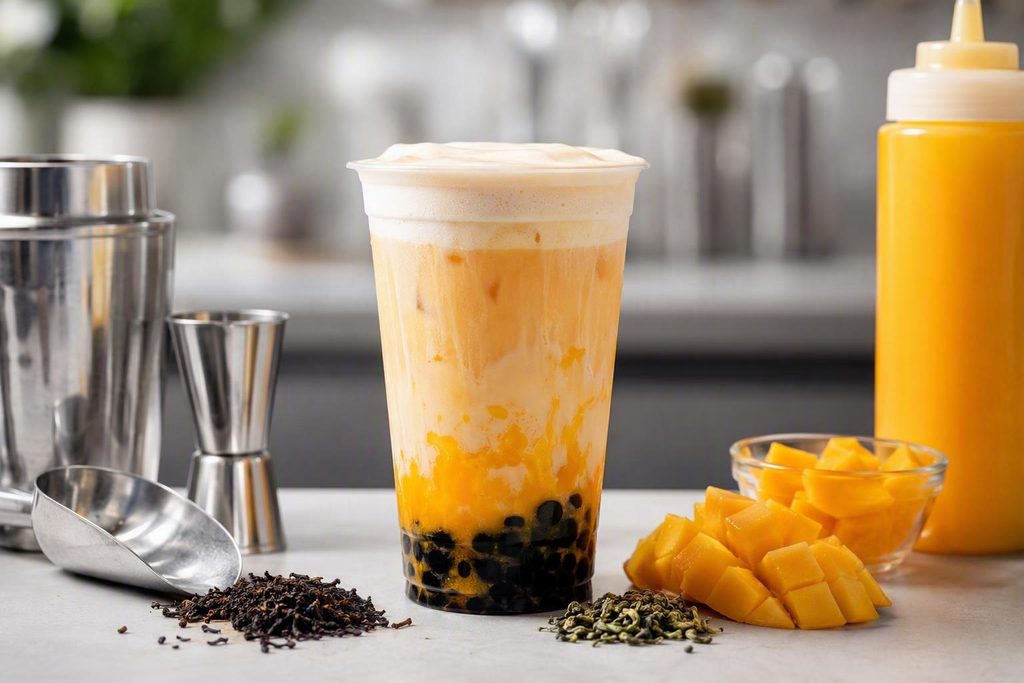
Choose your tea base: Assam black or jasmine green
Assam black tea is the safe default for a classic mango milk tea. It has the strongest body, and the tannins and malt-forward base give sweet mango something to sit on instead of letting the drink taste flat and thin. If you want a crowd-pleasing, “this is definitely milk tea” cup, black tea is your answer.
Jasmine green tea reads lighter and more floral. It keeps the mango bright and pushes the drink toward a fresher, more refreshing profile — the direction fruit-led menus are moving. If you’re building a summer LTO or a lighter “mango jasmine” variation, this is the base.
A strong practical setup is to offer both: black tea for the classic version and jasmine green for a lighter menu-line option. Pairing the tea base to your fruit layer matters more than most owners realize, and a general fruit and tea base pairing guide helps you think through the logic for other fruit drinks too.
If you’re torn on which to run as your default, start with black tea. It’s the more forgiving base across different mango formats and sweetness levels, and it keeps the drink reading as a genuine milk tea rather than a juice-forward fruit drink. Once the black-tea classic is dialed in and selling, add the jasmine version as a lighter alternative and let the sales data tell you which one your neighborhood prefers.
Pro Tip: Brew your tea stronger than a standard cup and cool it fully before service. A concentrated, cold tea base is what keeps a mango milk tea from tasting watery after the ice melts.
Choose your mango base: puree vs syrup vs powder
Your mango base is the biggest flavor and cost lever on the drink. Each format buys you something different.
Mango puree delivers the strongest, most “real fruit” flavor and the best texture. It’s the premium option — the one that lets you market a genuinely fruity drink. The trade-off is cost: real puree is the most expensive mango ingredient per cup.
Mango syrup is the workhorse for speed, consistency, and shelf stability. Most commercial mango syrups still carry a real mango-puree percentage in them, so you get consistent mango flavor without the prep or the cost of dosing puree by hand. If speed and predictable yield matter most, syrup wins.
Mango powder is best treated as a functional, cost-control ingredient — good for dry-mix programs or backup — rather than the hero of a premium mango milk tea.
Most shop operators end up combining them: puree for the main flavor layer, syrup to standardize sweetness, and powder reserved for specific production lines. The right call depends on your volume, your staffing, and how premium you want the menu to read. To see how puree and concentrate compare on consistency, cost, and shelf life, BubbleTeaSuppliers weighs the trade-offs in a mango concentrate vs fresh mango comparison that’s useful when you’re picking a supplier. If you’re planning how this drink slots into a broader menu, their mango milk tea flavor idea page gives you a lineup of complementary fruit combinations to test alongside it.
Dairy and dairy-free handling
The creamy component decides both the mouthfeel and how the drink holds up. Two options dominate commercial menus.
Non-dairy creamer gives the classic, rich milk-tea body and helps control cost. One important caveat: “non-dairy” doesn’t always mean dairy-free. Some creamers contain sodium caseinate, a milk derivative, so if you market the drink as dairy-free you need to check the label and confirm no milk derivatives are present.
Barista oat milk is the closest plant-based match to a creamy milk tea and is now the most popular non-dairy choice for boba shops. It reads as a cleaner, more customer-friendly label. The catch is stability — oat milk can separate more easily when it meets fruit and tea, especially with heat shock.
The single fastest way to a split or curdled cup is combining hot tea, an acidic fruit base, and milk in the same cup. Cool the tea before you add anything creamy, add the milk or creamer gradually, and it will hold. Allow a full dairy-free mango milk tea build by picking oat milk or a genuinely dairy-free creamer and keeping the rest of the build identical.
The core build: exact specs for 16 oz and 22 oz
Here is a spec you can hand to any barista and expect the same cup every time. It works with either non-dairy creamer or oat milk — pick one path and train it hard.
16 oz spec sheet
| Component | Amount | Build note |
|---|---|---|
| Cold tea concentrate (Assam or jasmine) | 150 ml | Strong, fully cooled |
| Mango puree or mango syrup | 60 ml | Your chosen base |
| Sweetener (fructose or simple syrup) | 25 ml | Set your default sweetness |
| Non-dairy creamer or barista oat milk | 90 ml | Add gradually, stir |
| Ice | Fill cup | Consistent scoop |
| Optional: toppings | 1 scoop | Boba, mango jelly, popping boba |
22 oz spec sheet
| Component | Amount | Build note |
|---|---|---|
| Cold tea concentrate | 200 ml | Fully cooled |
| Mango puree or mango syrup | 85 ml | Maintain the mango-forward ratio |
| Sweetener | 30 ml | Scale with cup |
| Non-dairy creamer or barista oat milk | 120 ml | Add gradually, stir |
| Ice | Fill cup | Consistent scoop |
| Optional: toppings | 1–1.5 scoops | Keep texture a feature |
Build steps
Step 1 — Portion the mango base. Add your measured mango puree or syrup to the shaker. Done when: the amount hits the same shaker mark or weight every time.
Step 2 — Add the sweetener. Use the documented pump or scoop count for your default sweetness. Done when: staff can repeat the sweetness level without asking.
Step 3 — Add the cold tea. Pour in the tea concentrate up to the pre-marked line. Done when: the shaker volume matches your 16 oz or 22 oz build line.
Step 4 — Add the creamy component. Add non-dairy creamer or oat milk gradually and stir once. Never add it to hot tea. Done when: the liquid looks uniform with no visible powder clumps or separation streaks.
Step 5 — Ice and shake. Add the standard ice scoop and shake 10–15 seconds until frosty. Done when: the shaker is cold and the drink is evenly mixed.
Step 6 — Build the cup. Add toppings first, pour the drink over, seal, and serve. Done when: the color is consistent top to bottom and the cup holds for handoff.
Pro Tip: If your steps can’t be explained in 60 seconds and verified in 10, they won’t survive a Saturday rush. Every spec line above has a measurable “done when” so training is fast and re-checks are quick.
Batching for rush hour
Batching mango milk tea saves time, but only if you control three things: tea strength, mango base viscosity, and age. What works well to batch is the tea concentrate (brew once, label time, store cold) and pre-portioned mango base (measured into service cups or a pump station ahead of the rush). What you generally shouldn’t batch is a fully mixed mango + milk + tea blend unless you’ve tested it for separation and are comfortable shaking before use. The practical middle ground: batch the tea, pre-portion the mango, and mix each drink fresh in the shaker.

Costing and menu strategy
Mango milk tea sits on the higher end of fruit-drink COGS because the mango base is the priciest ingredient. Industry guides commonly put bubble tea cost of goods at roughly 20–30% of the selling price, with a 16 oz ingredient cost often between $0.60 and $1.25 depending on recipe and toppings. A realistic breakdown of where the money goes — tea base, mango ingredient, creamy component, and packaging — is laid out in a boba economics guide that breaks down classic vs premium fruit drink costs.
The margin levers are the ones you already control:
- Mango content — the biggest cost driver; keep your portion standard.
- Tea strength — stronger tea means less mango needed to keep flavor present.
- Milk/creamer choice — premium plant milks cost more than non-dairy creamer.
- Toppings — boba, mango jelly, or popping boba add direct cost but also raise the sell price and perceived value.
- Packaging — cup, lid, seal, straw are a fixed per-cup cost worth optimizing.
For a deeper look at COGS bands and margins across drink types, the bubble tea business guide
is a useful benchmark for where your mango milk tea should land in price.
Troubleshooting common issues
- Drink looks split or curdled. Hot tea plus acidic mango plus milk is the usual cause. Cool the tea, avoid overly acidic add-ins, and add the creamy component gradually.
- Mango flavor tastes weak. The mango base dose is too low relative to the tea. Raise it in small increments and lock the new number into the spec.
- Drink tastes watery. Too much tea or too much melt from over-shaking. Reduce tea slightly or increase the creamy component, and standardize your ice scoop.
- “Chalky” or gritty mouthfeel. Powder mango or powder creamer wasn’t fully dissolved. Train a dissolve-first step with a little hot (then cooled) water before adding it to the build.
Mango milk tea FAQ
Can mango milk tea be dairy-free? Yes. Use barista oat milk or a genuinely dairy-free creamer. Just confirm the creamer contains no milk derivatives like sodium caseinate before labeling it dairy-free.
Green or black tea for mango milk tea? Black (Assam) gives the richest, most classic milk tea; jasmine green gives a lighter, more refreshing fruit-forward cup. Both work — pick based on your menu position.
Mango puree or syrup? Puree for the best flavor and premium feel; syrup for speed, consistency, and lower cost. Most shops use a mix.
Why does my mango milk tea split? Usually heat shock from hot tea meeting acidic fruit and milk. Cool the tea and add the creamy component gradually.
Next steps
If you’re standardizing a mango program, build your spec card from the sheet above, run a 30-minute tasting comparing tea base, mango format, and creamy component, then lock the winners into training. If you’re building a milk-tea program, a full milk tea ingredients and SOP structure guide helps you standardize beyond this single drink.