


If you source ingredients for a bubble tea shop, you’ve probably stared at a supplier sheet and wondered the same thing: is tapioca flour the same as cassava flour? The two names look like they should describe one product, and to make it worse, some brands use “cassava flour” and “tapioca flour” loosely. One invoice might say “tapioca starch,” the next “cassava flour,” and your back-of-house team quietly assumes they’re the same and can be swapped at will.
That assumption is exactly how a topping station ends up with a batch of pearls that won’t hold their chew.
The honest answer is no — they are not the same ingredient. They share a plant, but the processing path is completely different, and so is the job each one does in your kitchen. Here’s what you actually need to know before you order another pallet — and before you let “they’re basically the same” creep into your prep SOPs.
The Short Answer
Both flours come from the same plant, but they are processed in completely different ways and behave differently in the kitchen.
Tapioca flour — also labeled tapioca starch — is the extracted starch from the cassava root. The root is washed, pulped, and processed until only the pure starch remains. The result is a very fine, neutral-tasting white powder that is mostly carbohydrate and almost no fiber. It is a thickener and binder, prized for its glossy finish and chewy texture.
Cassava flour is the whole peeled root, dried and ground into a flour. Because it keeps the fiber and more of the root’s natural structure, it behaves more like a wheat-flour base in baking — it adds body, density, and a fuller crumb.
Think of it as the difference between cornstarch and cornmeal: same corn, very different jobs in the kitchen.
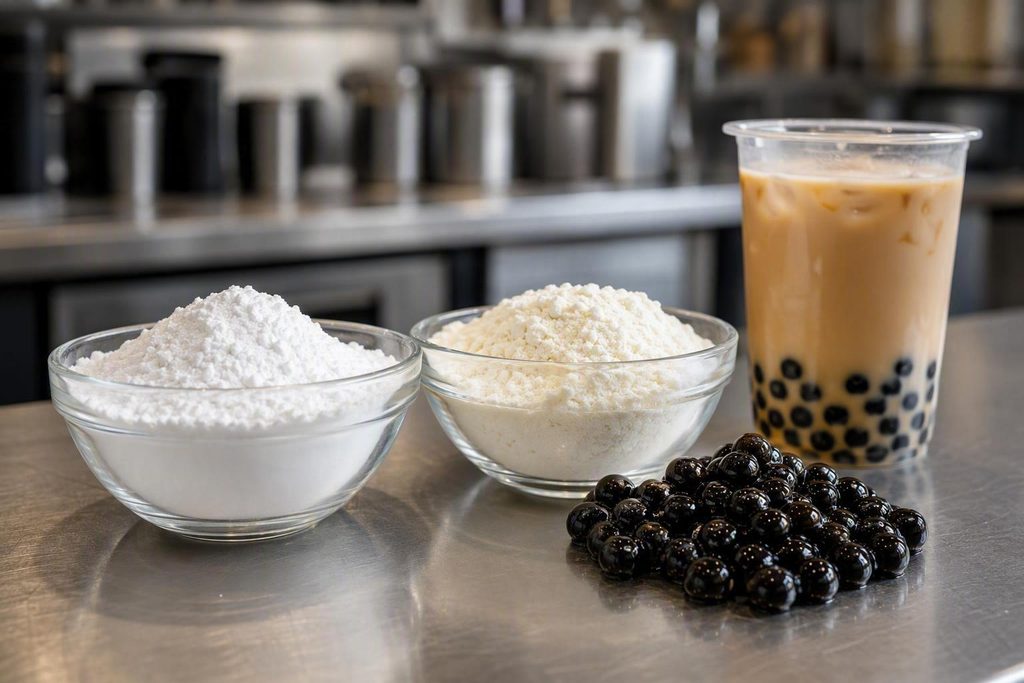
The Root They Share
Both ingredients trace back to the cassava plant (Manihot esculenta), a starchy tuber native to South America that is now a staple across Asia, Africa, and Latin America. You may also hear cassava called yuca or manioc — same root, different regional names.
That shared origin is exactly why the two flours get mixed up. But as Tasting Table explains, “both flours derive from cassava roots” while the processing and the final product are genuinely different. Understanding how each one is made is the key to telling them apart.
Why the Labels Confuse Everyone
Here is the part that trips up buyers more than anything else: most of the packaging you will see says “tapioca flour” and “tapioca starch” — and those two are the same thing.
In commercial B2B trade, the two names are used interchangeably for the same refined starch. Industry buyer’s guides
confirm this: “in most B2B trade, tapioca flour is used interchangeably with tapioca starch — both refer to the refined starch extracted from cassava roots.” The important exception is cassava flour, which really is a distinct, whole-root product.
So the practical takeaway is simple:
- Tapioca flour = tapioca starch (same refined starch)
- Cassava flour = a different product (whole root, not starch)
When you compare tapioca starch vs cassava flour on a supplier sheet, remember they are not competing substitutes — they are two different ingredients from one root.
Tapioca Flour vs Cassava Flour: Side by Side
| Characteristic | Tapioca Flour (Tapioca Starch) | Cassava Flour |
|---|---|---|
| What it’s made from | Starch extracted from the root | Whole peeled root, dried and milled |
| Fiber content | Very low | Retains root fiber |
| Texture | Ultra-fine, silky powder | Slightly coarser flour |
| Flavor | Neutral, almost none | Mildly earthy |
| Best at | Thickening, binding, gloss, chew | Flour-like body and structure in baking |
| Common uses | Sauces, puddings, boba pearls | Grain-free tortillas, breads, pancakes |
| Role in boba | The base of classic pearls | Not suitable for pearls |
What This Means for Your Boba Pearls
This is where the difference stops being academic. Classic boba pearls depend entirely on tapioca starch, not cassava flour.
Pearls are made from just tapioca starch, water, and (usually) sugar. The starch is mixed with boiling water into a dough, formed into spheres, and boiled. As Wikipedia’s entry on tapioca pearls describes, the pearls are then soaked in a sugar solution for sweetness and chew. When the starch-in-water mixture is heated, the granules gelatinize — they swell, absorb water, and turn translucent and springy. That gelatinization is what creates the signature “Q-bounce” chew your regulars expect from what boba balls are made of Cassava flour won’t do this job. Because it keeps the fiber and whole-root material, it never reaches the same pure-starch gelatinization, so it produces a denser, crumbly result instead of a chewy pearl. If a supplier pushes whole-root cassava flour as a pearl base, that’s a red flag — stick with tapioca starch for the topping line
Pro Tip: When you place your next topping order, confirm the bag’s spec as “tapioca starch” (or “tapioca flour”) rather than “cassava flour.” A single line on the packing list — starch vs. whole root — decides whether your pearls come out chewy or crumbly.
For a fuller picture of how pearls fit into your menu, our guide on core bubble tea ingredients walks through where tapioca starch sits in the topping lineup alongside jellies, puddings, and popping boba.
How to Choose for Your Shop
For most commercial boba operations, the cassava flour vs tapioca flour decision is straightforward because your use case is narrow.
If you are making or sourcing tapioca pearls, steam-cooking a chewy topping, or thickening a syrup or sauce, you want tapioca starch/flour. It delivers the texture your drinks are known for, and it is a true workhorse ingredient at the prep station.
If you run baked goods — grain-free muffins, breads, or tortillas on a cafe menu — cassava flour has a role as a wheat-flour-style base. It behaves very differently from starch, so don’t treat them as swap-ins for each other.
There’s also a cost angle worth tracking. Because tapioca starch undergoes more processing, its price and availability can swing with the starch market, while whole-root cassava flour is generally a simpler, often cheaper product. When you budget your ingredient costs and margin, confirm the exact spec and unit cost on your invoice so you aren’t paying starch prices for whole-root flour, or vice versa.
Here’s a quick way to think about it in practice. Let’s say you’re building out a small menu with a classic milk tea and a house-baked snack item. Start by listing exactly what each item needs:
- For the milk tea’s chewy topping: tapioca starch, because only the pure starch gelatinizes into the bouncy pearl texture.
- For a grain-free muffin or tortilla side: cassava flour, because it provides the structure and crumb that starch alone can’t.
- For syrup or sauce thickening where you want a glossy finish: tapioca starch again.
Once your menu is mapped to functions, the purchase order writes itself. You rarely need more than one bag of each on hand, and you avoid the costly mistake of a cook grabbing the wrong bag because the labels looked similar on the shelf. Keeping a clear, color-coded section for starches versus whole-root flours in your dry storage is a small SOP change that saves real money and a lot of wasted batches.
How to Verify What Your Supplier Actually Sells
Because the labels are so easily confused, it pays to verify before you commit to a wholesale order. Look at the spec sheet, not just the brand name on the front of the bag:
- Check the fiber and ingredient listing. Tapioca starch is essentially pure starch with minimal fiber; cassava flour lists whole-root material and shows higher fiber.
- Confirm the intended application in the product description. A supplier selling a “pearl base” or “thickener” is describing starch behavior; a seller framing their product as a “wheat-flour substitute” or “baking flour” is describing whole-root cassava flour.
- Ask for the technical data sheet or food-safety spec. Starch and whole-root flour usually carry different specs, particle sizes, and moisture targets.
This is also where wholesale sourcing gets valuable. Rather than guessing from retail packaging, a dedicated commercial supplier can tell you exactly which product is which, what it costs at your volume, and what it’s designed to do in a shop setting.

Common Misconceptions
“Tapioca flour and cassava flour are interchangeable.” No. One is pure starch, the other is whole-root flour. They do different jobs and rarely swap one-for-one.
“Tapioca flour is healthier than cassava flour.” Nutritionally it depends on what you mean. Tapioca starch is nearly pure carbohydrate with almost no fiber; cassava flour keeps more fiber. Neither is a “health” ingredient — they’re functional ones, chosen for what they do in a recipe.
“Cassava starch and tapioca starch are the same.” Yes — cassava starch is tapioca starch. Same refined starch from the cassava root, different names. This is the source of much of the confusion, so it’s worth repeating.
“You can use cornstarch instead of tapioca starch for pearls.” Don’t. Cornstarch doesn’t produce the same elastic, chewy gelatinization, and the pearls won’t form properly. Tapioca starch behaves uniquely.
Frequently Asked Questions
Is tapioca flour the same as tapioca starch? Yes. They are the same refined starch from the cassava root, just different labels.
Is cassava flour the same as tapioca flour? No. Cassava flour is made from the whole peeled root and keeps its fiber; tapioca flour is the extracted starch.
What is tapioca flour made from? It’s the starch extracted from the cassava root (also called yuca or manioc).
Can I use cassava flour to make boba pearls? No. Pearls need the pure starch behavior of tapioca starch to gelatinize into their signature chew.
Which flour is better for gluten-free baking? It depends on the goal — cassava flour for structure and body, tapioca starch for chew and binding. Many gluten-free blends use both.
Next Steps
Whether you are stocking a new topping station or renegotiating your ingredient list, knowing the difference between tapioca starch and cassava flour protects your product quality and your margins. If you’re ready to lock in a reliable wholesale source for the toppings your menu actually needs — from what is boba tea basics to full topping programs — talk to BubbleTeaSuppliers about wholesale ingredient sample kits and product catalogs built for commercial shops.