


Opening a bubble tea concept is all about reliable throughput, tight workflows, and equipment that passes plan review on the first try. This checklist is built for operators targeting 300–800 cups per day and those scaling to 800+ cups, working in compact back-of-house spaces with limited-to-moderate utilities. You’ll get a practical bubble tea shop equipment list with capacity-based quantities, typical power/water footprints, and compliance cues you can hand to your GC, electrician, and health inspector.
A quick compliance note: cold holding must stay at or below 41°F and hot holding at or above 135°F under the FDA Food Code; time-as-a-public-health-control (TPHC) requires time-marking and discard by the 4- or 6-hour options depending on start temperature. See the 2022 updates summarized by the FDA and allied explainers for specifics on hand sink water at 85°F and TPHC documentation requirements in §3-501.19. Sources: the FDA’s change summary and representative explainers such as the Trust20 overview of the 2022 Food Code changes.
Capacity-based Bubble Tea Shop Equipment List
This section is the core matrix. It prioritizes what’s mandatory to open vs. what’s recommended for speed and consistency. It overlays quantities for 300–800 cups/day and 800+ cups/day and flags common power/water notes and standards to verify.
Item Function Priority Qty by capacity Power/Water Notes and standards
On-demand hot water boiler (6–12 L) Brew water Mandatory 1 (300–800); 1–2 (800+) 208–240 V; dedicated circuit Verify NSF/ANSI 2; UL/ETL listing. Use timers/thermometers for brew accuracy.
Commercial tea brewer or urn (8–12 L+) Tea brewing Mandatory 1 (300–800); 2 or high-capacity system (800+) 120–240 V (model-specific) NSF/ANSI 2; pair with time/temperature SOP or TPHC when held ambient.
Tapioca cooker + warmer Pearl cooking/holding Mandatory (boba menu) 1 set (all tiers) 120–240 V or gas; warmer 120 V Time-mark and discard per TPHC if not held hot.
High-speed blender with sound enclosure Mixing Mandatory (blended menu) 2 (300–800); 3 or 2 + shake machine (800+) ~1.5–1.8 kW each; 120 V NSF/ANSI 8. Daily clean/sanitize per manufacturer.
Automatic cup sealer (90–95 mm) Sealing Mandatory 1 (300–800); 2 or 1 high-throughput (800+) 120 V Throughput commonly 450–650 cups/h tabletop. Match PP vs PET settings.
Ice machine + storage bin Ice supply Mandatory 120–250 lb/day, 200–300 lb bin (300–800); 300–600+ lb/day, 400–600 lb bin (800+) Cold water line; floor drain; 120–208/230 V Consider remote condenser at high outputs to reduce heat/noise.
Undercounter reach-ins + prep table Cold holding & line prep Mandatory 1–2 reach-ins totaling ~24–48 cu ft + 1 prep table (300–800); add 2-door reach-in (800+) 120 V; condensate/drain varies NSF/ANSI 7; maintain ≤41°F. Split dairy/non-dairy lines at scale.
Multi-stage water filtration (sediment + carbon; optional RO/decarbonization) Taste & scale control Mandatory 1 system sized to total flow/ice/boilers Cold water feed; bypass valve Choose based on hardness/TDS and tea/ice taste. Monitor cartridges/DP.
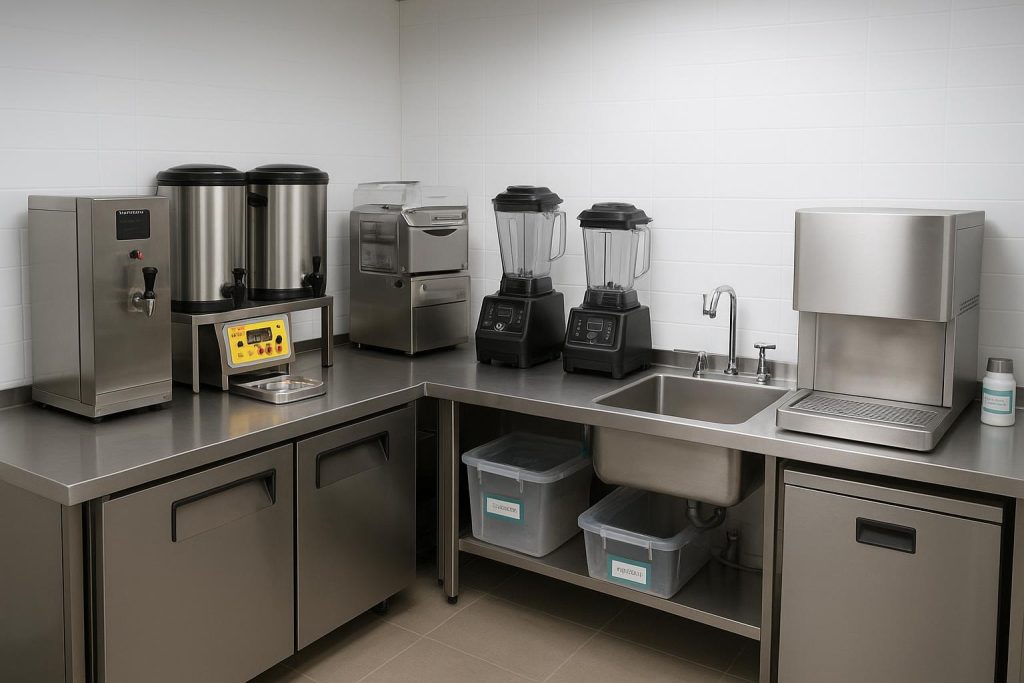
Three-compartment sink + hand sink(s) + mop/service sink Warewashing, hand hygiene, janitorial Mandatory As required by plan review Hot/cold water; indirect drains; floor sinks Wash/rinse ≥110°F; sanitize via hot water ≥171°F or chemicals per label; keep test strips.
POS + kitchen display + label/receipt printer Order flow Recommended 1–2 registers + KDS (capacity-dependent) 120 V; network UPS recommended Improves accuracy; label printers speed drink assembly.
Utilities & ventilation elements Power/water/hood Mandatory Panel capacity per tier; backflow; floor sinks Electrical service 60–100 A (300–800); 100–200 A (800+) Ventless often viable for beverage-only; verify hood needs with AHJ.
Remember: plan review teams will look for spec sheets showing NSF/ANSI and UL/ETL sanitation/safety listings. Keep those data plates and manuals on file.
Brewing and Holding
Size your brewing so your team can brew in predictable batches and never starve the line. For 300–800 cups/day, a 6–10 L on-demand boiler paired with an 8–12 L brewer/urn covers most tea menus; at 800+ cups/day, step up to dual boilers or a higher-capacity on-demand system with two brewers in parallel so one can brew while the other serves.
Brew strength lives and dies by water temperature, steep time, and leaf ratio. Use timers and thermometers, and standardize recipes by tea type. If you hold brewed tea ambient to speed service, use Time as a Public Health Control. Start at ≤41°F or ≥135°F as required by the chosen TPHC option, time-mark every batch, and discard at the four- or six-hour limit per the 2022 Food Code framework.
Pearls are starch, sugar, and water; treat them like any TCS-risk item unless your jurisdiction says otherwise. Hot-hold per your SOPs, or if ambient, time-mark under TPHC. Keep warmers clean, lids on, and serving scoops stored out of standing water.
Cold Chain and Ice
Ice is the hidden constraint in many shops. For a beverage-heavy bubble tea menu:
300–800 cups/day: target roughly 120–250 lb/day production with a 200–300 lb bin.
800+ cups/day: target roughly 300–600+ lb/day production with a 400–600 lb bin; consider a remote-condenser unit to move heat and noise out of a tight back room.
Manufacturer calculators help right-size your machine to peak demand and cube type. One example is the Manitowoc family of ice sizing tools and brochures that emphasize sizing to peak and verifying AHRI-rated daily production. See the IndigoNXT materials for how published capacities vary with ambient conditions and why bin size matters.
Installation details matter: provide a cold-water feed with shutoff, an indirect floor drain per code, clearance for airflow, and filtration to cut scale and off-tastes. For refrigeration, start with 1–2 undercounter reach-ins totaling about 24–48 cubic feet plus a refrigerated prep table; at scale, add a 2-door reach-in and split dairy from non-dairy to prevent cross-contact. Choose NSF/ANSI 7-listed units so they reliably hold at or below 41°F.
Mixing and Sealing
Blenders do the heavy lifting on fruit teas, smoothies, and slushes. In the 300–800 band, plan for two commercial high-speed units (about 1,500–1,800 W) with sound enclosures; at 800+, run three units or two blenders plus a dedicated shake machine to straighten your peak line.
Sealers should match your cup program. Many tabletop automatic sealers publish 450–650 cups per hour with 90–95 mm rings. Material compatibility is non-negotiable: PP cups typically seal at higher temperatures than PET, and mismatching film/cup leads to leaks and warped lids.
Daily SOP callouts (keep it simple and consistent):
Blender sanitation: Between rushes, run warm water with a drop of detergent 30–60 seconds, rinse, then end-of-day sanitize per the manufacturer’s manual and air-dry. Manufacturer guides for commercial units like Blendtec and Vitamix detail cycle and sanitizer concentrations.
Sealer quick checks: Confirm cup diameter ring, film width, and PP vs PET settings. Test the first few seals each day and keep a spare heating element on hand.
Water Quality and Filtration
Great tea is 90% water. Start with sediment and carbon filtration to protect taste and equipment. If your hardness or alkalinity is high, add decarbonization to reduce limescale. Reserve reverse osmosis for source waters where TDS and hardness overwhelm carbon alone or where taste targets demand it; blend RO with bypass to maintain mouthfeel. Pentair Everpure application guides outline when to choose carbon-only, decarbonization, or RO and how to monitor cartridges using differential pressure and scheduled change-outs.
Practical targets: aim for a clean, neutral taste, consistent TDS, and scale control for ice and boilers. Label your filter housings, note install dates, and mount a pressure gauge set where techs can see it.
Sanitation, Sinks, and Compliance
Your warewashing backbone is a three-compartment sink with drainboards, plus conveniently located hand sinks and a mop/service sink. Follow the classic method: wash and rinse at or above 110°F, then sanitize either with hot water at or above 171°F for at least 30 seconds, or with an approved chemical sanitizer per label concentration and contact time. Keep chlorine or quaternary ammonium test strips at the sink and use them. Representative guides aligned to the FDA Food Code lay out these temperatures and procedures clearly.
Hand sinks must deliver warm water quickly; the 2022 Food Code lowered the minimum to 85°F for handwashing, but your local adoption and plumbing code prevail, so confirm during plan review. For cold holding equipment, verify the NSF/ANSI 7 standard on spec sheets; for powered prep gear such as blenders, look for NSF/ANSI 8. In general, health departments accept NSF marks and equivalent sanitation listings such as UL EPH or ETL Sanitation; the mark appears on the data plate or in official documentation.
Utilities and Space Planning
Think in circuits and drains. For 300–800 cups/day, plan roughly 60–100 amps of total service with a few 208–240 V dedicated circuits for boilers and high-draw appliances; for 800+ cups/day, 100–200 amps or three-phase service helps with headroom and dedicated runs. Work with a licensed electrician to build a panel schedule listing breakers, voltages, and outlet locations at each station.
Plumbing must show hot/cold to the three-comp sink, hand sinks where needed, a mop/service sink, indirect waste to floor sinks or approved air gaps, and backflow prevention on applicable connections. Many plan review checklists from health units call out these expectations explicitly. Map all points on your floor plan with elevations for field install.
Ventilation in beverage-only concepts is often ventless, but anything generating grease-laden vapors or smoke pushes you into a Type I hood under NFPA 96 and UL 710. Some listed ventless systems tested under UL 710B may be acceptable for low-grease appliances, subject to pre-approval by the authority having jurisdiction. Engage the AHJ early to avoid surprises.
Automation vs Handcrafted
When do you automate? Use capacity and menu complexity as your compass. Here’s a compact comparison to frame decisions.
Approach Speed & consistency Labor & training Typical CAPEX Maintenance & space
Manual focus (hand-shake, manual fructose) Slower at peak; more variance Higher training burden; skilled labor Lower upfront Lower maintenance; smallest footprint
Automation-assisted (auto fructose, auto shakers, continuous brewers) Faster and repeatable Lower training time; easier onboarding Higher upfront Scheduled maintenance; more circuits/space
Rules of thumb: in the 300–800 range, keep core automation light—manual shake with tight SOPs, two blenders, one sealer. Past 800 cups/day, consider auto shakers, measured syrup/fructose dosing, and N+1 redundancy on sealers and blenders to survive equipment downtime.
Two Quick Scenarios
400 cups/day in a 12 m² shop: One 6–10 L boiler, one 8–12 L brewer, two enclosed blenders, one automatic sealer, an ice machine rated around 150–200 lb/day with a 250 lb bin, one refrigerated prep table plus a 27–48 cu ft total in undercounters, carbon filtration with sediment prefilter, three-comp sink, two hand sinks, mop sink, and a compact POS + KDS. Electrical service around 80 amps with one 208–240 V circuit for the boiler. Ventless operation accepted by AHJ.
1,200 cups/day in a 22 m² back room: Dual boilers (10–12 L) or one high-capacity on-demand plus two brewers, three blenders or two plus a shake machine, two automatic sealers (or one high-throughput), an ice machine rated 400–500 lb/day with a 500–600 lb bin and remote condenser, two-door reach-in added to undercounters and prep table, filtration with decarbonization or RO blend per source water, expanded POS/KDS with label printers, 150–200 amps service with more dedicated circuits. Split dairy/non-dairy cold storage and consider a blast chiller for syrups.
Next Steps
Assemble your plan review package: scaled floor plan, equipment schedule with spec sheets showing NSF/ANSI and UL/ETL sanitation/safety marks, plumbing and electrical one-line notes, and SOPs for TPHC and sanitizing.
Finalize procurement by priority: mandatory open-ready items first, then recommended throughput gear and any optional automation.
Coordinate install sequencing: rough-in utilities, set and level refrigeration/ice, connect filtration, then commission hot equipment and verify drain/air gaps.
Train to SOPs and time-marking; post sanitizer concentrations and blender/sealer cleaning steps where staff can see them. Run a soft open to stress-test ice and sealing.
—
References (selected):
FDA 2022 Food Code changes on hand sink temperature and TPHC are summarized in the FDA’s official change brief and in the Trust20 explainer of 2022 updates: see the FDA’s Summary of Changes and the Trust20 2023 overview of Food Code updates.
Cold holding performance depends on NSF/ANSI 7–listed equipment; see the NSF page on the refrigeration standard.
Three-compartment sink procedures are outlined in FDA-aligned guides such as WebstaurantStore’s overview of the method.
Ice sizing and installation considerations appear in manufacturer materials and guides, including Manitowoc IndigoNXT brochures and WebstaurantStore’s ice machine guide.
Cup sealer throughput and material compatibility are illustrated in representative product specs such as Yifung’s ET-999SN and Webstaurant’s Narvon machine pages.
To explore these topics:
FDA Food Code 2022 change summary: https://www.fda.gov/food/fda-food-code/summary-changes-2022-fda-food-code
Trust20 explainer (2023) on Food Code changes: https://trust20.co/blog/fda-food-code-update
NSF/ANSI 7 refrigeration standard overview: https://www.nsf.org/nsf-standards/standards-portfolio/food-equipment-standards
Three-compartment sink rules: https://www.webstaurantstore.com/article/620/three-compartment-sink-rules.html
Webstaurant ice machine guide: https://www.webstaurantstore.com/guide/525/types-of-ice-machines.html
Manitowoc IndigoNXT brochure reference: https://dijf55il5e0d1.cloudfront.net/pdf/ManitowocIndigoNXT.pdf
Yifung ET-999SN sealer spec (throughput example): https://www.yifunggroup.com/en/product/Cup-Lid-Sealer-Machine-ET-999SN.html