


A guava matcha latte that lands differently at 8 a.m. and 2 p.m. is not a recipe problem, it is a spec problem. On a two-person bar during a Saturday rush, one barista packs the matcha, another free-pours the guava, and the third iced guava matcha latte on the pass looks nothing like the first. The fix is a fixed 16 oz build: weighed matcha, measured guava base, a stated sweetness target, and a written sequence anyone can follow. This guide gives you that guava matcha latte recipe, the reasoning behind each ratio, and the hold limits that keep it safe. It also covers a scaled-down version for anyone making one at home.
The demand is real. Yelp’s 2026 trend data reports guava matcha searches up 508% year over year, alongside ceremonial matcha up 210% and matchatinis up 1,036% (Yelp’s 2026 matcha trend data, published December 22, 2025). A drink people are already searching for is worth putting on a menu with a number attached to it, not a guess.
Why a Guava Matcha Latte Recipe Keeps Coming Out Different
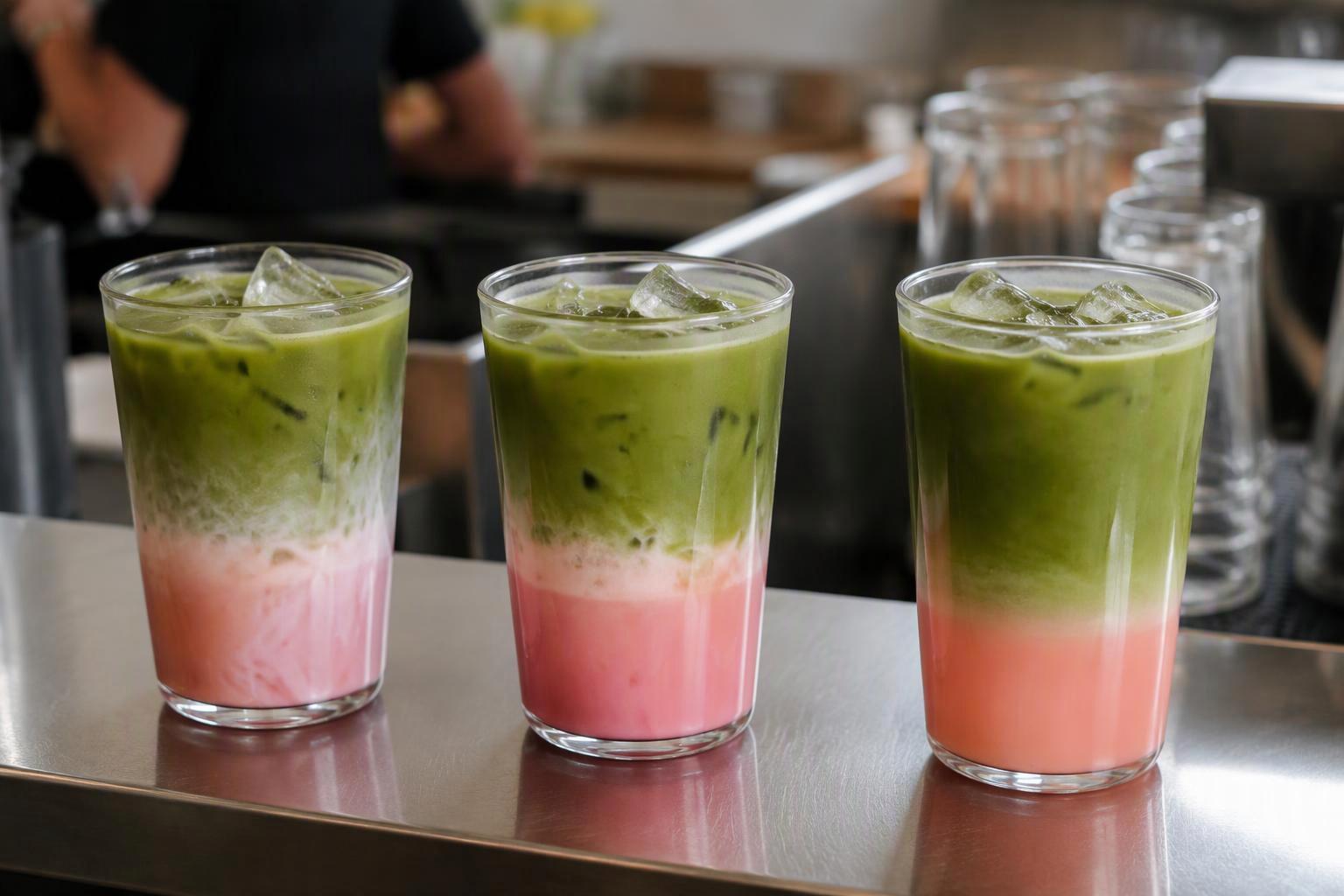
A guava matcha latte recipe fails at consistency for one reason: the two ingredients that carry the drink’s identity are the two most often eyeballed. Matcha gets scooped by volume, guava gets poured by feel, and the milk and ice fill whatever space is left. Fix those three variables and the drink stops drifting.
The trend data says this is worth solving now. Spate’s search-trend analysis across Google, TikTok and Instagram from June 2025 to May 2026 found mango matcha latte up 114.4% year over year, strawberry matcha up 26.6%, and matcha overall up 57.8% (Spate’s search-trend analysis, published September 22, 2026). Separately, the 2026 café drinks trend report puts matcha menu items up 30.22% year over year (the 2026 café drinks trend report, published May 6, 2026). These are two different datasets measuring two different things, search interest and menu presence, so treat them as separate signals rather than one combined number.
Three variables explain almost all the variation:
- Guava form and sweetness. Nectar, puree, syrup and paste carry different sugar loads and different water content, so the same volume pours a different drink.
- Matcha weight and water temperature. A gram of matcha is not a teaspoon of matcha, and water temperature changes how much of the powder’s bitterness and caffeine lands in the cup.
- Milk and ice ratio. Milk volume sets the body; ice volume sets the dilution as it melts. Both need a number.
Write those three down and the drink becomes reproducible. Leave any of them to the barista’s judgment and you are back to three different lattes on the same pass.
What You Need Before You Start
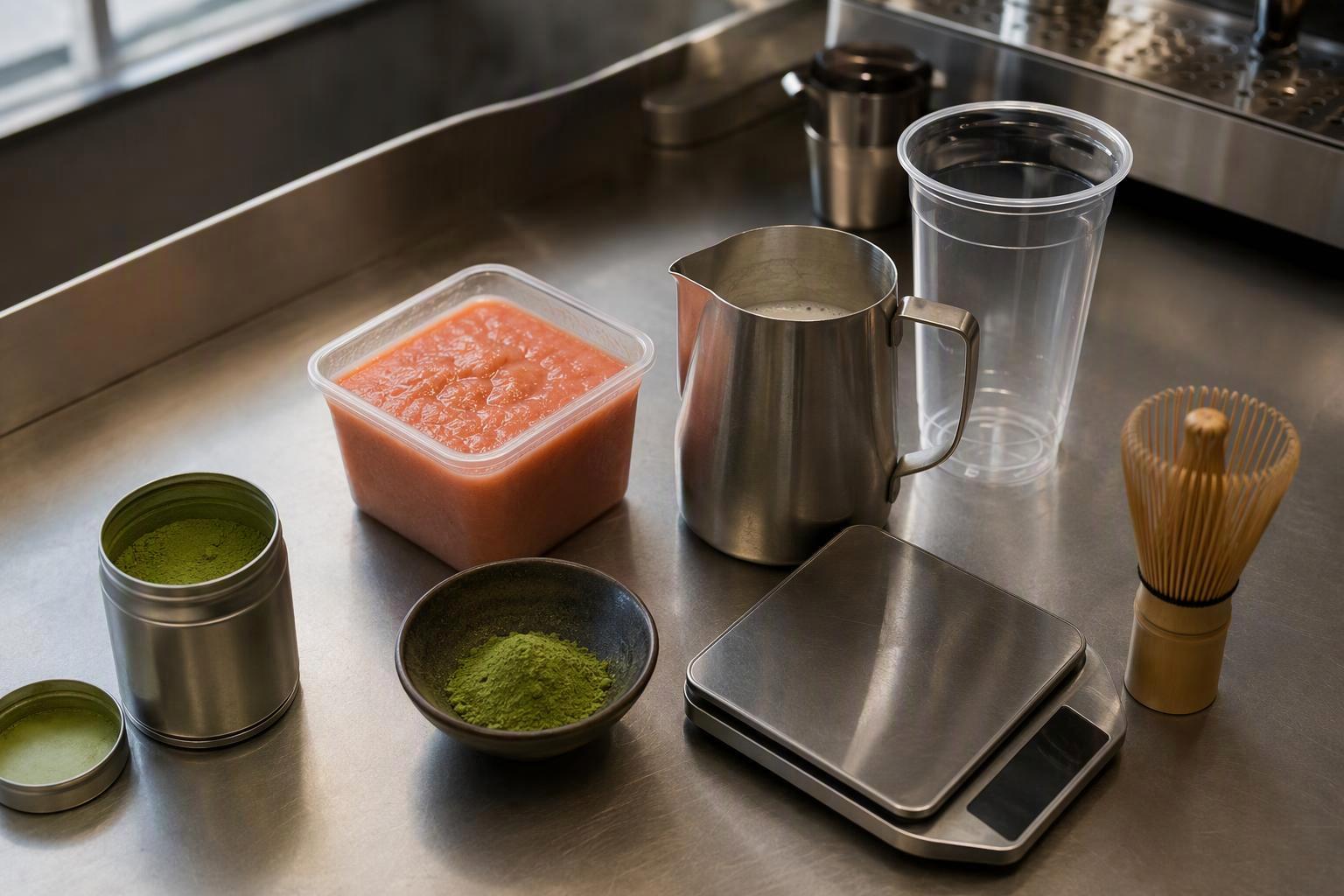
Get the guava matcha latte ingredients and the tools onto the counter before you build anything. The full build runs about 3 minutes per drink once the concentrate is prepped, and the only real skill it asks for is weighing accurately. If you already make matcha drinks, you have everything you need here; no culinary background required.
| Item | Specification |
|---|---|
| Matcha | 3.0–4.0 g per 16 oz drink |
| Guava | One form chosen and recorded (see Step 1) |
| Cold milk | 10–12 oz (300–360 ml) per 16 oz drink |
| Ice | Enough to fill the cup |
| Cup | 16 oz |
| Tools | Digital scale, whisk or frother, fine strainer, spoon |
| Time | 3 minutes per drink; 15 minutes for a batch of concentrate |
| Difficulty | Low, but accuracy matters more than speed |
The matcha weight range comes from a barista ratio table that scales the dose by cup size, listing 3.0–4.0 g for 16 oz, 2.5–3.5 g for 12 oz, and 2.0–3.0 g for 8 oz (the barista ratio table, published September 23, 2026). The same table gives milk volume at 10–12 oz for 16 oz, 8–10 oz for 12 oz, and 6–7 oz for 8 oz.
Sift the matcha before you do anything else. Matcha-specific preparation guidance is direct on this point: the powder must be sifted before preparation to avoid clumps (matcha-specific preparation guidance). A clumped scoop disperses unevenly, which means one drink gets a bitter pocket and the next does not.
One honest limitation before you buy: guava products vary by brand. Commercial single-strength guava purees are typically supplied around 8.5–11 °Brix with naturally acidic pH, and the sourcing guide that gives that range states plainly that its figures are indicative examples rather than purchasing standards (guava puree specification range). Treat the spec below as a starting point you calibrate once against the product in your hand.
Step 1: Choose Your Guava Form and Lock the Sweetness
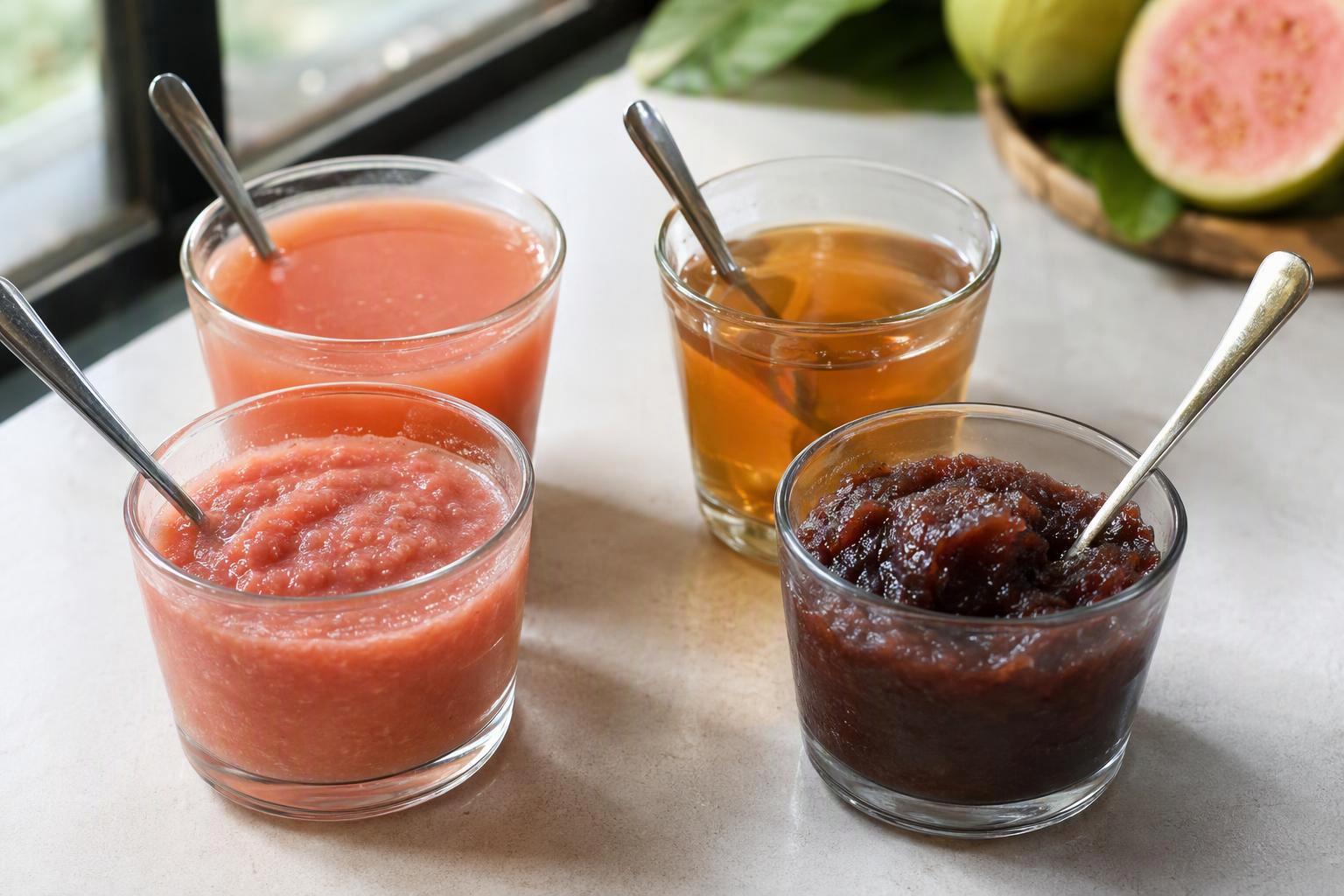
Pick your guava form before you pick anything else, because that choice sets the sweetness and the usage rate for every drink that follows. For a shop that wants repeatability, single-strength puree is the default: it carries real fruit identity, it batches predictably, and its sugar level is stated on the technical sheet.
The four common forms behave differently in the cup:
- Puree. Around 8.5–11 °Brix with naturally acidic pH, and enough pulp to give the drink body. The sourcing guide notes guava aroma is comparatively intense, so its required formulation percentage can be quite different from milder fruits (guava puree specification range). That intensity is an advantage: you use less, which keeps cost per drink down without thinning the flavor.
- Nectar. Sweeter and thinner. USDA figures for guava nectar list 10.2 g total sugars and 13.3 g carbohydrate per 100 g, with water at 86.2 g (USDA figures for guava nectar). The high water content means you need more volume for the same fruit presence, and you will likely cut the added syrup.
- Syrup. Consistent and fast, but it delivers sugar and aroma more than fruit body, so the drink reads flatter.
- Paste or jam. Concentrated and thick, best used as an accent or a foam layer rather than the base, because it resists even dispersion in cold liquid.
If your guava product is a nectar or a juice-bearing blend, check the label before you write a menu description. Under 21 CFR 101.30, a beverage that bears the name of a fruit juice, or that has the appearance and taste of containing juice, must carry a percentage-juice declaration stated as a whole number no greater than the actual percentage (the percentage-juice labeling rule). That rule governs what goes on a packaged product’s label, not your menu board, but it is the reason the word “nectar” on a supplier’s jug does not mean the same thing as “juice.”
Verify your result: you have one guava product chosen, its Brix or sugar level written down, and a note of how many milliliters that product needs to hit the target sweetness in Step 2.
Step 2: Build the 16 oz Drink to a Fixed Spec
Build the iced guava matcha latte to these numbers and it will taste the same at open and at close. The guava matcha latte ratios that matter are 4 g matcha, 60 ml cold water at or below 104°F, 60–75 ml guava base strained to 0.5 mm or finer, 200–240 ml cold milk, 15–30 ml simple syrup, and ice to fill, targeting 12–16 °Brix final sweetness. Lock those numbers into your guava matcha latte recipe card and a two-person bar can hit them at 2 p.m. on a Saturday.
Work in this order:
- Sift 4 g of matcha into a bowl or cup. Sifting first breaks up the clumps that a whisk alone pushes to the surface, which is what leaves dry green flecks floating on the finished drink.
- Whisk it with 60 ml of cold water at or below 104°F until fully dispersed. Cold water is the operator’s choice here, and the reason is shelf life as much as flavor: café batching guidance puts water at or below 104°F in the band that stays sweet and stable, while 158–176°F is the band that releases catechins and with them more bitterness (café matcha batching guidance, published October 6, 2025).
- Strain the matcha concentrate through a fine strainer to catch any remaining clumps.
- Measure 60–75 ml of guava base and strain it to 0.5 mm or finer so it pours cleanly and does not clog the straw.
- Fill the cup with ice first, then add 200–240 ml cold milk. Ice goes in before the milk so the milk chills on contact and the layers hold instead of blending into one flat pink-green cup.
- Sweeten with 15–30 ml simple syrup, adjusting within the range to hit 12–16 °Brix.
- Pour the matcha concentrate last, slowly, over the back of a spoon. It settles as a deep green cap over the pale guava-milk base, and the two stay separate until the customer stirs.
The temperature choice deserves one more note, because the trade guidance and the peer-reviewed data are describing the same chemistry from opposite directions. A controlled brewing study on green tea found peak EGCG extraction of 50.69 mg/100 ml at 85°C for 3 minutes, with 75°C reaching only 40.04 mg/100 ml even after 20 minutes, and 95°C peaking lower at 40.92 mg/100 ml before falling (controlled brewing study, published 2015). The temperature that maximizes catechin extraction is the same one the operator guidance flags for bitterness. For an iced latte you are not chasing extraction, so cold water is the right call.
Verify your result: the finished cup reads 12–16 °Brix and shows a distinct layer. If it reads flat, the guava volume is low. If it reads sharp or drying, the matcha dose is high or the water ran warm.
Step 3: Keep the Layers Intact at Bar Speed
Layers hold when the drink is built in the right order and the last pour is slow. The technique cluster that covers iced matcha builds is specific about the mechanics: fill ice first, then pour the upper layers slowly over the back of a spoon or down the glass wall, because layers blend with fast pours, insufficient density difference between components, and warm ingredients (the iced matcha layering technique).
That gives you three failure points to watch on the pass:
- A fast pour. The stream punches through the milk and mixes the drink. Pouring over the back of a spoon spreads the stream and lets it sit on top.
- Too little density difference. If your guava base is thin and your milk is thin, they will merge on their own. A strained puree base sits better than a watery nectar.
- A warm component. Warm matcha concentrate rises and mixes rather than resting. Chill the concentrate before service.
At bar speed, the practical version is to keep the concentrate cold and in a squeeze bottle, keep the guava base in a second squeeze bottle, and pour both against the spoon in one motion. Two bottles and a spoon beat a ladle and a guess.
Verify your result: the finished drink shows a distinct green layer over a pink or coral base, and it still shows that separation when it reaches the customer.
Step 4: Batch, Hold and Prep Ahead Safely
Batch for one to two hours of service, not for the day. Café batching guidance recommends sizing batches to 1–2 hours of service, holding them chilled, and notes that flavor and color degrade noticeably past 12–18 hours even under refrigeration, with a recommendation never to carry a batch to the next day (café matcha batching guidance, published October 6, 2025). The same guidance caps warm holding at 30 minutes and calls for opaque, airtight containers in stainless or dark glass.
The batch math is straightforward. For 10 drinks at 16 oz, the guava build SOP gives 40 g of matcha plus 600 ml of water for the concentrate, and roughly 700 ml of single-strength guava puree plus 150–250 ml of 1:1 simple syrup for the guava base (the guava build SOP, published April 1, 2026). The same SOP sets the matcha concentrate hold at 1–2 hours chilled and covered with a stir before use, and the guava base at up to 24 hours refrigerated.
Cold holding has a legal floor. The Food Code cold-holding provision requires time/temperature control for safety food to be maintained at 5°C (41°F) or less (the Food Code cold-holding and date-marking provisions, 2022). If you hold a prepped component for more than 24 hours, the Food Code date-marking provision requires it to be date marked and held at 41°F or less for a maximum of 7 days, with the day of preparation counted as Day 1. The state adoption of the Food Code carries the same 41°F cold-holding and 7-day date-marking language with the same Day 1 rule (Washington State Retail Food Code). Note that these are two different documents at two different levels of government, so cite the one your jurisdiction enforces.
Two more points from the state code that apply directly to a layered iced drink: ice used as an exterior coolant may not later be used as food, and dispensing equipment must protect the delivery tube, chute and orifice from manual contact. In practice, that means the ice in your cup is food ice from the start, and your squeeze bottles need caps.
If you want a sourcing reference for guava as a commodity, USDA My Market News carries Guava and Miscellaneous Tropical Fruits in its Terminal Market fruit price series, including the Miami MH_FV010, Los Angeles HC_FV010 and New York NX_FV010 reports (USDA terminal market reporting). That is a place to look, not a price.
Verify your result: you should now have a batch sheet listing each component’s yield and a discard time written on it, so the next 10-drink run is a repeat of this one rather than a new guess.
Common Mistakes That Break the Spec
Most consistency failures trace back to a short list of habits. Here are the ones that cost the most, and what to do instead.
Scooping matcha by volume. A teaspoon of matcha varies with how the powder settles and how heaped the scoop is. Weigh it. The 16 oz spec calls for 4 g, and a scale settles the argument in seconds.
Skipping the sift. Matcha-specific guidance is explicit that sifting prevents clumps (matcha-specific preparation guidance). Skip it and you get uneven dispersion, which reads as bitterness in some sips and not others.
Pouring guava by feel. This is the single biggest source of drift, because guava aroma is intense enough that a small volume change moves the flavor noticeably. Measure it, and strain it to 0.5 mm or finer.
Brewing the matcha hot for an iced drink. Hot water extracts more catechins, and the trade guidance associates that same band with bitterness (café matcha batching guidance, published October 6, 2025). Cold water keeps the drink smooth and gives the concentrate a longer working life.
Holding a batch all day. Flavor and color degrade noticeably past 12–18 hours even refrigerated, and the guidance is to batch for 1–2 hours of service (café matcha batching guidance, published October 6, 2025). A batch made at open is not the same drink at 4 p.m.
Pouring fast and losing the layers. Fast pours, thin components and warm ingredients all cause the layers to merge (the iced matcha layering technique). Slow the last pour and chill everything first.
Leaving the concentrate in a clear container. Light and air drive oxidation. Use opaque or dark glass, or stainless, with an airtight lid.
How to Make One at Home With Supermarket Ingredients
The shop spec scales down, but home recipes in the wild look nothing like it, so it helps to know what you are adapting. Published home versions typically call for far less matcha and far more liquid: one common build uses 1 teaspoon of matcha, about 2 oz of water near 175°F, 4–6 oz of guava juice and 2–3 oz of milk (a typical home recipe ratio). Another uses 2 g of matcha, 60 ml of warm water, a tablespoon of guava paste whipped into a 50 g cream foam, and 4 oz of milk for a 15 oz yield (the cream-top variation). A third treats guava as an accent, with 2 teaspoons of matcha, 3 tablespoons of water near 160°F, 2 tablespoons of guava nectar or syrup, 6 oz of milk and a cup of ice (the accent-style guava recipe). A fourth recreates a café build with 1½ teaspoons of matcha, ¼ cup of water, and guava puree under a guava cream top (the café-recreation recipe).
Those are all different drinks, and none of them is the 16 oz shop spec. For a single home serving, scale the shop numbers down rather than following a home post:
- Matcha: 2 g, sifted.
- Water: 30 ml, cold or room temperature.
- Guava: 30–40 ml of puree or nectar, strained if it has seeds or pulp.
- Milk: 100–120 ml cold.
- Sweetener: 5–15 ml simple syrup, to taste, since home palates vary more than a menu target.
- Ice: fill the glass.
Whisk the sifted matcha with the water until smooth, strain it, fill a glass with ice, add the milk and guava, then pour the matcha over the back of a spoon. If you only have guava juice from the supermarket, expect a thinner drink and start with the higher end of the guava range, because juice carries more water than puree.
One note on caffeine if you are drinking this in the afternoon: matcha’s caffeine content is reported at 18.9–44.4 mg/g, citing a 2020 analysis in Plant Foods for Human Nutrition (peer-reviewed matcha composition review, published 2020). That is dry powder, not the brewed cup, so do not read it as a direct comparison to a brewed coffee. The same review gives green tea at 11.3–24.67 mg/g and coffee beans at 10.0–12.0 mg/g of beans, and it attributes the wide matcha range to harvest time, leaf age, variety, weather and brewing method.
Frequently Asked Questions
These are the questions a guava matcha latte recipe does not settle on its own: caffeine load, how the drink compares with coffee, how long it keeps, what your guava base actually is, and whether it can go dairy-free.
How much caffeine is in a guava matcha latte?
It depends on how much matcha you scoop, because caffeine is measured in the dry powder, not in the finished cup. A peer-reviewed matcha composition review puts matcha at 18.9–44.4 mg of caffeine per gram of dry powder (Kochman et al., Molecules, 2020). At the 4 g spec in this drink, that works out to roughly 76–178 mg before the milk and guava go in. The range is wide because leaf grade, shading and harvest timing all shift it, so treat your own matcha’s label as the better guide once you have one.
Is matcha stronger than coffee?
Only the dry-to-dry comparison holds up. Gram for gram, matcha powder carries more caffeine than roasted coffee beans, which is why a small scoop goes further than it looks. Once you brew both, the comparison flips into serving size and strength: a 16 oz latte built to this spec lands in the same general territory as a single espresso drink, not above it. If you are watching intake, count the grams of matcha you actually scoop.
How long does the assembled drink keep?
Short. Once the matcha is whisked into water and the layers are built, the drink is at its best within about 15 minutes and is worth discarding after an hour. Matcha solids settle, the color dulls, and the guava layer loses its edge against the milk. Build to order rather than holding finished cups, and if you must stage anything, stage the components separately and assemble at the pass.
Are guava nectar and guava juice the same thing?
No, and the label tells you which one you have. Under the percentage-juice labeling rule (21 CFR 101.30), a product sold as juice must declare its percentage of juice, while a nectar is a diluted drink that may contain added sugar and water. For this recipe that matters: nectar is sweeter and thinner, so pull the simple syrup back when you swap it in.
Can I make a guava matcha latte vegan or dairy-free?
Yes, and the build barely changes. Swap the dairy milk for oat, soy or barista-blend almond milk at the same 200–240 ml, and keep the matcha, guava and syrup untouched. Oat holds a foam and a layer best of the three; soy is closest to dairy in body. Check that your guava base has no added dairy or honey if you are serving someone who needs it fully plant-based.
How do I make a guava matcha latte without a scale?
Use volume, then write down what you did so the next cup matches. Sift about 2 g of matcha, whisk it into 30 ml of cold water, then add 30–40 ml of guava and 100–120 ml of milk over ice. Taste, adjust the guava by a spoonful, and note the number. A cheap kitchen scale removes most of that guesswork, which is the whole point of a fixed spec.
Conclusion
A guava matcha latte that tastes the same every time comes down to four numbers: 4 g of matcha, 60 ml of cold water at or below 104°F, 60–75 ml of strained guava base, and 200–240 ml of cold milk, all built to a 12–16 °Brix target and poured slowly over the back of a spoon. Those ratios are the spec. Everything else, the guava form you choose, the batch size you mix, the hold time you set, is a decision you make once and write down.
The case for putting this on a menu is a demand signal, not a forecast. Yelp’s 2026 data shows guava matcha searches up 508% year over year (Yelp’s 2026 matcha trend data, published December 22, 2025), and Spate’s cross-platform analysis shows matcha overall up 57.8% (Spate’s search-trend analysis, published September 22, 2026). Guava is a seasonal fruit profile, so the practical move is to run it as a limited-time special first, calibrate the spec once against the guava product you actually bought, and see how it performs before you commit permanent menu space.
Start with one drink. Mix the concentrate, build it to the numbers above, and taste it against your recorded Brix target. If it holds, you have a spec sheet worth handing to staff, and a drink that comes out the same way on the next shift.