


You are planning a build-out for a single-location boba shop, and the question in front of you is concrete: what do you buy, in what order, and what does it cost? The most useful framing the sources support is that the machine list follows from the menu and the local health code, not from a generic shopping list. WebstaurantStore’s bubble tea supplies guide makes the point directly: a range is needed only if you cook uncooked pearls, and a blender only if you sell smoothies or blended drinks.
Two cost anchors recur in vendor guides. 7shifts puts a small shop’s equipment package at $10,000 to $30,000, while BobaSync prices the day-one core list at $6,000 to $15,000. Both are vendor-sourced rather than audited, so treat them as planning bands, not quotes.
What follows is a phase-by-phase boba shop equipment list: what makes drinks, how much of each machine a single counter needs, what the code requires, and what can wait until volume proves itself.
What equipment does a boba shop actually need to make drinks?
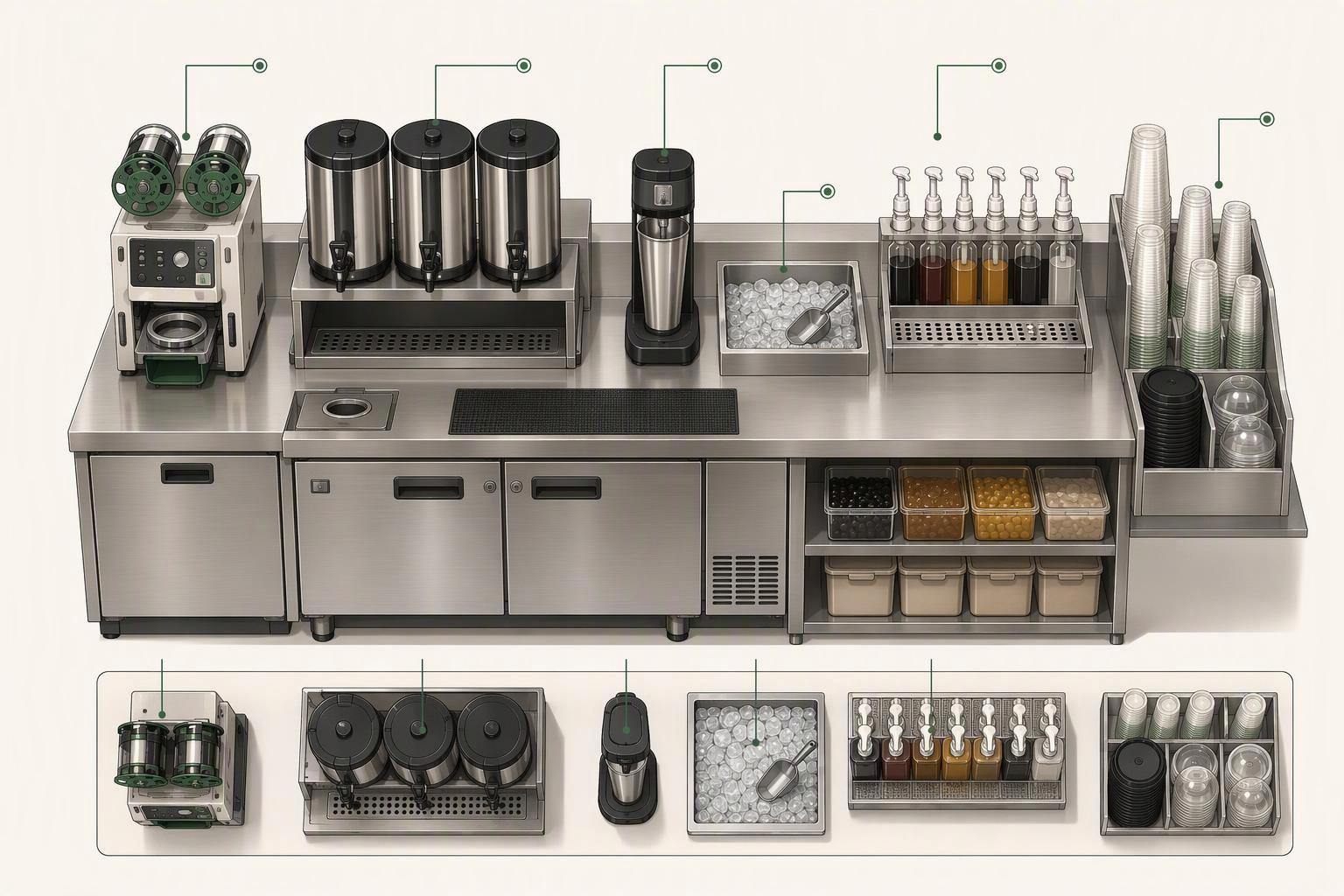
The day-one drink-production set is smaller than most vendor catalogs suggest, and the governing rule is that which machine is required depends on the menu, not on convention. WebstaurantStore’s bubble tea supplies guide states the principle directly: a range is needed to cook uncooked pearls, but a stock pot or countertop range suffices for a drinks-only shop, while a full restaurant range is needed only if food is served; a blender is required only if smoothies, milkshakes or blended drinks are sold; and a shaker cup can replace a shaker machine where boba is a side menu item (WebstaurantStore).
BobaSync’s day-one core list names eight items: cup sealer, tea brewer or kettles, pearl cooker, shaker machine, refrigeration, ice machine, fructose dispenser and POS (BobaSync, 22 Jul 2026). 7shifts’ equipment list covers the same categories, adding insulated tea dispensers and water filtration as essentials (7shifts, 4 Mar 2026). Those categories recur across seven or more vendor guides because they describe the same physical build-out, not because each guide independently measured it, so treat the overlap as confirmation of the build-out’s shape rather than as seven separate sources.
Water filtration belongs on the list even though it is plumbing rather than a machine. WebstaurantStore treats filtration as equipment in a boba build-out because quality water protects tea-brewing and ice-making equipment from scale and contaminant build-up, and protects drink consistency (WebstaurantStore).
How much of each core machine does a single-unit shop need?
Sizing is arithmetic, not guesswork. BobaSync plans for three to four tea bases on rotation, which sets brewer or kettle capacity rather than the number of brewers (BobaSync, 22 Jul 2026). 7shifts puts insulated tea dispensers at 10 to 12 liters, the holding capacity that matches that rotation (7shifts, 4 Mar 2026).
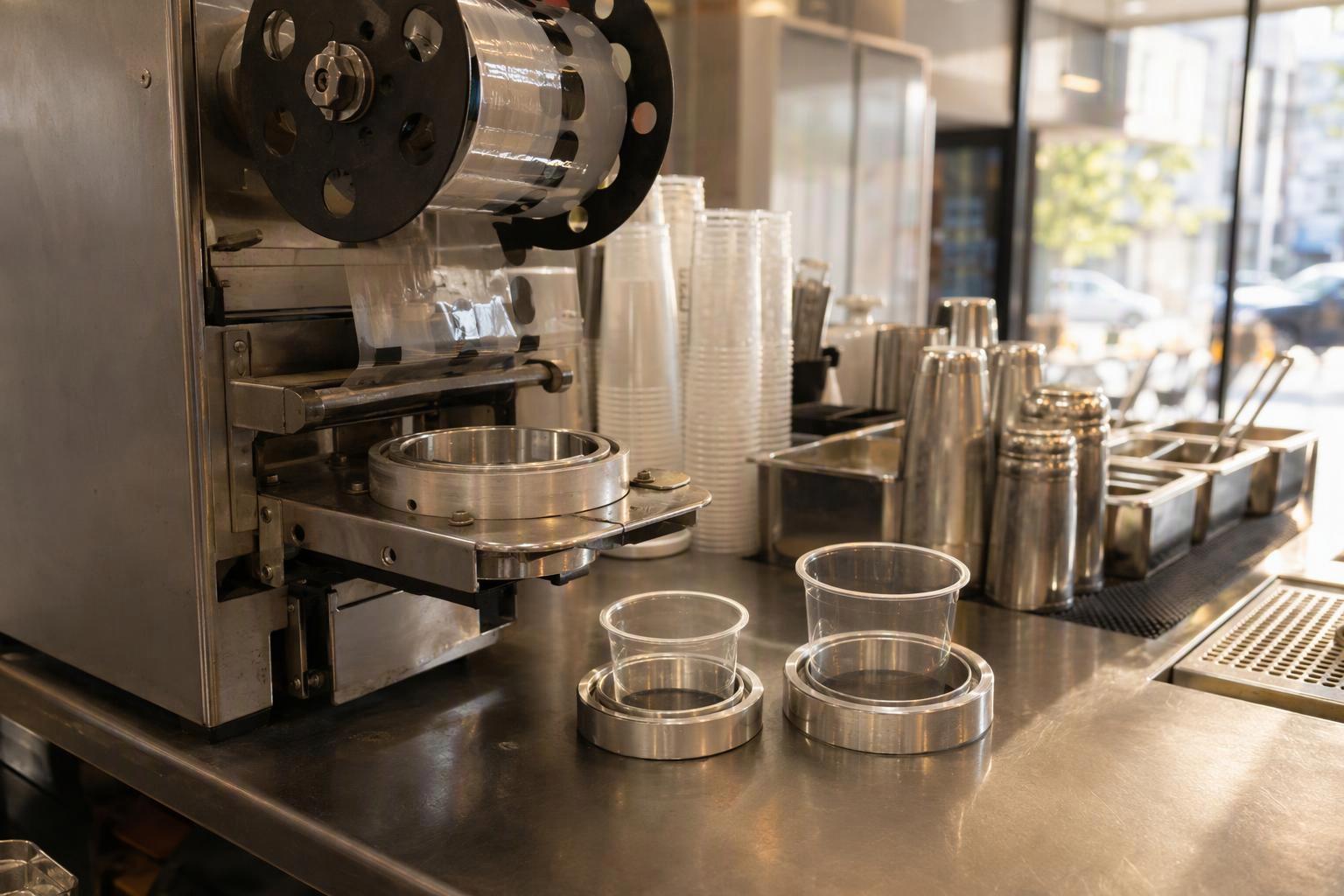
Cup sealing is where throughput decides the purchase. Manual sealers handle 60 to 120 cups an hour and cost $150 to $500; automatic sealers clear 300 to 500 cups an hour at $800 to $2,500; high-speed dual-head units reach $3,000 to $5,000 (yiouyi101, 14 Jul 2026). The same guide notes that US cup diameters are commonly 90 mm and 95 mm and that the die must match the cup, so confirm the rim size on your actual cups before ordering film. BobaSync puts the second sealer at around 200 cups a day, the point where one jam stalls the line (BobaSync, 22 Jul 2026).
One honest limit: no manufacturer datasheet for a named tea brewer or pearl cooker was read for this guide, so cooker throughput stays qualitative. Size the stock pot for the expanded pearl volume rather than the dry load, because cooked tapioca pearls expand to almost twice their original size (WebstaurantStore, updated 22 Apr 2026).
What kitchen, prep and cold-storage equipment is required?
Ice sizing is the one capacity calculation in this build-out with a published method, and it runs in three steps. WebstaurantStore’s sizing tables convert cups into pounds: roughly 0.375 lb of ice per 7 to 10 oz cup, 0.6 lb per 12 to 16 oz cup and 0.75 lb per 18 to 24 oz cup, which works out to about 38 lb per 100 customers at 5 oz per cup, 60 lb at 8 oz and 90 lb at 12 oz (WebstaurantStore, updated 8 Oct 2026). Memphis Ice reports that a small-to-mid beverage shop typically needs a 200 to 500 lb/day machine, that an undercounter unit produces about 50 lb/day, and that you should size the machine above measured daily use, not at it, by adding at least 10 to 20% capacity for demand spikes (Memphis Ice, undated).
Then derate for your actual room. Rated capacity assumes 70°F air and 50°F water, so a 90°F shop gets noticeably less: a 500 lb/24h unit produces about 500 lb at 70/50, 455 lb at 80/60, 400 lb at 90/70 and 340 lb at 100/80, and where only one rating is published you should plan a 20 to 25% reserve (HiCon International, 28 Sep 2026). Size for the busiest season, not the average month.
For cold storage, pick a qualifying reach-in or under-counter unit when specifying, because ENERGY STAR’s commercial-refrigerator criteria cover reach-ins, under-counters and back-bar coolers but exclude refrigerated prep tables and walk-ins (ENERGY STAR, Version 5.0 criteria). Commercial refrigerators and freezers must also meet federal efficiency standards under 10 CFR 431 subpart C (eCFR, current).
What does US health code require as equipment?
The Food Code is a model that each state and local health department adopts and can make stricter, so the binding equipment list is your local health department’s, and the 2026 edition is the current one (FDA). Everything below is the baseline local rules usually start from.
The warewashing requirement drives your floor plan. The code requires a sink with at least three compartments for washing, rinsing and sanitizing, sized to immerse your largest item (FDA Food Code, Chapter 4, 2022 edition reprint; the 2026 edition is current). North Carolina’s plan review manual states the same minimum and adds the numbers a reviewer will ask for: wash solution at 110°F or above, and an identified means of heating the third compartment to 171°F if hot water sanitizes.
Hand sinks are a separate line item, and their temperature standard moved. The current FDA Food Code requires hand sinks to supply water at 85°F or warmer through a mixing valve or combination faucet (FDA Food Code 2026), a change from the prior 100°F minimum (FDA). North Carolina’s manual still states 100°F, the clearest example of a state guide lagging the federal text. A warewashing sink may not be used for handwashing, and a mop sink or curbed cleaning facility is a standard plan-review item (Florida Department of Health, uploaded Sept 2025).
The two-compartment shortcut is conditional, not a design choice. Texas allows a two-compartment sink only where single-service tableware and an approved sanitizer are used (Texas DSHS, Aug 2021 edition). Plan the three-compartment sink and confirm any exception in writing. Water filtration converges here too: the code requires filter elements of the replaceable type and conditioning devices designed for periodic disassembly and cleaning, the same purchase the boba trade press recommends (FDA Food Code 2026).
Key Takeaway: Four code-driven items anchor a boba shop equipment list: a three-compartment warewashing sink, a dedicated hand sink at 85°F, a mop sink, and replaceable-element water filtration.
What front-of-house and POS setup does a boba shop need?
The register-side requirement is software logic, not hardware. A boba shop’s POS must carry the drink’s modifier logic end to end: size, tea base, milk type, temperature, sweetness percentage, ice level, priced toppings and conditional options such as disabling ice on hot drinks, with the same logic applying at the register, online and on kitchen tickets (MenuSifu, undated). A tablet-based system is enough hardware for most single-unit shops, so the boba shop startup equipment cost at the register sits mostly in transaction fees rather than in the terminal itself.
The physical front-of-house list is lighter still, and it carries no published price data: cup and lid storage sized to your busiest hour, straw dispensers, a pickup counter, menu boards, and a seating or grab-and-go format decision that follows from your lease footprint rather than from any machine. Work through it as a short checklist:
- Does the POS apply the same modifiers online, at the register and on kitchen tickets?
- Is cup and lid storage sized to peak hour, not average?
- Do you have a defined pickup counter separate from the order point?
- Are menu boards readable from the back of the queue?
- Does your seating or grab-and-go format match the lease you signed?
Because no source quantifies these items, budget them from your contractor’s fixture allowance rather than from a boba shop equipment list price band.
What should I buy first, and what can wait until volume grows?
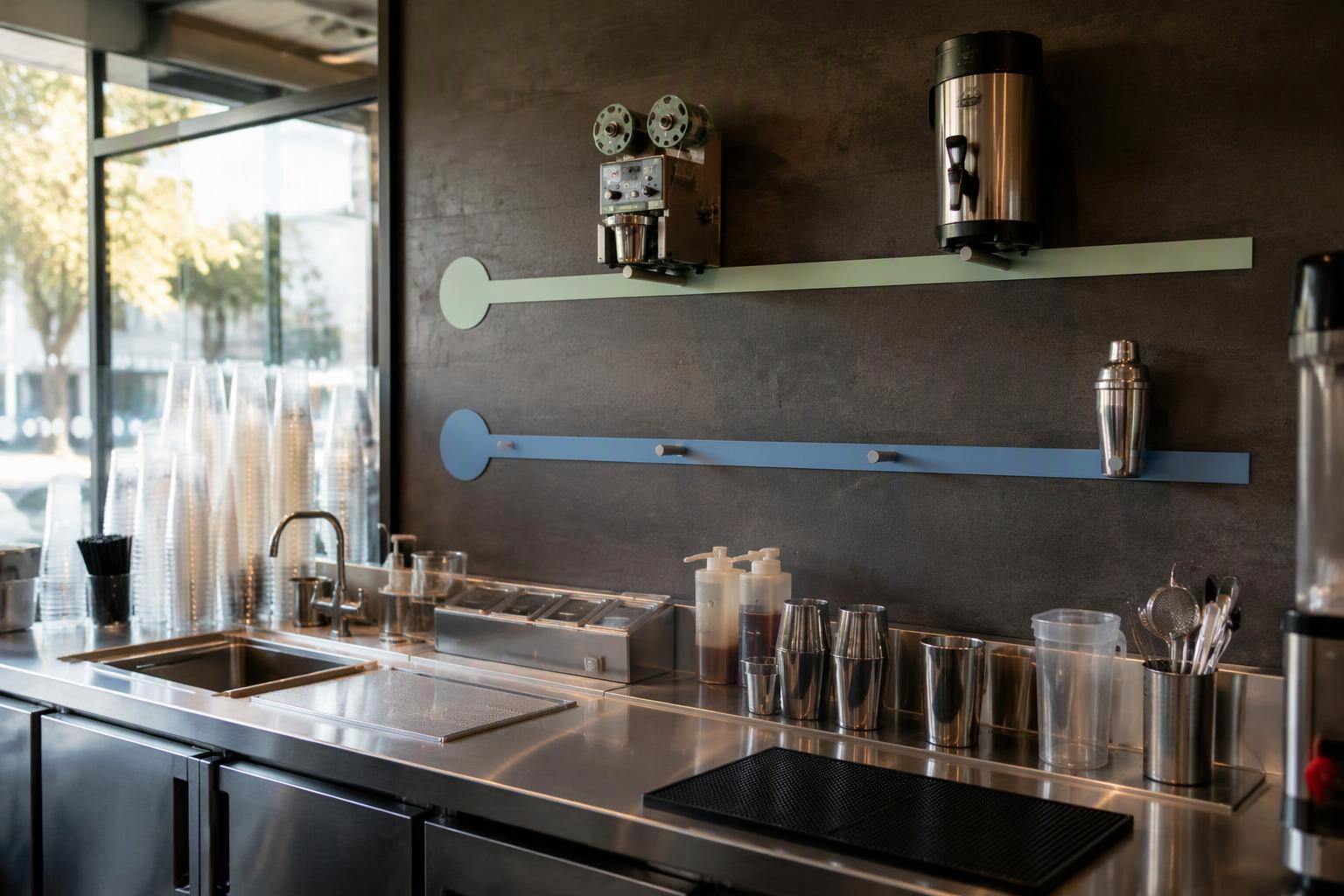
Refrigeration, ice production sized for the busiest season, tea brewing, pearl cooking, a cup sealer, shakers and blenders for the launch recipes, prep and sanitation infrastructure, water filtration and a tablet POS are day-one items. Automatic pearl cookers, blenders beyond the first two, a second sealer and snow-ice or slush machines can wait for volume or menu expansion (BobaSync, 22 Jul 2026).
The upgrade triggers are measurable rather than a feeling: BobaSync puts the second sealer at around 200 cups a day, which is the point where one machine stops keeping up with a rush.
Sequence matters more than the list, because equipment should be specified before build-out. Sinks, drain lines, dedicated circuits and HVAC clearances are what constrain machine placement, and brewers, induction cookers, ice machines, refrigeration, water heaters and automatic sealers each need verified nameplate voltage, amperage, plug type and breaker size (Botrista). Most jurisdictions require a handwashing sink, a three-compartment warewashing sink and a mop or service sink, and those locations drive the back-bar layout before any machine is ordered (Florida Department of Health, uploaded Sept 2025).
The practical order: settle the menu, confirm sink and utility locations with your plan reviewer, then order the machines that need dedicated circuits, then the countertop units. Buying a sealer before you know your cup rim size, or a brewer before you know your circuit capacity, is how build-outs stall.
Which items are typically financed, leased or bought used, and what does the setup cost?
BobaSync prices the day-one core list at $6,000 to $15,000, itemized as cup sealer $500 to $2,100, tea brewer or kettles $300 to $1,000, pearl cooker $200 to $2,500, shaker machine $400 to $1,200, refrigeration $1,500 to $5,000, ice machine $1,500 to $4,000, fructose dispenser $400 to $900 and POS $0 to $1,500 (BobaSync, 22 Jul 2026). 7shifts gives the wider headline: a small shop’s equipment package typically lands between $10,000 and $30,000, with financing or leasing offered on expensive units and leasing preserving cash flow at higher lifetime cost (7shifts, 4 Mar 2026). The gap between the two bands is mostly automation level and new-versus-used, not a disagreement about the machine list.
An executed franchise document gives the only audited comparison point in this set. The franchise’s own disclosure puts the required branded machines at $6,500 to $7,500 for a shaker machine, cup sealing machine, fructose dispenser, POS system and smallwares kit, paid in full on order and non-refundable, with other equipment, furniture, fixtures and signage running $30,000 to $40,000 inside a total initial investment of $169,000 to $378,000 (Kung Fu Tea FDD, 20 Apr 2026 version). That is a franchise’s cost structure, not an independent shop’s, but it shows how much of a build-out sits outside the drink-production machines.
Two gaps are worth stating plainly. No source quantifies the savings from buying used commercial equipment, so the claim that used saves money can only be made qualitatively. And no source gives loan amounts or terms for equipment financing, so any decision to lease or finance should be run past a lender rather than sized from these ranges.
Frequently Asked Questions
How much does it cost to open a boba shop’s equipment package?
The most commonly cited vendor range for a small shop’s complete equipment package is $10,000 to $30,000 (7shifts, 4 Mar 2026), while an itemized day-one core list comes in at $6,000 to $15,000 (BobaSync, 22 Jul 2026). Both figures are vendor-sourced rather than audited. The difference between them is automation level and how much you buy used.
Do I need a three-compartment sink in a boba shop?
Yes, as the baseline. The code requires a sink with at least three compartments for washing, rinsing and sanitizing (FDA Food Code, Chapter 4, 2022 edition reprint). Some states allow a two-compartment sink under narrow conditions, such as Texas, which permits it only where single-service tableware and an approved sanitizer are used (Texas DSHS, Aug 2021 edition). Confirm with your local health department before designing around the exception.
What size ice machine does a boba shop need?
A small-to-mid beverage shop typically needs a 200 to 500 lb/day machine, and you should add at least 10 to 20% capacity above measured daily use (Memphis Ice, undated). Convert your cup volume first: about 0.6 lb of ice per 12 to 16 oz cup (WebstaurantStore, updated 8 Oct 2026). Then derate for your room, because a machine rated at 70°F air and 50°F water produces noticeably less in a 90°F shop (HiCon International, 28 Sep 2026).
Can I buy used boba shop equipment?
Used equipment is widely recommended for simple metal-and-motor items such as refrigerators, ice machines, work tables and sinks, and new equipment is recommended where precision and parts support matter, such as sealers and fructose dispensers (BobaSync, 22 Jul 2026). No source in this set quantifies the savings, so treat the discount as real but unsized, and budget a service visit before opening day.
The equipment list for a boba shop is a consequence of two decisions you make before you buy anything: what is on the menu, and what your local health department requires. The menu determines whether you need a range or a stock pot, a blender or just shaker cups, a shaker machine or a hand shaker (WebstaurantStore). The code determines your sink count, your hand-sink plumbing and your mop facility, and it is adopted locally, so the Food Code is a baseline rather than a binding list (FDA).
From there, the sequence protects your cash flow. Specify equipment before rough-in so your circuits and drain lines match the machines you actually order (Botrista). Buy the day-one set, size the ice machine for August rather than February, and let volume trigger the upgrades: the second sealer at around 200 cups a day is the clearest example of a purchase with a measurable trigger (BobaSync, 22 Jul 2026).
Budget between $6,000 and $15,000 for the core drink-production list, or up to $10,000 to $30,000 for a fuller package, and treat both as vendor-sourced planning bands rather than quotes (BobaSync, 22 Jul 2026; 7shifts, 4 Mar 2026). Your next step is to turn this into a printable, phase-grouped checklist: day-one items, volume-triggered items, and the code-driven plumbing and sink items your plan reviewer will ask for. Once the machines are specified, the next constraint is the consumable supply line, since cups, wide straws, sealing film and syrup pumps are what keep the equipment running.