


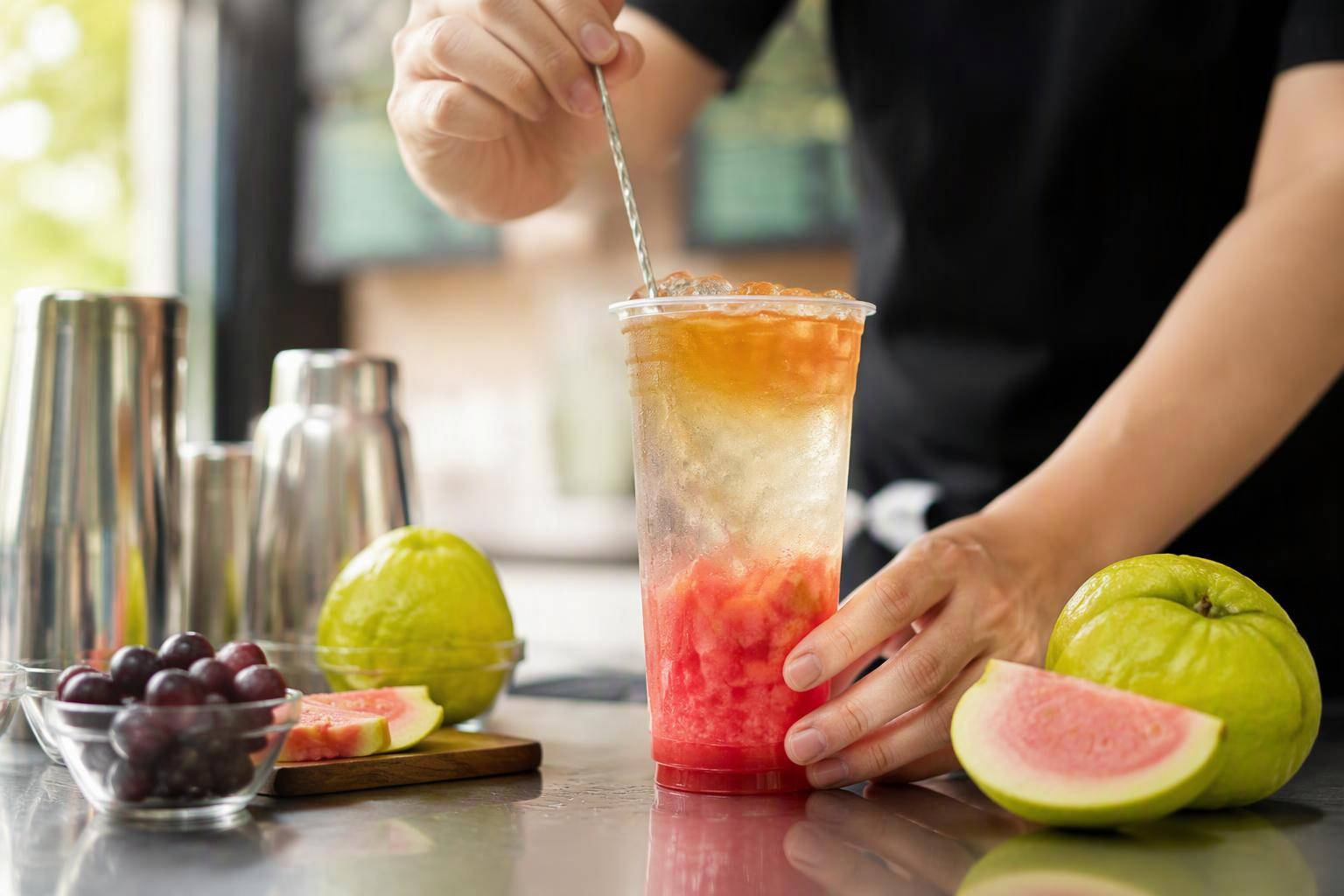
Your fruit tea tastes different at 8 pm than it did at 11 am because it is built by eye, and a menu built around milk teas still needs a fruit-forward signature to sit beside them. A guava grape fruit tea is a shaken iced drink built on a chilled jasmine green tea base, layered with guava purée and a grape or grapefruit component, sweetened with liquid fructose, and finished with ice and a topping. Brix is the dissolved-solids reading that tells you how sweet a finished drink actually is; purée is blended whole fruit with body and pulp, while a concentrate is a reduced juice or syrup you dilute and dose by volume; batching means brewing and holding one measured tea base so every cup starts from the same liquid. The build spec below is a starting point to test with one sample batch and adjust to your own water, leaf and supplier, not a universal law.
What makes a guava grape fruit tea work as a shop drink
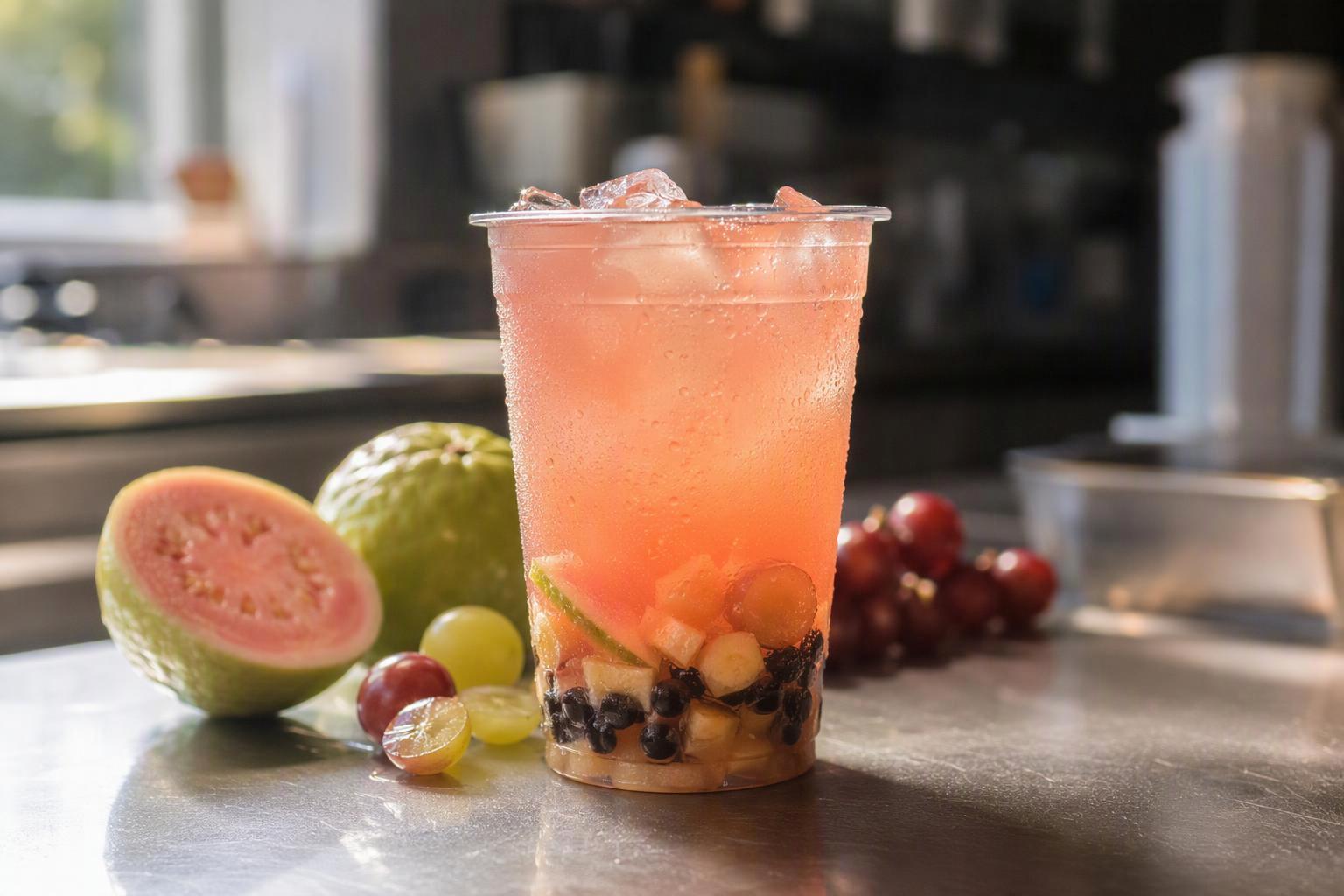
The drink earns its slot because fruit flavor is where the category’s growth is concentrated, and because a fruit tea carries a higher ticket than a milk tea at nearly the same gross margin. A market-research estimate of the fruit-flavor share puts that segment at 38.3 percent of the bubble tea market in 2025 (Grand View Research, 2026 edition). A second market estimate, which puts the number about 20 percent higher on the same market, names fruit-flavored bubble tea the leading product type in 2026 without publishing a figure (Coherent Market Insights, 2026 edition). The two reports disagree by roughly 20 percent on total market size, so read both as direction rather than as a number you can plan against.
What the reports agree on matters more for your menu: fruit-forward drinks are the segment growing fastest, and they are the ones customers photograph. Guava and grape specifically are not ranked above mango, strawberry or passion fruit in any source here, so treat the pairing as your own point of difference rather than a documented trend.
The sensory target is a pale pink-orange drink with visible ice and a clean fruit aroma, sweet enough to read as fruit rather than as syrup. That is a Brix question, and the commercial spec for a guava-and-citrus profile sets the finished drink at 12 to 13 Brix (a published commercial fruit tea SOP and spec sheet, 2026-09-23). Buy a refractometer before you buy a case of purée; it is the only way to hold that target when your purée lot changes.
What tea base and fruit components go into it, and in what ratios
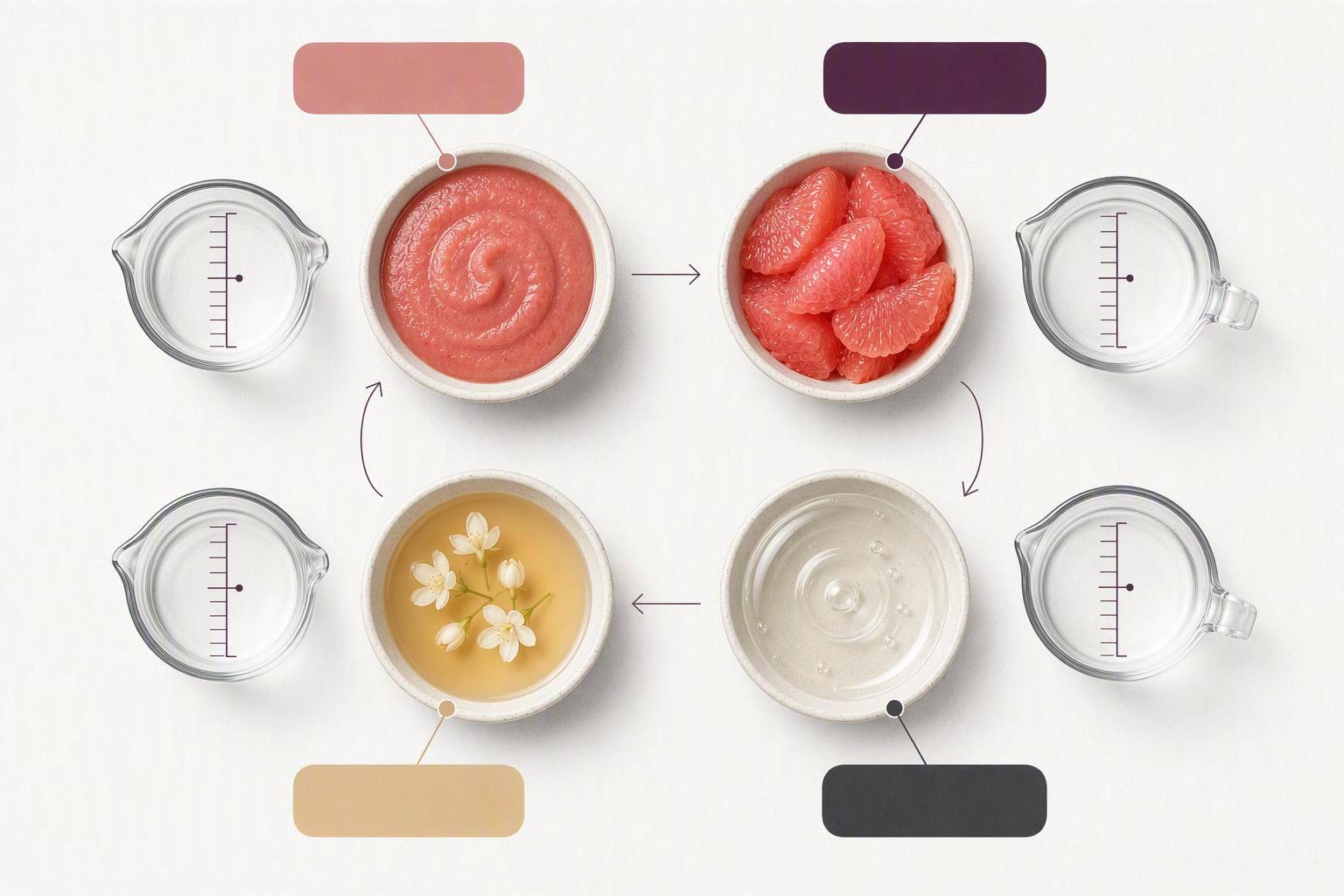
The 16 oz build is 200 ml chilled jasmine green tea, 35 ml fruit component, 10 ml liquid fructose at 55 percent, 5 ml fresh citrus juice, 180 g ice and 50 g topping; the 22 oz scales to 280 ml tea, 50 ml fruit, 15 ml fructose, 8 ml citrus, 250 g ice and 70 g topping (a published commercial fruit tea SOP and spec sheet, 2026-09-23). That is a guava grapefruit fruit tea recipe in its simplest form: split the 35 ml fruit component into roughly 20 ml guava purée and 15 ml grape or grapefruit, then let the 5 ml of fresh citrus carry the top note.
Jasmine green is the base because it is the tea the spec sheet pairs with fruit builds, and because its floral edge sits under guava rather than fighting it. The same publisher’s pineapple SOP repeats the identical 200 ml and 280 ml tea volumes with a different fruit, which tells you the tea layer is the fixed part of the formula and the fruit is the variable (a commercial fruit tea SOP with a fructose scaling matrix, 2026-08-19).
Purée and concentrate are not interchangeable at the same volume. A supplier’s per-cup concentrate dosing table gives 40 to 50 ml of concentrate for a 700 ml cup, 30 to 40 ml for 500 ml and 20 to 25 ml for 350 ml, and it recommends cutting the concentrate by about a quarter when you layer it with another sweetener such as fructose, brown sugar syrup or fruit jam (a supplier’s per-cup concentrate dosing table, 2026-04-23). If you build on concentrate instead of purée, start at the low end of that range and reduce it further, because your fructose is already doing sweetness work.
Cost is the trade-off you feel first. A premium fruit tea carries a fruit component at USD 0.45 per 16 oz cup against USD 0.05 for the syrup in a classic milk tea (an operator’s published fruit tea versus milk tea cost model, 2026-07-26). That gap is the price of the category, not a sourcing failure.
How to prep and batch it so it tastes the same every shift
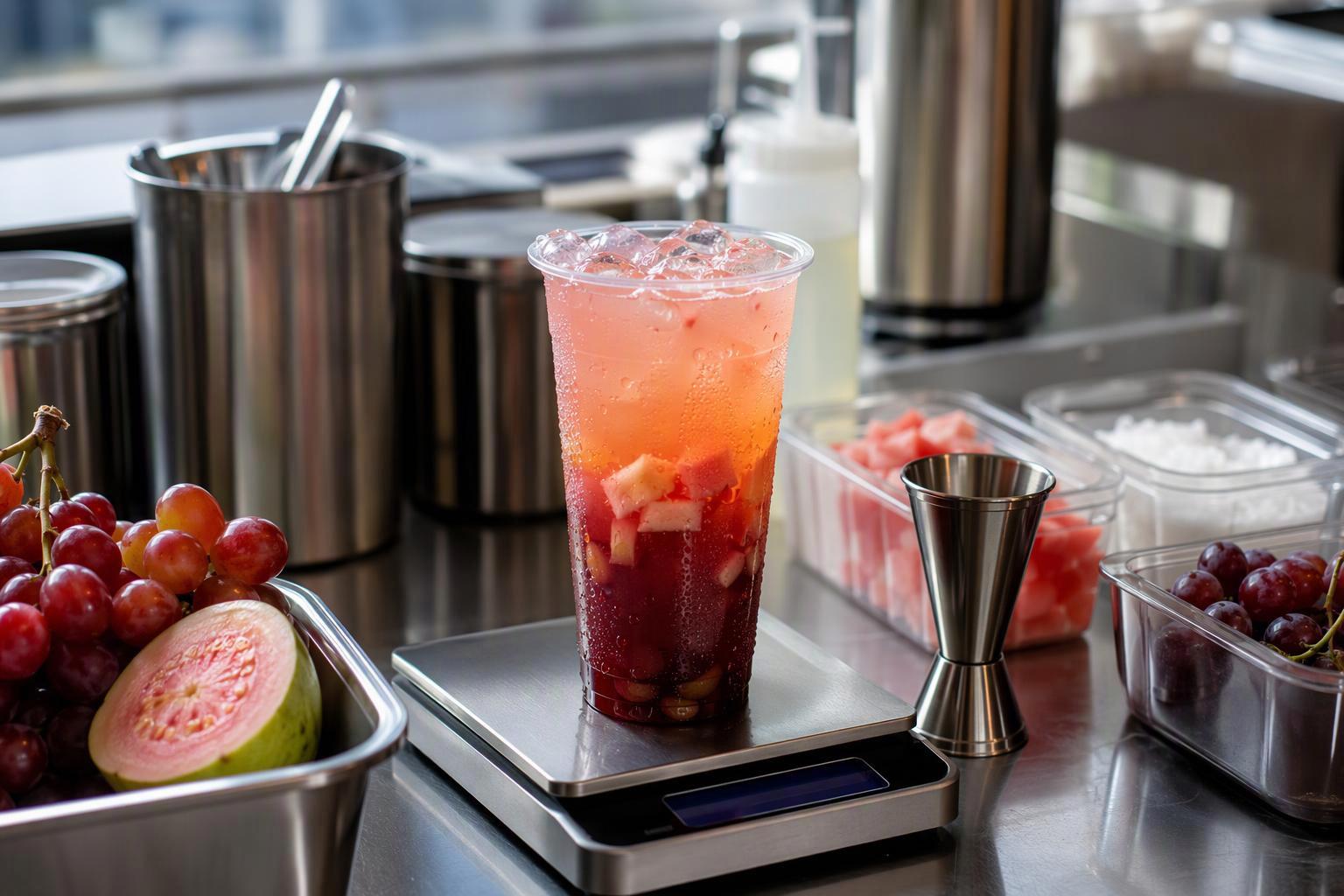
Batch the tea to a fixed recipe and hold it cold for no more than 4 hours. The commercial SOP brews a 3 L batch from 90 g loose jasmine leaf (a 1:33 leaf-to-water ratio) in 3,000 ml RO water at 175 to 180 F, steeps exactly 6 minutes, ice-shocks with 1,000 g ice, holds at 35 to 38 F and discards after 4 hours (a published commercial fruit tea SOP and spec sheet, 2026-09-23).
Steep parameters are the first place your shop will diverge. A second commercial SOP uses the same 90 g per 3,000 ml but steeps 7 minutes at 172 to 176 F and stirs in 1,500 g ice (a commercial fruit tea SOP with a fructose scaling matrix, 2026-08-19), while a boba supplier’s published brew chart runs premium jasmine green at 175 F for a 10-minute steep on production equipment (IMACK Coffee, undated). The equipment maker’s iced-tea preparation guidance sits at the other end entirely, calling for brew water of at least 195 F and a 3 to 5 minute brew cycle (Bunn, undated). Pick one method, write it down, and hold it, because a 4-minute swing in steep time is a different drink.
The hold rules are two separate rules, not one number. The SOP’s 4-hour discard applies to your chilled jasmine base; the equipment maker’s 12-hour maximum applies to finished brewed tea held at room temperature, and it also says to brew only what you expect to sell within a few hours (Bunn, undated). Do not read the 12-hour figure as permission to hold your fruit tea base through a double shift.
Build in this order: topping and any fresh slices into the serving cup, then tea, fruit component, fructose and ice into the shaker, then a hard shake of 8 to 10 seconds (a published commercial fruit tea SOP and spec sheet, 2026-09-23). The shake is not theatre: it dissolves the fruit solids fully, combines the syrups evenly and chills the drink so nothing tastes gritty or layered (an equipment vendor on why fruit teas are shaken, 2025-04-16). On an automated shaker the cycle runs under 10 seconds, and over-tightening the cup holders cracks cups.
Scale sweetness with the fructose matrix rather than by taste. At 16 oz the spec is 10 ml at 100 percent sweetness, 7 ml at 70 percent, 5 ml at 50 percent, 3 ml at 30 percent and 0 ml unsweetened; at 22 oz it is 15, 10, 7 and 4 ml (a commercial fruit tea SOP with a fructose scaling matrix, 2026-08-19). Verify each batch by tasting against your Brix target and by checking the base temperature before service.
Sanitation is the step most shops skip. Clean and sanitize tea brewing, storage and dispensing equipment at least once a day, with spigots getting extra attention because they are especially prone to contamination (Bunn, undated). For opened purée, published refrigerator-shelf-life guidance gives a 2 to 5 day working band at 40 F or below, and it cites no manufacturer basis, so treat it as a conservative planning number and follow your supplier’s label where it is stricter (fridge.com, 2026-02-16).
What does one cup cost me, and what should I charge
A premium fruit tea runs about USD 1.00 in ingredients and packaging per 16 oz cup, against USD 0.60 for a classic milk tea (an operator’s published fruit tea versus milk tea cost model
, 2026-07-26). That dollar breaks down as tea base 0.15, fruit purée or syrup 0.45, premium topping 0.25 and packaging 0.15. A second operator’s itemized 16 oz build-up on a different drink lands at USD 0.65 total, with the powder alone at USD 0.42, which shows how much of the spread is the base ingredient rather than the cup (an operator’s itemized 16 oz cost build-up
, undated). Neither figure comes from a dated price survey, so model your own from your invoices.
Hold beverage COGS between 20 and 30 percent of revenue. The same cost model prices its premium fruit tea at USD 1.00 COGS against a USD 6.50 retail, roughly 15 percent, and reports gross margins of 65 to 80 percent across the category (an operator’s published fruit tea versus milk tea cost model, 2026-07-26). A 3x to 4x markup on materials is the working rule: a drink that costs you USD 1.20 should not retail below USD 4.80.
For a US anchor, a menu price survey of passion fruit tea across 77 menus and 71 priced menus in 68 cities found a median of USD 5.95, an interquartile range of USD 5.25 to 6.50 and a full range of USD 4.72 to 7, from list prices collected between 2026-09-11 and 2026-10-07 (a US menu price survey of passion fruit tea, 2026). Passion fruit tea is the closest comparable fruit tea with published data, so use the interquartile range as your band and place guava grape inside it.
The pricing environment is mildly inflationary. The BLS August 2026 inflation release put food away from home up 3.4 percent and nonalcoholic beverages up 3.7 percent over the 12 months ending August 2026 (the BLS August 2026 inflation release, 2026-09-11). That is broad-basket data, not boba-specific, so it justifies a modest annual menu adjustment rather than a specific price.
Where does it go on my menu, and how do I launch it
Put it in a small signature block, not in a long flavor list. Published boba menu-design guidance separates signature drinks, which are flagged with “Best Seller” or “Staff Pick”, photo-led, placed top or center and kept deliberately small, from seasonal specials as a separate category (published boba menu-design guidance, undated). A guava grape fruit tea belongs in the signature group if you intend to keep it, and in seasonal if you are testing it against a fruit window.
Keep the name short and identical everywhere. The same guidance says the name should be short and clear, name the base or flavor, and stay the same across printed menu, digital menu, online ordering and POS, with customization ordered as drink, size, toppings, sweetness, ice, upgrades (published boba menu-design guidance, undated). “Guava Grape Green Tea” survives that test; a poetic name does not.
Launch it as a limited special first. Run it for two weeks at the low end of your price band, track cups per day, and only then decide whether it earns a permanent slot. The honest urgency here is seasonal: fruit availability and quality move through the year, and a guava-forward drink built on a fresh-fruit garnish will read differently in January than in July.
One labeling point to check before you print. The FDA labeling rule for juice percentage and fruit-flavored names applies to beverages that purport to contain juice, and it requires wording such as “contains __ percent juice”, with “less than 1 percent juice” where the beverage contains under 1 percent (21 CFR 101.30, current text). No source here states whether a boba shop’s fruit tea triggers that rule or what the juice percentage of a commercial purée is, so confirm your obligations with your supplier and your local health department before you print a claim.
Which ingredient quality tier should I buy
Buy the tier that hits your Brix target at the lowest cost per cup, and let the refractometer decide. The commercial spec sets a guava white peach profile at 12 to 13 Brix and a ruby grapefruit citrus profile at 11 to 12 Brix (a published commercial fruit tea SOP and spec sheet, 2026-09-23). A cheaper purée that forces you to add fructose to reach the same reading is not cheaper; it just moves cost from the fruit line to the sweetener line and flattens the fruit flavor.
Purée is the premium tier and the one the cost model prices. The USD 0.45 fruit component in the premium fruit tea build is real fruit purée or syrup, against USD 0.05 of liquid sugar in the milk tea build (an operator’s published fruit tea versus milk tea cost model, 2026-07-26). That is a ninefold difference on one line, and it is the line that determines whether the drink tastes like fruit.
Concentrate is the middle tier and the one with published dosing. A supplier’s concentrate table gives 40 to 50 ml for a 700 ml cup and recommends cutting the concentrate by about a quarter when another sweetener is layered in (a supplier’s per-cup concentrate dosing table, 2026-04-23). Concentrate gives you consistency and shelf life at a lower cost per cup, with less pulp and a thinner mouthfeel.
On the supplier side, the puree you buy should come from a facility following the FDA’s preventive-controls rule for food facilities, which applies to operations that manufacture, process, pack or hold food for US sale and are required to register under the FD&C Act (21 CFR Part 117, current text). The FDA’s juice HACCP rule covers juice used as an ingredient in beverages, and it defines juice to include purées and concentrates, but it excludes the operation of a retail establishment that provides juice directly to consumers (21 CFR Part 120, current text). That means the HACCP obligation sits with your supplier, not on your prep counter, and it is a reason to ask for documentation rather than to build a plan of your own.
No source here publishes a yield-per-case figure for guava purée, grapefruit concentrate or grape syrup, so you cannot calculate cups per case from the research. Ask your supplier for the reconstitution ratio and pack size, then run the math against your own invoices.
Common mistakes to avoid
The most common failure is building by eye, and it shows up as a drink that drifts across a shift. The spec exists to remove that variable: 200 ml tea, 35 ml fruit, 10 ml fructose and 180 g ice at 16 oz, held to the same measure every time (a published commercial fruit tea SOP and spec sheet, 2026-09-23).
The second is skipping the refractometer. Without a Brix reading you cannot tell whether a new purée lot is sweeter or weaker than the last one, and your 12 to 13 target becomes a guess.
The third is holding the tea base too long. The SOP limit is 4 hours for the chilled jasmine base, and the equipment maker’s 12-hour figure applies to finished brewed tea at room temperature, not to your fruit tea base (Bunn, undated). Shops that read the longer number as a general permission end up serving a flat, oxidized base.
The fourth is under-shaking. A quick stir does not dissolve fruit solids or combine syrups the way a hard 8 to 10 second shake does, and the result is a gritty first sip and a sweet last one (an equipment vendor on why fruit teas are shaken, 2025-04-16).
The fifth is pricing off competitors instead of your own build. The cost model’s own framing is that operators set prices from local competitors without understanding their internal cost structure, which is how a USD 1.00 cup ends up on a USD 6.50 menu (an operator’s published fruit tea versus milk tea cost model, 2026-07-26).
The sixth is treating opened purée as shelf-stable. Published guidance gives a 2 to 5 day refrigerated band at 40 F or below with no manufacturer basis cited, so it is a planning number, not a rule (fridge.com, 2026-02-16). Date the container when you open it.
Frequently asked questions
How long does it take to build one drink once the tea is batched?
Under two minutes at the counter. Everything slow happens before service: the base is brewed and chilled, the fruit components are portioned, and the sweetener is measured into a squeeze bottle or a pump. What is left is ice, tea, fruit, sweetener, a shake, and a seal. The build time only stretches when someone is measuring fructose by eye at the register, which is also where consistency goes first.
Can I use a concentrate instead of purée?
Yes, and the swap is not one-for-one. Concentrates are usually more concentrated and often sweeter than a purée, so start at roughly two-thirds of the purée volume, taste against your target Brix, then adjust upward in 5 ml steps. What changes most is texture: a purée carries pulp and body that a concentrate does not, so a concentrate build reads thinner and its colour settles lighter. If mouthfeel matters to you, keep a small amount of real fruit or a textured topping in the cup.
What if the drink tastes flat or the colour looks muddy?
Flatness is almost always sweetness or acid, not fruit. Check the finished Brix first, then add citrus in 2 to 3 ml increments until the guava lifts. Muddy colour usually comes from over-steeping the green tea, from a base held past its 4-hour window, or from shaking a purée that has separated. Strain the base, re-brew if the liquor is dull, and stir the purée back together before you portion it.
How do I scale the spec to a 24 oz cup?
Scale by volume, not by feel. A 24 oz cup is 1.5 times a 16 oz build, so the tea, fruit component, fructose, citrus and ice all move by that factor, while the topping goes up by closer to 1.25 times because the cup fills faster than the liquid grows. Re-check Brix after scaling rather than assuming the ratio held.
Can I sell it hot?
You can, but expect a different drink. Heat pushes the grape and citrus aromatics forward and dulls the guava, and a purée-based build can turn grainy once it is warmed. If you want a hot version, brew it fresh to order, skip the ice, drop the fruit component slightly, and serve it in a smaller cup. Most shops run this spec iced and keep a separate hot fruit tea on the menu.
A guava grape fruit tea is buildable this week: one jasmine base batched to a fixed recipe and held 4 hours, one measured fruit component, one fructose matrix, and one Brix target of 12 to 13. The numbers here come from a published commercial SOP, a supplier’s dosing table, an equipment maker’s brewing guidance and two operator cost models, and they disagree with each other in exactly the places you would expect, which is why the spec is a starting point rather than a law.
The next step is one sample batch. Brew 3 L of jasmine to the 90 g and 6-minute spec, build a single 16 oz cup at 200 ml tea, 35 ml fruit, 10 ml fructose and 180 g ice, and read it on a refractometer against 12 to 13 Brix. Log the numbers, taste it, and adjust one variable at a time until the cup is repeatable. Then hand the log to your staff and let the drink hold its own on the menu. *