


If your line stalls the moment smoothies hit the queue, you don’t have a blender problem—you have a process problem. This bubble tea smoothie SOP gives you a dual-path workflow that delivers a cup in about 60–75 seconds, stays consistent across staff, protects per‑cup cost, and onboards new hires fast. Whether you run programmable commercial blenders with presets or a basic blender, you’ll get clear ratios, checkpoints, and fixes that work in the real world.
Set Up Your Station for Speed
Speed begins before the first button press. Build the station so the next cup almost makes itself.
Cold holding and staging: Keep pre‑portioned fruit/puree kits and dairy/tea bases at or below 41°F (5°C) inside reach‑in or cold wells. If you stage at room temp during a rush, time‑mark and discard within the allowed window per the FDA Food Code (2022). See the FDA Food Code 2022.
Boba readiness: Cook tapioca pearls to plan and hold in syrup; many suppliers advise using within about four hours for best texture—Bossen states “use within four hours.” Reference Bossen’s pearl holding guidance and align with your product label.
Gear placement: Place the scale at the jar-loading spot; sound‑enclosed blender within arm’s reach; ice bin on the non-drip side; straws/lids/sealer downstream from the blender to avoid backtracking.
Jar loading order and fill: Load liquids first, then soft items (puree), then hard/frozen items (ice/frozen fruit) on top. Don’t exceed the container’s max fill line—this reduces cavitation and re‑blends. This order mirrors manufacturer guidance such as Vitamix’s smoothie tips and WebstaurantStore’s troubleshooting practices; see Vitamix smoothie loading tips and WebstaurantStore’s blender troubleshooting guide.
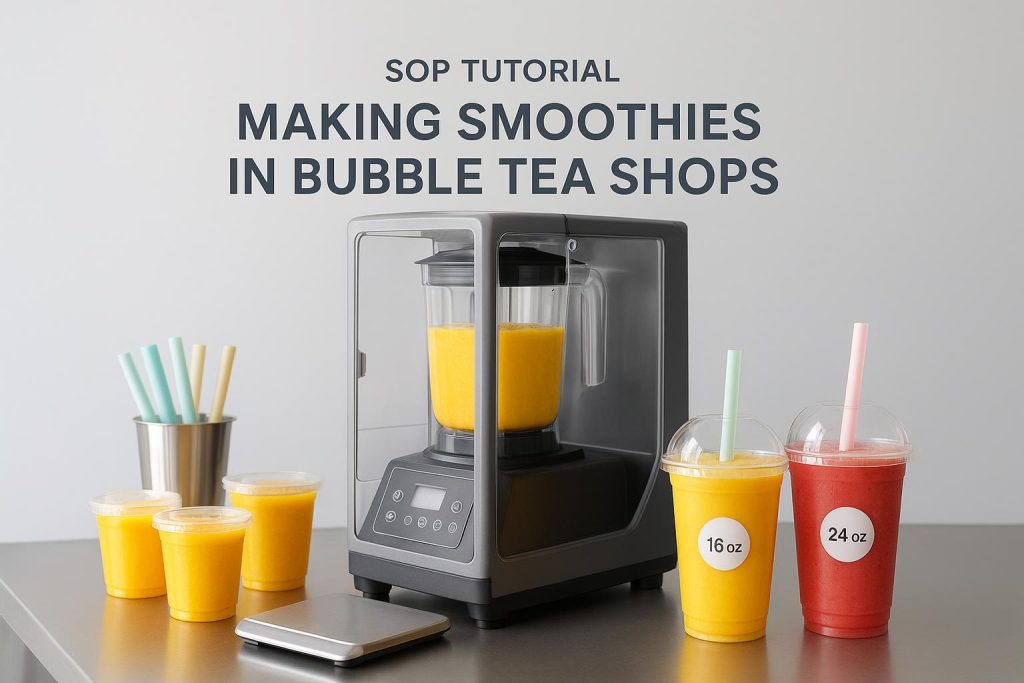
Labeling & FIFO: Pre‑portion kits with date/time, flavor, sweetness level, and size (16 or 24 oz). Use FIFO to control shrink and keep quality predictable.
Standard Ratios and Targets — Your House Formula
Lock ratios by weight to control texture, sweetness, and cost. Calibrate once; repeat forever.
Suggested single‑cup targets (adjust ±10% for your brand’s mouthfeel):
16 oz cup: 160–200 g fruit puree or frozen fruit, 120–160 g liquid base (milk/tea/water), 90–120 g ice. Total jar load typically 430–520 g before blending. Thicker: add ~10% fruit or reduce liquid ~10%. Lighter: add ~10% liquid or reduce fruit ~10%.
24 oz cup: 240–280 g fruit puree or frozen fruit, 180–220 g liquid base, 140–180 g ice. Total jar load typically 620–740 g before blending. Thicker or lighter: adjust as above.
Quick checkpoints:
Viscosity/flow: The pour should form a smooth ribbon that folds back on itself within ~2–3 seconds; no visible ice shards.
Sweetness: Define a house “standard” (e.g., 8–10% brix equivalent). If you have a refractometer, spot‑check weekly. Otherwise, taste‑calibrate with a lead barista.
The bubble tea smoothie SOP — Step‑by‑Step
This is your shop’s backbone: one universal sequence with two equipment paths. It’s your practical, repeatable bubble tea smoothie SOP.
Path A — Programmable/Auto‑Blend Blender
Presets: Map house programs to Light, Standard, and Thick. For Vitamix The Quiet One, align with smoothie cycles documented in the programming tables. Factory smoothie and thick‑smoothie programs run about 18–40 seconds depending on load. See Vitamix The Quiet One programming. For Hamilton Beach Summit Edge HBH855, Auto Blend detects texture and stops automatically; see HBH855 Auto Blend overview.
Steps:
Tare the jar on the scale. Add liquid base, then puree/softs, then ice/frozen fruit to target grams. Keep under the max fill line.
Close sound enclosure. Select the mapped preset (e.g., Standard for 16 oz; Thick for 24 oz with heavy fruit) and start. Do not lift the lid mid‑cycle.

When the cycle stops, perform a 2–3 second pour‑ribbon check. If shards remain, pulse the preset’s finishing cycle or re‑run the hard‑to‑blend smoothie cycle.
Pour into the cup, top with pearls if ordered, lid/seal, and pass to FOH.
Path B — Basic Blender Fallback
Without presets, depend on time and visual cues.
Steps:
Tare jar; load ingredients in the same order; reduce batch size slightly (aim 60–70% of jar capacity) to avoid stalling.
Blend high for 30–45 seconds; pause and check flow; run an additional 10–15 seconds if needed. Use brief pulses at the end to smooth foam.
Ribbon check and straw‑draw test (10–12 mm straw should pull product without collapsing). Adjust next batch ratios based on the result.
Universal sequence (use this ordered flow every time):
Scale and load: liquids → puree/softs → ice/frozen fruit; verify grams and fill line.
Blend: preset/Auto‑Blend cycle (or 30–60 s high on basic blenders).
Check: ribbon pour + straw‑draw; no visible shards.
Finish: pearls and toppings; lid/seal; handoff.
Quality Checks That Keep Every Cup Consistent
Ribbon pour: A smooth, glossy ribbon that folds back within ~2–3 seconds signals the right viscosity.
Straw‑draw: With a 10–12 mm boba straw, you should draw product smoothly without a vacuum collapse. Too tight? Add 20–30 g liquid next batch. Too loose? Add 30–40 g fruit next batch.
Visual shards: If ice glints in the stream, add 10–15 seconds of blending or a 15–30 g liquid top‑off and pulse.
Temperature: Smoothies should feel cold and dense; if they drink warm, your staging is too long or your ice ratio is low.
Recordkeeping: Log daily checks for each flavor/size—grams used, preset used, any mid‑shift tweaks. This is how you keep multiple baristas in sync.
Troubleshooting and Fast Fixes
Symptom Immediate fix Prevention
Chunky ice or unblended fruit Run 10–15 s on high or re‑run the hard‑to‑blend cycle; add 20–30 g liquid if cavitating. Load liquid first; don’t exceed max fill; follow manufacturer cycle guidance like Vitamix smoothie programs and WebstaurantStore troubleshooting.
Watery/thin texture Add 30–50 g puree and 2–3 short pulses; adjust next batch ratios. Pre‑weigh ingredients; reduce liquid by ~10% for that recipe.
Cavitation/stalling Stop, tamp down safely, add 10–20 g liquid; resume. Strict load order; moderate batch size; Auto‑Blend helps on HB models per Hamilton Beach HBH855.
Excess foam/aeration Finish with 2–3 pulses instead of extended high speed. Use cycles with ramp‑down finishes (see Vitamix programming overview).
Pearls too hard/cold Quickly warm pearls in syrup per supplier notes; remake if texture is unacceptable. Cook and hold pearls to supplier window (Bossen ≈4 hours). See Bossen’s use‑within‑four‑hours note.
Cleaning, Calibration, and Food Safety Essentials
End‑of‑shift cleaning: Unplug, remove sound enclosure components if applicable, wash containers with warm soapy water, rinse, then sanitize by running the jar with an approved solution for ~30 seconds; let air‑dry. This aligns with manufacturer procedures for commercial models such as Vitamix; see Vitamix Quick & Quiet cleaning guidance.
Weekly checks: Inspect blades, drive sockets, and centering pads; replace worn parts to maintain texture and reduce blend times. Vitamix’s commercial FAQs outline care and maintenance best practices; see Vitamix Commercial care guidance.
Cold holding: Keep TCS ingredients at ≤41°F (5°C); if using time as a control, mark time and discard within the Food Code window. Reference the FDA Food Code 2022.
Pearl holding: Plan batches in 4‑hour windows, per supplier guidance like Bossen; pearls harden if over‑held or refrigerated without proper syrup management. See Bossen’s pearl storage guide.
Training Script for New Hires — 15 Minutes
Here’s a quick, coachable sequence you can run between shifts.
Minute 0–3: Show the station map and load order (liquids → puree → ice). Have the trainee set up the scale and pre‑portioned kit.
Minute 3–7: Preset drill. On a programmable blender, identify and press the Standard smoothie preset for a 16 oz cup; on a basic blender, run 40 seconds on high with a pulse finish.
Minute 7–10: Ribbon and straw‑draw tests on a practice batch; ask the trainee to describe what “ideal” looks like.
Minute 10–15: One supervised serve from start to finish, with time‑to‑cup tracking. If over 75 seconds, discuss where time was lost (loading, searching, re‑blend) and correct.
Provide a small printable card at the station with your ratio notes, preset map, and QC checks.
Scale Up Without Losing Speed or Margin
Pre‑portioning: Build flavor kits (fruit/puree + dry add‑ins) labeled by size; keep kits cold per the Food Code. This reduces scale time and variance.
Batch bases: Brew tea and milk bases in 1–2 L batches; chill promptly. Record yields and shelf life.
Preset mapping: Create 2–3 house presets and lock them in: Light (more liquid), Standard, Thick (more fruit). Document the program numbers/names from your specific model (e.g., Vitamix The Quiet One cycle IDs) in the SOP binder.
Demand‑timed pearls: Cook pearls to your forecast and refresh every block based on supplier windows (often ≈4 hours). WebstaurantStore’s boba guide gives context for workflow and timing; see their boba tea overview.
Cost control: Track grams per cup and waste. If you’re consistently topping off, raise the fruit target by 10–20 g rather than pouring extra base post‑blend.
Adopt this bubble tea smoothie SOP, calibrate it on your equipment, and write the settings into your shop binder. Set the presets once, weigh every cup, and use the same visual checks across the team—your rush will feel a lot shorter, and your smoothies will taste the same no matter who’s on the blender.