


If you love a drink with toasted depth, gentle bitterness, and a velvety finish, black sesame milk tea delivers a flavor story that’s both nostalgic and modern. This guide is written for operators—product managers, cafe owners, and beverage R&D—who need more than a home recipe. You’ll get operator-ready SOPs, batchable ratios, paste vs powder trade-offs, plant-based options, allergen guidance, and menu ideas that scale from pilot to rollout.
What makes black sesame milk tea stand out
Black sesame (kuro goma) brings a roasted, nutty aroma and subtle bitterness from its hull and oils. Paired with caramelly sweeteners like brown sugar or kuromitsu, it reads comforting yet sophisticated, and it’s naturally caffeine-optional when built without tea—fitting late-day menus and decaf-first guests. For a quick primer on core components of bubble tea (tea bases, milks, sweeteners, toppings), see this practical overview of core bubble tea ingredients for shops.
Cultural note: Many modern cafe builds adapt Japanese and East Asian home techniques (toasting, grinding, then blending with milk or alt-milk) into streamlined service SOPs. Several operator-translatable recipes emphasize balancing roast with honey, maple, or brown sugar to round edges, as shown in HWC Magazine’s black sesame latte variations (2024) and the dairy-free approach in iHeartUmami’s guide (2024).
Paste vs powder vs syrup: choose by scenario
In shops, “best” depends on your constraints: flavor fidelity, speed, cleanup, and waste. Here’s a qualitative comparison to align your choice with operations.
Format Sensory fidelity Speed of service Consistency Cleanup/waste Notes
Paste High, truest roast aroma Medium (needs slurry + brief shear) Medium–High with SOP Medium (oily residue) Great as a flagship; watch storage and oxidation. Sources show paste-forward methods in latte/bubble builds.
Powder Medium High (scoopable) High (controlled scoops) Low Favor pre-slurrying to avoid grit; grind/defatting impacts dispersibility.
Syrup/base Medium Very High Very High Low Fixed sweetness/Brix; verify label/storage. Useful for chains seeking speed.
Evidence and examples: Paste-centered builds are common in latte and bubble tea methods, with handling cues in Vitamix’s honey–matcha foam latte (2024) and Oh How Civilized’s bubble tea walkthrough (2025).
Operator handling tips:
Pre-hydrate paste or powder with a little hot water and sweetener to form a smooth slurry before adding milk; brief high-shear (5–10 seconds) minimizes grit.
Slightly warm paste (around 40–45°C) to thin it for better dispersion, then cool promptly for storage stability.
If your brand standards allow stabilizers, low levels of carrageenan/CMC/xanthan/pectin can help suspend particles; a milk-beverage study showed carrageenan can all but eliminate sediment at low concentrations—use supplier guidance and validate in-house, as detailed in a 2025 milk-based stabilizer study and processing notes from Silverson on flavored milk drinks (2024).
Milk matrix choices that carry sesame well
Your milk or alt‑milk determines mouthfeel, foamability, and how the toasted notes present. Rather than declare a universal “winner,” test within your bar program.
Dairy: Whole milk offers body and a round finish; skim/low‑fat brightens roast notes but can feel thin.
Oat (barista): Often ~3% fat and designed for micro‑foam; a common choice for plant-based sesame builds. See the Oatly Barista Edition product page for baseline specs.
Soy/pea: Higher protein can support foam and structure; flavor can run “bean‑y” unless balanced with sweetener or tea. Techno-functional research suggests extraction methods affect foaming stability, but direct latte‑steaming comparisons are limited in public literature; contextual overviews appear in 2024–2025 plant‑protein studies.
For an expanded look at milk selection trade-offs in boba programs, see this shop-focused breakdown of milk choices for bubble tea menus.
Operator SOPs and repeatable recipes
Below are starting points. Validate with your ingredients and equipment, then lock SOPs.
Single-serve—paste benchmark (iced or hot)
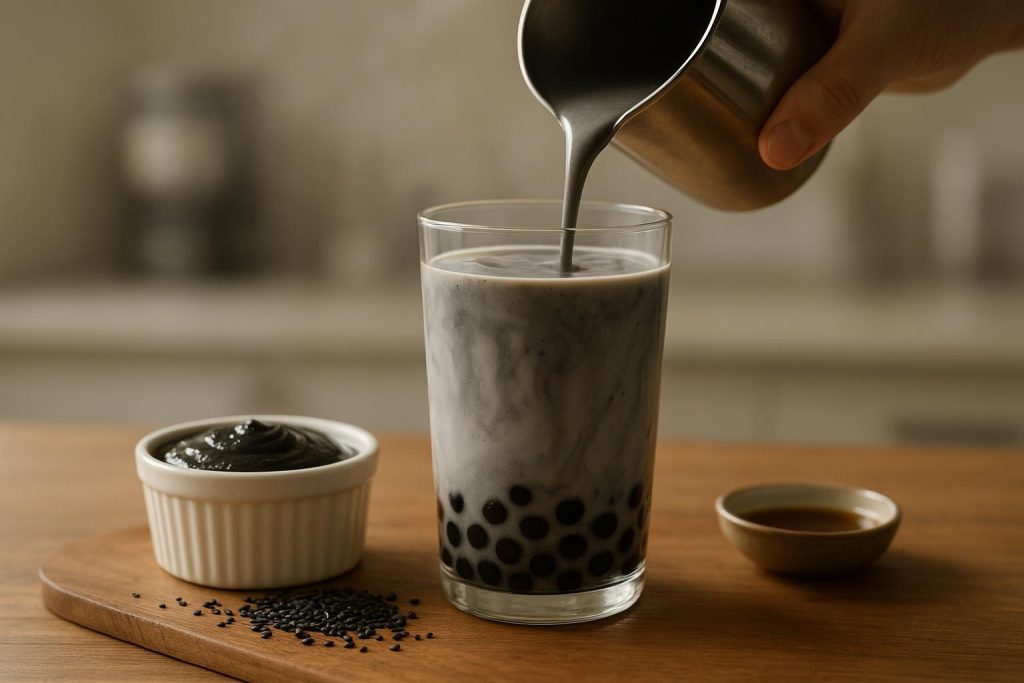
Slurry: 12–18 g black sesame paste + 10–20 ml hot water + 10–20 ml sweetener (brown sugar syrup, honey, or maple). Whisk/froth 5–10 s until glossy.
Build: Add 240–300 ml milk or alt‑milk; for iced, pour over 180 g ice. For hot, steam milk lightly or heat to 60–65°C for a cozy, round profile.
Optional bases: Pull toward tea with a black or hojicha concentrate, or go tea‑free for a caffeine‑optional build. Method cues mirror recipe sources cited earlier.
Batch—1 L paste method (scale 5× or 20× as needed)
Pre‑mix: 120–160 g paste + 120–160 ml hot water + 120–200 ml brown sugar syrup; immersion‑blend 10–15 s.
Combine: Add to 700–760 ml chilled milk or barista oat. Shear 10–15 s to homogeneity.
Hold: Refrigerate; define a 4–24 h hold window per your QA program. Re‑shear 3–5 s before service.
Stability note: If your brand allows, a micro‑dose of a suitable hydrocolloid (per supplier TDS) can improve suspension. Validate visually (no excessive sediment after 8–24 h) and sensorially.
Powder fast‑lane (single‑serve or bar gun prep)
Pre‑slurry powder with 30–50 ml warm water and sweetener to remove clumps; whisk 5–10 s.
Add milk/alt‑milk and brief‑shear. Standardize with a dosing scoop for line speed and consistency.
Quality control checkpoints
Visual: Minimal sediment after 2–4 hours on the line and after hold periods.
Sensory: Smooth pour, low grit, balanced roast‑to‑sweetness.
Process: Repeatable shear time, temps, and dosing.
Service builds and menu ideas
From here, you can dress “black sesame milk tea” in formats that fit your brand and seasons.
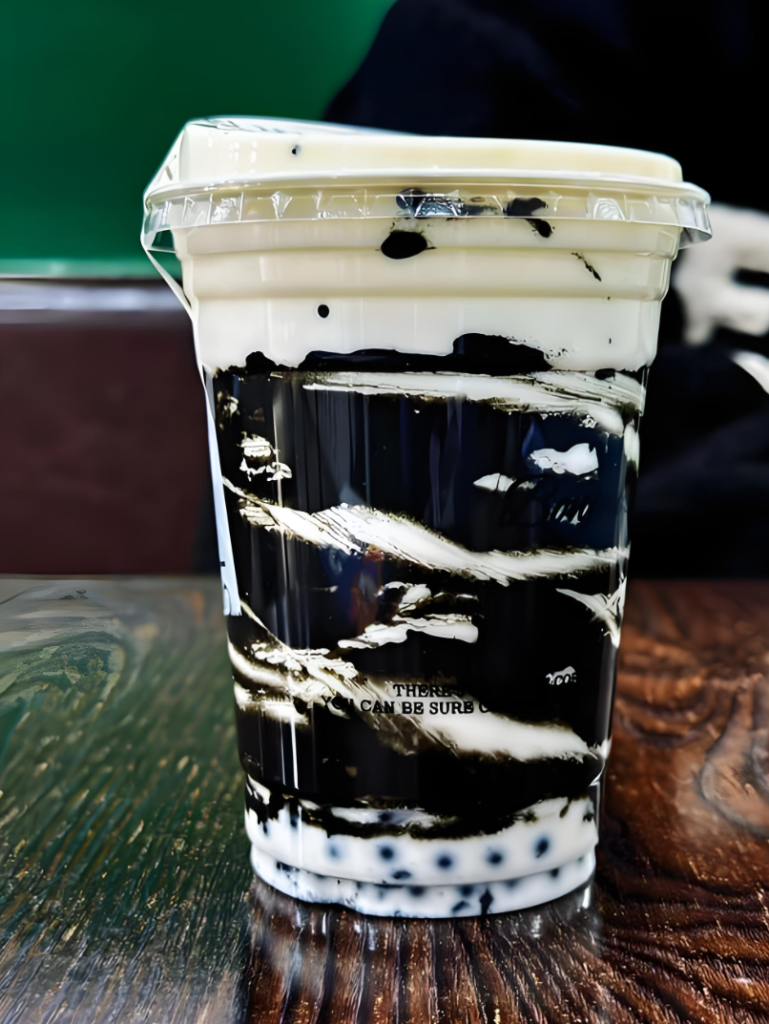
Bubble tea classic: Iced black sesame milk with brown sugar and tapioca pearls. A consumer‑friendly walkthrough appears in Oh How Civilized’s 2025 recipe; adapt to shop‑scale with your batch slurry.
Matcha or hojicha fusion: Layer an earthy tea backbone against roasted sesame; matcha and sesame are a proven pair in operator and recipe contexts, including ideas from MochiMommy’s fusion builds (2024).
Cold foam accents: Honey or strawberry‑matcha cold foam can add color and aroma lift, as explored in HWC Magazine’s variations (2024).
Toppings and textures: Tapioca pearls, grass jelly, coffee jelly, or crystal boba change the sip cadence. For a quick program‑level overview, see a primer on high‑quality bubble tea toppings.
LTOs and pairings: Pair with azuki, chocolate, or toasted coconut; feature kuromitsu ribboning or brûléed foam for a premium feel.
For more seasonal ideas, browse this new drinks inspiration gallery.
Allergen and labeling essentials
Sesame is a major allergen in the United States. Packaged foods must declare sesame under the FASTER Act; retail menus and placards should clearly disclose allergens for unpackaged foods and train staff on cross‑contact prevention. See the FDA’s overview of sesame as the ninth major allergen and its consumer‑facing Food Allergies explainer. Industry discussions of the 2022 Food Code updates also highlight menu‑level disclosures for unpackaged items and training expectations, summarized in this Food Code explainer (2024).
Operationally, reduce risk with dedicated tools and storage, avoid shared oils/fryers, sanitize between tasks, and mark allergy orders—practices reinforced by a 2025 NIH‑hosted review on managing food allergies in dining.
Caffeine and calorie context for menu communication
Black sesame milk tea can be caffeine‑optional, or tea‑forward if you add black tea, matcha, or hojicha. For a 16 oz serving (adjust to your brew strength and SOPs):
Black tea: roughly 80–140 mg of caffeine, per general consumer health references compiled by Mayo Clinic (2025) and CSPI’s chart (2025).
Matcha: about 50–150 mg depending on grams used; chain references like Starbucks place a 16 oz in the ~80 mg zone, but your usage may differ.
Hojicha: typically less than matcha/green for equivalent volumes, driven by roast and dose.
Calories vary with milk choice, sugar level, and toppings. Many cafes disclose 200–500 kcal ranges, and a serving of tapioca pearls commonly adds ~150–200 kcal. Public menus and recipe references show a wide spread; examples include Niko Niko Boba’s nutrition ranges (2024) and item‑level listings from chains like It’s Boba Time (2024).
Sourcing and standardization
When you pilot or scale black sesame milk tea, request spec sheets for paste, powder, or syrup: grind size or Brix, storage/hold, allergen and cross‑contact statements, and recommended use rates. Industry directories and supplier catalogs can jump‑start your trials; for example, Bubble Tea Suppliers maintains educational pages and product categories relevant to bubble tea programs. Keep sourcing mentions neutral and validate everything in your own environment.
Troubleshooting and quick FAQs
Separation or sediment after a few hours?
Increase pre‑hydration and shear time slightly; check milk fat/protein; if brand‑acceptable, evaluate a micro‑dose stabilizer with supplier guidance. Re‑shear before service.
Gritty mouthfeel?
Finer grind/paste quality, warmer slurry, or brief extra shear usually fixes it. Avoid over‑toasting DIY seeds; bitterness and grit often travel together.
Bitter finish overwhelming sweetness?
Use medium roast paste; balance with brown sugar/kuromitsu or honey; check hold time—oxidation can add harsh notes.
Weak aroma after batching?
Up the paste/powder by 10–15% or reduce ice dilution; verify that your milk choice isn’t muting aroma. Barista oat or whole milk often carry roast notes better than very low‑fat options.
Can I make it caffeine‑free?
Yes—skip tea bases and build a sesame latte with milk/alt‑milk. Consider a dessert‑leaning profile with condensed milk or cold foam.
Your next steps
Run a bench of three formats (paste, powder, syrup) using the same sweetness and milk to compare flavor, speed, and stability.
Choose two milk matrices (e.g., whole milk and barista oat) and one tea variant (matcha or hojicha) to define your menu spread.
Lock single‑serve and 1 L batch SOPs; train on slurry, shear, hold, and allergen controls; and document QC checks.
Pilot two LTOs (e.g., matcha fusion with honey cold foam; brown sugar ribbon with azuki) and measure attach rate with toppings.
Think of this guide as your starting rig. Once you tune paste load, milk matrix, and service flow, black sesame milk tea can become a signature with both comfort and craft baked in.