


Cups that drift bitter by mid-afternoon and boba that goes hard before the lunch rush are not a recipe problem. They are a spec problem. A grapefruit bubble tea is a fruit-tea build of brewed tea, grapefruit, sweetener and boba, not a milk tea, and the reason two baristas can follow the same card and pour two different drinks is that the card never said how much tea, how much fruit, how long the pearls sit, or what “done” looks like. This guide sets out a repeatable 16 oz and 24 oz spec the whole bar can hit, with shop-scale ratios, timed boba handling and a verification checkpoint at each stage. A supplier’s 16 oz fruit green tea formula already exists as a reference point (Firsd Tea, training sheet dated 2024-05-15), and it is a useful starting line rather than a standard. Treat every ratio here the same way: a starting spec to calibrate per product, not an absolute.
How Do You Build a Grapefruit Bubble Tea Recipe the Whole Bar Can Repeat?
Three variables move a grapefruit cup between shifts: syrup sweetness varies by brand, dilution from ice and added water, and texture decay in the boba. A supplier’s 16 oz fruit green tea formula makes the first one concrete: 180 mL jasmine tea, 50 g flavour syrup, 45 mL water, ice to fill, and 25 g crystal or popping boba (Firsd Tea, 2024-05-15). Note what the sheet does not state: no boba weight for tapioca pearls, no grapefruit, no 24 oz version.
A second supplier build shows how far apart two published specs can sit. This supplier’s syrup-based build for a 16 oz grapefruit tea is 7 fl oz brewed tea, 1.7 fl oz grapefruit syrup, then 7 fl oz ice (Boba Supply USA, listing dated 2026-07-13). That is roughly 44% ice by volume and no added water at all, against a formula that adds 45 mL of water and tops with ice. Neither is wrong. They are different sweetness targets, and a bar that switches between them without changing anything else will taste the difference.
The fix is to write down which build you are running, in grams and millilitres, and to name the syrup brand and lot on the card. Syrup sweetness varies by brand because the sugar load differs, so a card that says “50 g syrup” without a brand is not a spec. Dilution is the second lever: every gram of ice that melts before the customer drinks adds water the recipe never counted. Texture decay is the third, and it is a clock problem rather than a ratio problem, which is why the boba section below is built around time rather than temperature alone.
What Ingredients and Exact Shop-Scale Ratios Go Into a 16 oz and 24 oz Cup?
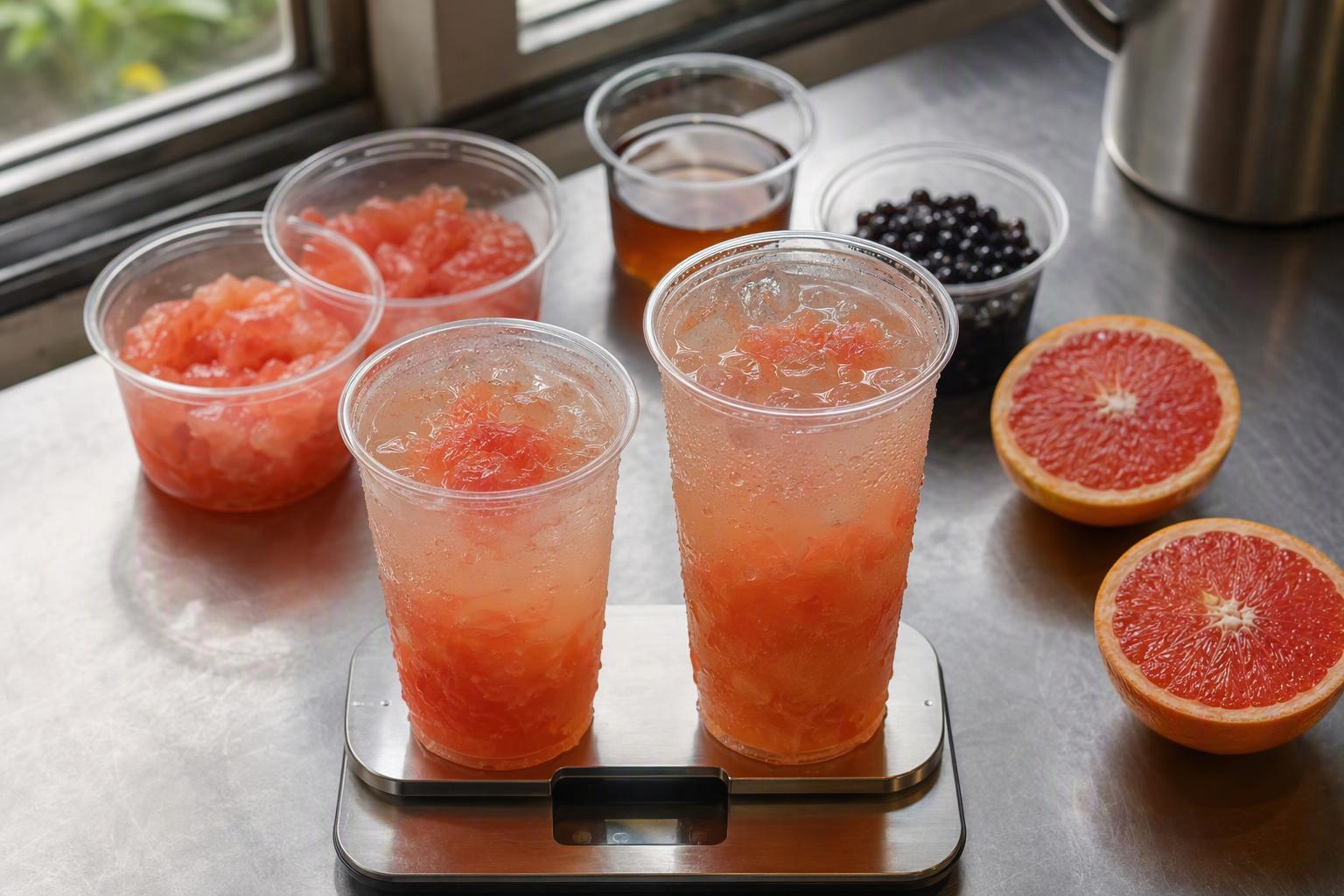
The 16 oz column below is a working spec built on the supplier builds above, with the grapefruit handled as a measured ingredient rather than a splash. The 24 oz column is scaled 1.5×, and no supplier sheet exists for 24 oz, so label it as scaled on your own card. The tapioca portion is the operator’s own call: the only published figure is 25 g of crystal or popping boba for a 16 oz fruit tea (Firsd Tea, 2024-05-15), and no source gives a tapioca pearl weight per drink.
| Component | 16 oz | 24 oz (scaled 1.5×) | Note |
|---|---|---|---|
| Brewed jasmine tea | 180 mL | 270 mL | chilled before build |
| Grapefruit component | 50 g | 75 g | syrup, puree or juice, per your card |
| Added water | 45 mL | 68 mL | balancing lever, adjust last |
| Ice | to fill | to fill | weigh it once, then fix the gram figure |
| Crystal or popping boba | 25 g | 38 g | published figure is for 16 oz only |
| Tapioca pearls | operator’s call | operator’s call | no published per-drink weight |
Two labelling traps sit inside the grapefruit line. Under the federal standard of identity for grapefruit juice, “grapefruit juice” is the unfermented juice of Citrus paradisi Macfadyen with seeds, peel and excess pulp removed, and juice made from concentrate must reach at least 10% soluble solids by weight (21 CFR § 146.132). A puree with pulp and body is not “juice” under that definition, so a menu that says juice while pouring puree is describing something else.
Concentrate is the other trap. Florida’s 2024-25 frozen concentrated grapefruit juice yield was 0.84711 gallons of 40° Brix concentrate per box (USDA NASS and FDACS, March 2026), which tells you a shop buying concentrate is buying something far denser than single-strength juice. Dilute it per the supplier’s own dilution card, never 1:1 on assumption.
How Do You Brew and Batch the Tea Base for Service?
Brew in batches sized to a service block, chill the tea before it meets ice, and log the batch time on the pitcher. The chilling step is where shops lose control, because a warm base melts the ice you weighed and quietly changes the dilution. The two-stage cooling rule gives you the clock: cooked time/temperature control for safety food must go from 135°F to 70°F within 2 hours, and reach 41°F within 6 hours total (WAC 246-215-03515). Tea is not a cooked TCS food in the same sense as a stew, but the two-stage clock is the clearest published standard for “chilled properly,” and it is the one to write on the batch card.
Batch math is plain arithmetic once the cup spec is fixed. At 180 mL per 16 oz cup, a 3 L batch covers 16 cups with a little headroom; at 270 mL per 24 oz cup, the same batch covers 11. Brew what you will sell inside the hold window rather than what fits the urn.
Brewing temperature and steep time are the weak point in the public record. The figures commonly used at shop scale, roughly 10 g of leaf per litre at 75 to 85 °C for 2 to 3 minutes, come from vendor blogs and no tea-association or supplier primary spec was located for this article. Write your own numbers on the card, taste the batch at the start and end of service, and treat any borrowed figure as a starting point.
One regulatory note that matters for every temperature on this page: the FDA Food Code is a model code, and the FDA encourages state, local, tribal and territorial partners to adopt the latest version (FDA Food Code). The 2026 changes summary records no change to the cooling section, so the two-stage wording still describes the current rule (FDA).
Verify: the chilled base reads 41°F or below on a probe before the first cup is built, and the batch time is written on the pitcher.
How Do You Handle Grapefruit So the Drink Isn’t Bitter?
Bitterness comes from the pith and the seeds, not from the juice, so the handling rule is to press and strain rather than to blend. A blended segment throws the white pith through the whole drink, and no amount of sweetener brings it back. Cut segments away from the membrane, press them, strain, and keep the peel and pith out of the shaker.
Fresh-squeezed juice is allowed, but not unregulated. Juice packaged in a food establishment must be treated under a HACCP plan to a 5-log reduction, equal to a 99.999% reduction, of the most resistant microorganism of public health significance, or carry the 21 CFR 101.17(g) warning label (Washington State Retail Food Code § 03445). The warning-label route has a hard limit: the same section bars serving juice bearing that label to highly susceptible populations, and juice prepared on premises must be HACCP-treated if it is served to them (§ 03800).
The simpler route for most shops is commercially processed juice. Packaged juice must come from a processor with a 21 CFR Part 120 HACCP system and be pasteurised or treated to a 5-log reduction (§ 03280). That covers concentrate, NFC juice and puree bought in, and it removes the in-house treatment question entirely.
Cut segments held out for garnish fall under a different clock. The 2022 amendment to time as a control allows ready-to-eat produce that becomes TCS when cut to start at 70°F or less, stay at or below 70°F, and be held for a maximum of 4 hours, marked with that time (FDA). No source located for this article covers juice squeezed to order in a tea shop specifically, so confirm the route with your local health department before you put fresh juice on the menu.
Check which edition your local health department enforces. The FDA Food Code is a model code, not the law in your jurisdiction.
How Do You Cook, Sweeten and Hold Boba So Texture Survives Service?
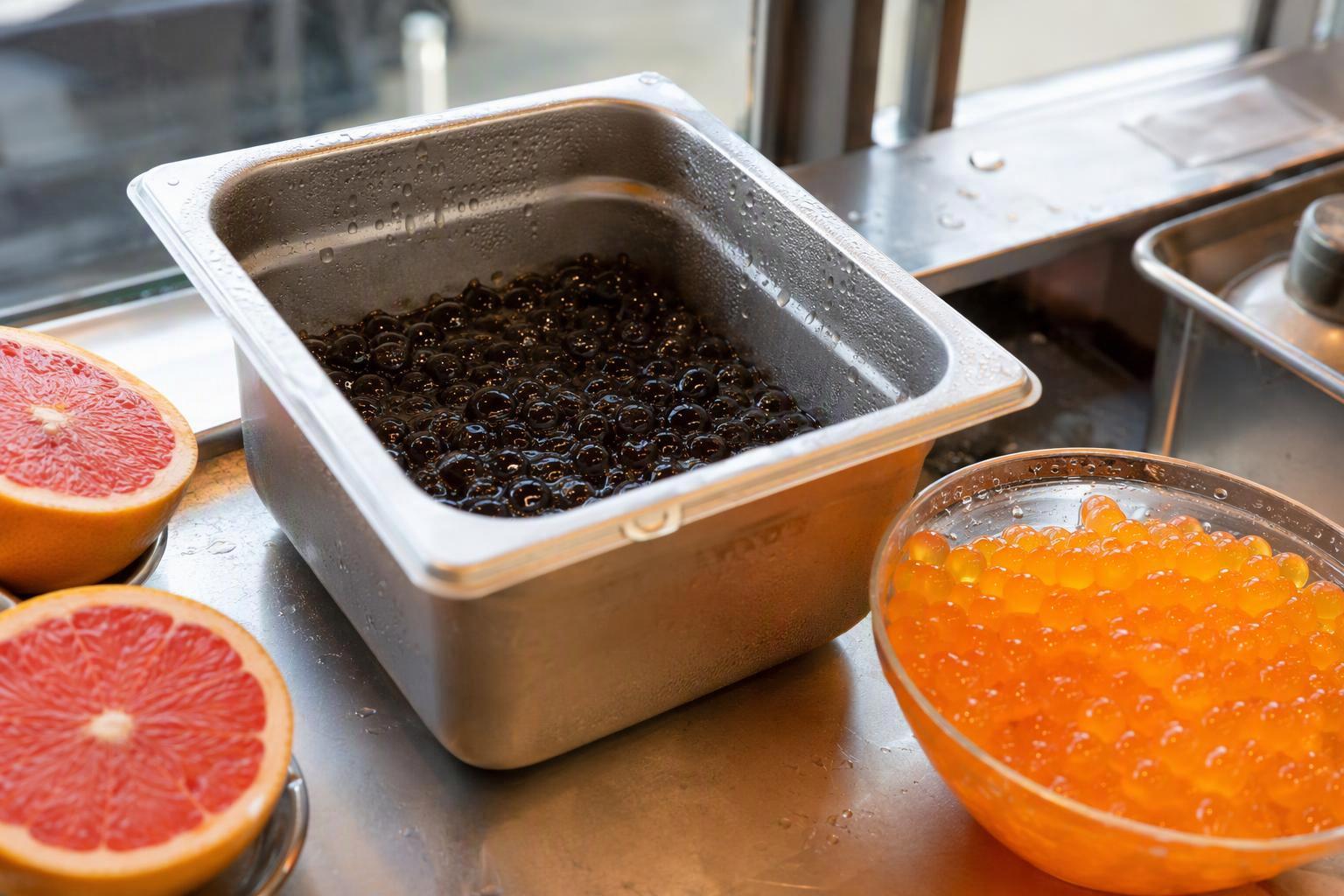
Cook to the package, sweeten while hot so the syrup absorbs, and hold under time as a control with the discard time written on the tray. The four-hour time-as-control rule is the actual limit: hold TCS food without temperature control for up to 4 hours if it starts at 41°F or below or 135°F or above, is marked with the 4-hour discard time, and written procedures exist, and discard anything unmarked or marked past the limit (WAC 246-215-03530).
That rule has a precondition the summaries tend to skip. Written procedures must be prepared in advance, kept in the establishment and made available to the regulatory authority on request. A tray with a sticker and no written procedure is not compliant, even if the sticker is right.
Whether boba is TCS at all depends on formulation. The FDA definition is formulation-based: foods requiring time/temperature control to limit pathogen growth or toxin formation, with heat-treated plant foods and products in the product-assessment zone treated as TCS unless a valid assessment shows otherwise (FDA). Tapioca pearls in syrup sit in exactly that grey area, so the practical answer is to hold them cold or hold them on the clock, and to write down which one you chose.
Verify: bite-test a pearl at open, mid-shift and hour four, and log all three. A pearl that has gone hard at hour two is a cook-time or hold-temperature problem, not a recipe problem.
How Do You Standardize Sweetness, Ice and Toppings Into a Menu Spec?
Publish sweetness levels, ice levels and topping portions as fixed gram and pump figures, and hold them with a scale and a pump rather than a scoop. Ice is a sweetness lever, not a filler: more ice dilutes the syrup as it melts, so a 50% sweetness cup built with light ice does not taste like a 50% sweetness cup built to spec.
| Setting | Adjustment from base | Effect on the cup |
|---|---|---|
| Sweetness 100% | base syrup weight | reference build |
| Sweetness 75% | minus 25% syrup weight | keep water the same |
| Sweetness 50% | minus 50% syrup weight | grapefruit acidity reads sharper |
| Sweetness 0% | no syrup | fruit and tea only, no boba syrup |
| Ice light | reduce ice, add tea | less dilution, sweeter finish |
| Ice regular | weighed ice | reference build |
| Ice extra | more ice | dilutes as it melts |
| Popping boba | 25 g per 16 oz | published figure |
| Tapioca | operator’s call | set your own gram weight |
Cost per serving is the number to put beside each row. A supplier training sheet puts a 16 oz fruit green tea at an average price of $5.45 against an estimated ingredient cost of $0.92, about a 17% ingredient cost ratio on the drink alone (Firsd Tea, 2024-05-15). That is one supplier’s estimate for a generic fruit tea, not a grapefruit build with fresh fruit, so use the method rather than the number: weigh every component, price it at your invoice cost, and add the cup, lid and straw.
Menu price points in 2026 sit in a narrow band. Sharetea’s San Francisco online menu lists grapefruit green tea at $6.50 and up, with fruit teas across the range from $5.75 to $6.95 (US Menus, checked 2026-09-28). Chagee’s grapefruit green tea was $6.25 for a large in a June 2026 review (Bobamenu, 2026-06-28). These are single-store listings, not a national average.
What Variations and Fixes Keep It Selling?
Fix three things in order when cups drift: steep, boba clock, ice-to-tea ratio. Steep first, because a bitter base tastes bitter in every variation. Then the boba clock, because a hard pearl ruins an otherwise correct cup. Then the ice-to-tea ratio, because it is the lever most likely to have been changed by hand mid-shift.
For variations, keep the base spec fixed and change one component at a time. A grapefruit popping boba version swaps the topping at the same 25 g portion. A grapefruit green tea with a cream top adds the foam without touching the tea weight. A summer limited-time slot can push grapefruit forward with a second citrus, but run it as a separate card rather than editing the base.
Supply is worth watching. Florida all-grapefruit production was 1,300 thousand boxes in 2024-25, down 27% from 1,790 thousand, with an on-tree price of $22.08 per box (USDA NASS, 2025-08-29). Of that crop, 889 thousand boxes went fresh and 411 thousand went to processing, and red grapefruit made up 1,160 thousand of the 1,300 thousand boxes, about 89% (USDA NASS, 2025-08-29). A smaller crop with a flat grower price is a reason to lock a juice or puree supplier rather than to change the recipe.
Verify: run one test batch against the written spec, log every weight and time, and compare it to the next batch before you change anything.
Frequently Asked Questions
How long does it take to make one grapefruit bubble tea?
Assembly is a few minutes once the tea base is cold and the pearls are ready: weigh the liquids, add weighed ice, shake, portion the boba, seal. The real clock runs on prep. Under the two-stage cooling rule, a batch has up to 2 hours to drop to 70°F and 6 hours in total to reach 41°F (WAC 246-215-03515), so tea brewed at open is not build-ready until it has cleared both stages.
Can I scale this recipe down for a home kitchen?
Yes, and the math does not change. Quarter the 16 oz column for a single test cup, or halve it for two. Keep the ratios exact instead of rounding: 45 mL tea, 12.5 g grapefruit component and 11 mL water is a quarter batch, and it lands close to the shop cup only if the ice is weighed as well.
Is fresh-squeezed grapefruit juice allowed in a boba shop?
It depends on how the juice is handled and labelled. Squeezing in-house means either treating the juice under a HACCP plan to a 5-log pathogen reduction or carrying the 21 CFR 101.17(g) warning, and a labelled juice cannot go to highly susceptible customers (Washington State Retail Food Code § 03445). Buying juice from a processor regulated under 21 CFR Part 120 avoids the question entirely (§ 03280).
Can I swap tapioca pearls for grape popping boba?
Yes, and the swap simplifies service. The published 25 g portion covers crystal or popping boba in a 16 oz fruit tea (Firsd Tea, 2024-05-15), so grapefruit popping boba keeps the same weight and drops the cook step. Follow the package’s refrigeration instructions and keep the four-hour marking rule for anything held out.
Should I raise my price if grapefruit costs more?
Look at your supplier invoice before you touch the menu. Florida’s all-grapefruit on-tree price averaged $22.08 per box in 2024-25 versus $21.22 the season before (USDA NASS, 2025-08-29), nearly flat even as production dropped 27%. The squeeze is in availability, not in the grower price.
Which food code edition applies to my shop?
The one your state or local health department has adopted. The FDA Food Code is a model code, and the agency encourages state, local, tribal and territorial partners to adopt the latest version (FDA Food Code). Confirm the enforced edition with your inspector before you post temperature and time figures on the bar card.
A grapefruit bubble tea that tastes the same at 11 a.m. and 3 p.m. is a written spec, not a talented barista. The spec has four parts: a 16 oz and 24 oz ratio card with the grapefruit component weighed and the 24 oz column labelled as scaled, a chilled tea base logged against the two-stage cooling clock, boba held under the four-hour time-as-control rule with the discard time marked and the written procedure on site, and a customization matrix that fixes sweetness, ice and toppings in grams and pumps. The bitterness problem is solved upstream by pressing and straining rather than blending, and the juice question is solved by buying commercially processed juice or by treating and labelling what you squeeze.
Run one test batch this week. Weigh every component, log the cooling time, mark the boba tray, and build the same cup at open and at close. If the two cups match, you have a spec. If they do not, the difference tells you which of the four parts needs the next adjustment.