


A chalky taro milk tea is almost always a mixing problem, and a watery one is a ratio problem. The drink itself is simple: taro, a starchy corm, blended into milk or a tea base and usually poured over tapioca pearls. Taro milk tea is that same combination built on brewed tea, while a taro milk drink leaves the tea out. The difference matters because it decides whether your cup carries caffeine at all.
This guide covers both ways to get a good one. You can order it at a counter with the right vocabulary, or build it at home from powder or from a fresh corm. Quantities here are scaled to a 16-ounce drink, which is the size most commercial recipe cards are written for. A shop’s taro mix varies by brand, so a drink that tastes perfect at one counter can land differently at the next.
The global bubble tea market was valued at about USD 3.3 billion in 2025 (Grand View Research, 2026), which means most readers meet taro through a shop cup first. The home method exists for the days you want to control the sugar yourself.
What Taro Milk Tea Tastes Like and Where It Comes From
Taro is the corm of Colocasia esculenta, a starchy underground stem base that has been a staple root crop across tropical Asia and the Pacific (University of Hawaiʻi CTAHR, VC-5). Eaten as a drink, it reads as mild and faintly vanilla-like, with a heavy, creamy body rather than a sharp flavor. The sweetness in a shop cup comes from added sugar, not from the taro.
The texture is the giveaway. Taro is a starch-first ingredient, 70 to 80% starch on a dry basis (Food Science & Nutrition, 2023), which is why a well-made drink coats the tongue instead of tasting like flavored water. That starch is also why powder clumps if you rush it.
Market researchers expect taro to outgrow the category, forecasting a 13.9% annual growth rate for taro flavor against 12.7% for bubble tea overall through 2033 (Grand View Research, 2026). That is a vendor forecast, not a measured share of orders, and no published source reports what fraction of cups sold are taro.
Key Takeaway: Taro milk tea is tea-based. A taro milk drink is the caffeine-free version, and the flavor itself is mild, starchy and creamy rather than boldly sweet.
Why Is Taro Milk Tea Purple, and Is the Purple Real Taro?
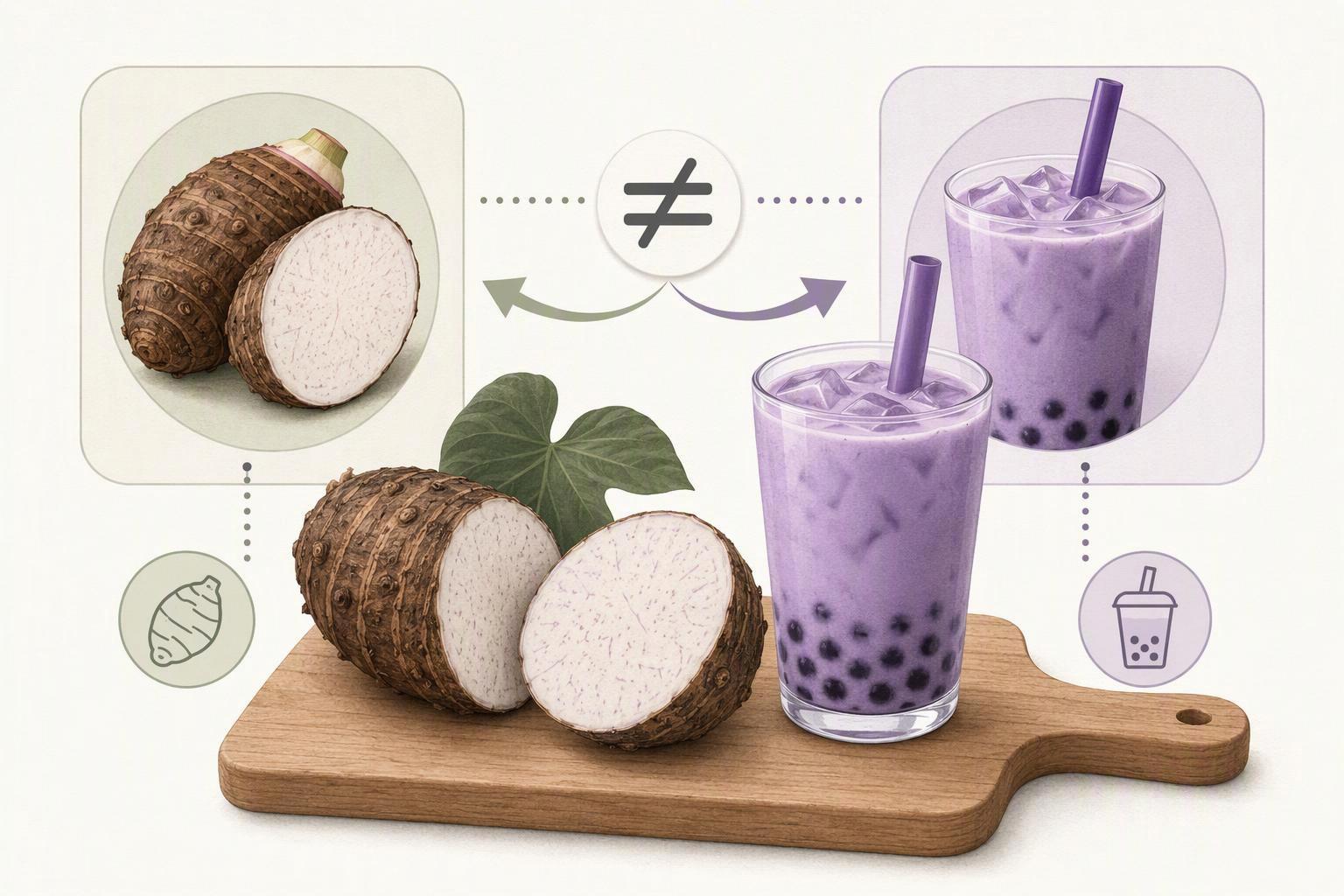
The vivid purple in most shop cups is added color, not taro. The ingredient list on a commercial taro powder puts non-dairy creamer first, then sugar, glucose, taro powder, taro flavor, and finally FD&C Red #40, Blue #1 and Red #3 (Bossen, current product page). Taro appears fourth by weight, and the purple comes from dyes at the end of the list.
Real taro does carry its own pigment, just far less of it. Total anthocyanin across 30 taro genotypes ranged from 0.50 to 0.86 mg per 100 g dry weight (Frontiers in Nutrition, 2025), a measurement taken across a field trial of 30 varieties. That is a trace compared with what a dye delivers, and it explains why a fresh corm mash looks grey-lavender rather than neon.
Purple-fleshed landraces do exist, including a ‘Purple taro’ grown in Guangdong and a ‘Jiangyan purple taro’ in Jiangsu, and anthocyanins are among taro’s bioactive compounds (Food Science & Biotechnology review, 2025). A home cook working from a purple variety gets a muted, natural color. A cook working from white corm gets beige, and that is the honest result.
Is Taro Milk Tea Caffeinated?
Whether your cup carries caffeine depends entirely on the base. The USDA nutrient record for raw taro lists no caffeine value (USDA FoodData Central, SR Legacy release), so any caffeine in your cup comes from tea. A taro milk drink built on milk or a creamer base carries none.
Tea caffeine is a range, not a number. Mayo Clinic’s beverage table gives about 48 mg per 8 oz cup of brewed black tea and 29 mg for brewed green tea (Mayo Clinic, reviewed 2024). Bigelow’s tea education table widens that to 30 to 60 mg for black and 25 to 50 mg for green per 8 oz cup, with herbal tea at 0 mg (Bigelow Tea, current).
A 16-ounce drink doubles those figures, so a black tea base lands near 96 mg and a green tea base near 58 mg. Oolong sits between black and green in processing and flavor, and its measured dry-leaf caffeine varied so widely across samples, 10.96 to 39.71 mg per gram, that no reliable per-cup figure exists (Food Science & Nutrition, 2016). Steep time also matters: a three-minute steep extracts well below the maximum a long steep pulls out.
How to Order Taro Milk Tea at a Boba Shop
At the counter, say the drink name, then set the base, sweetness and ice in that order. The current US menu at Gong cha calls it Taro Milk Tea with Pearls, described as a taro plant milk tea with tapioca pearls (Gong cha USA, live menu), so expect a plant-milk build rather than dairy unless the shop says otherwise.
- Name the drink and the size. “A 16-ounce taro milk tea with pearls.”
- Ask what the taro base is. Powder mix, fresh taro, or a pre-made paste. The answer tells you whether the drink is pre-sweetened.
- Set sweetness against that answer. Sweetness runs from 0 to 100 percent in steps of 30 at most chains, including Gong cha, whose levels are 0, 30, 50, 70 and 100 percent (Gong cha customization guide, current). If the mix is already sweetened, order 30 or 50 percent rather than 100.
- Choose ice. No ice, less ice, standard or extra. Less ice keeps the drink from diluting as it sits.
- Pick your topping. Tapioca pearls are the default; crystal boba, a jelly-like topping, adds texture without the starch.
Pro Tip: Ask whether the taro mix is pre-sweetened before you set sweetness. A pre-sweetened powder at 100 percent doubles the sugar you taste.
Your checkpoint: the first sip should taste of taro before it tastes of sugar. If it does not, the sweetness level was set too high for that shop’s mix.
Taro Powder or Fresh Taro: Which Should You Use at Home?
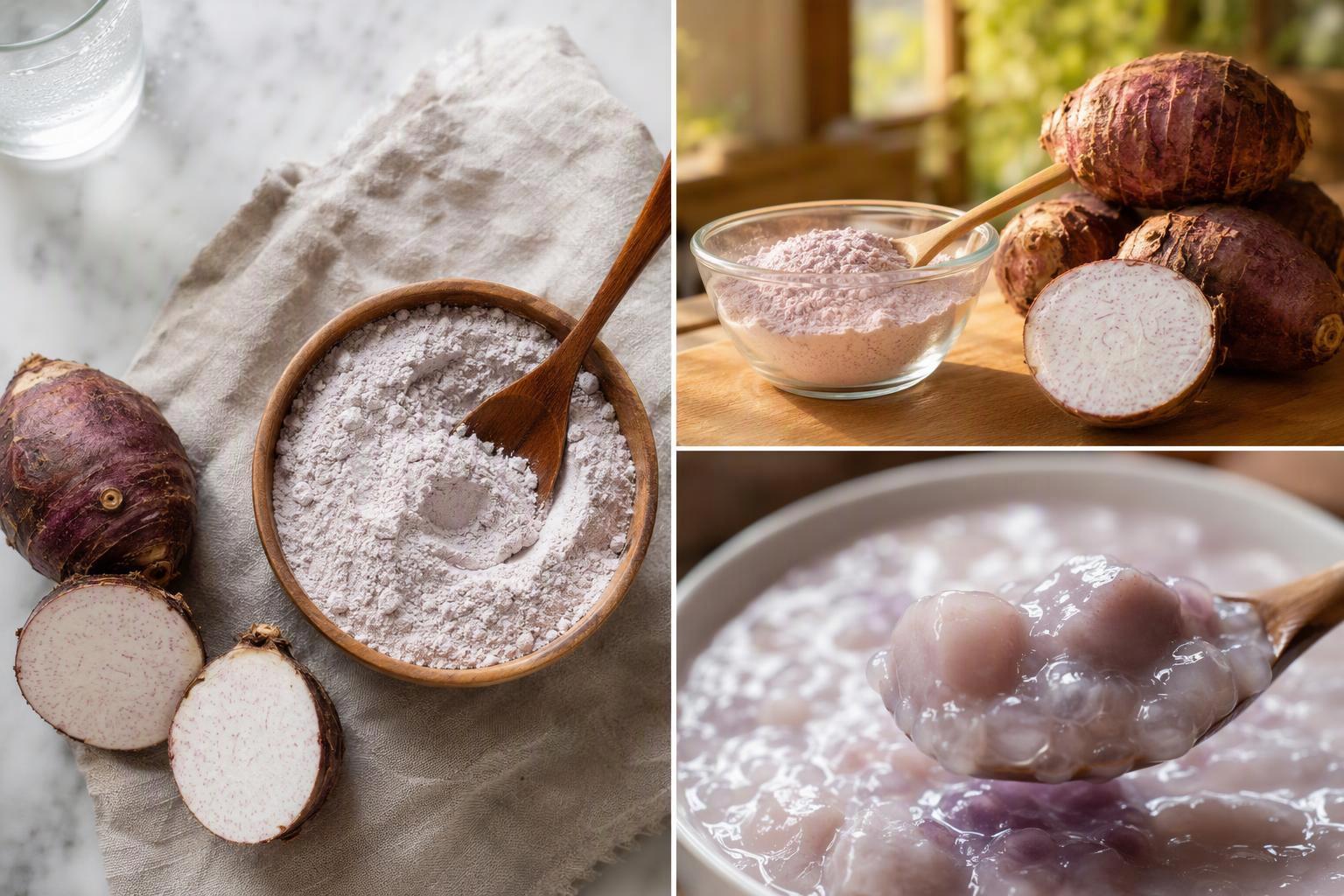
Choose powder for consistency and speed, fresh taro for a rounder, earthier flavor and a color you made yourself. Neither wins outright, and the trade-off is real.
Powder is a formulated product. The ingredient list on a commercial taro powder leads with non-dairy creamer, then sugar and glucose, before taro powder and taro flavor appear (Bossen, current). You are buying creaminess and sweetness as much as taro, which is why powder drinks taste uniform and why you cannot dial the sugar to zero without changing the texture.
Fresh taro demands cooking, and the safety rule is absolute. Hawaiʻi’s extension service is blunt about it: all parts of the plant must be cooked prior to eating because of the acridity associated with a compound on the calcium oxalate crystals it contains (University of Hawaiʻi CTAHR, VC-5). Those are needle-shaped crystals bundled in the plant’s cells (PMC9440338, 2022), and raw taro delivers an itchy, numbing irritation.
Boiling pulls oxalate into the water and rapidly removes the corm’s irritation, while baking instead raises total oxalate by concentrating it through water loss (Taro Roots review, 2023). Boil or steam, do not bake, if you are working from a fresh corm.
How to Make Taro Milk Tea with Powder, Step by Step
Follow the ratio printed on commercial taro powder packaging and you get a taro drink made with taro powder mix, non-dairy creamer, hot water and fructose (Bossen, current recipe card). The hot water is not optional; it is what dissolves the starch.
- Boil the pearls first. Bring water to a boil at a ratio of at least 6 parts water to 1 part pearls, add the pearls and cook 20 to 25 minutes at medium-low.
- Rest them covered. Turn off the heat and let the pearls sit covered another 20 to 25 minutes, per the pearl maker’s own cook-and-hold sheet (US Boba Co., TAP001-A spec).
- Sweeten and hold. Drain, rinse, and soak the pearls in syrup. Shops write the syrup strength into a measured SOP and hold pearls at room temperature for no more than 4 hours (BubblePhil, commercial method).
- Whisk the powder into hot water. Combine the 36 g powder and 20 g creamer with the 150 ml hot water and whisk until no dry pockets remain.
- Add fructose and milk, then ice. Stir in the 30 ml fructose, top with milk to your 16-ounce line, and add ice last.
- Combine and serve. Add the drained pearls to the cup, pour the drink over them, and stir once before drinking.
Your checkpoint: tilt the cup. The drink should run thick and leave a faint coat on the side. If it looks like milk with a tint, you used too much liquid for the powder.
How to Make It from Fresh Taro, and How to Cook Taro Safely
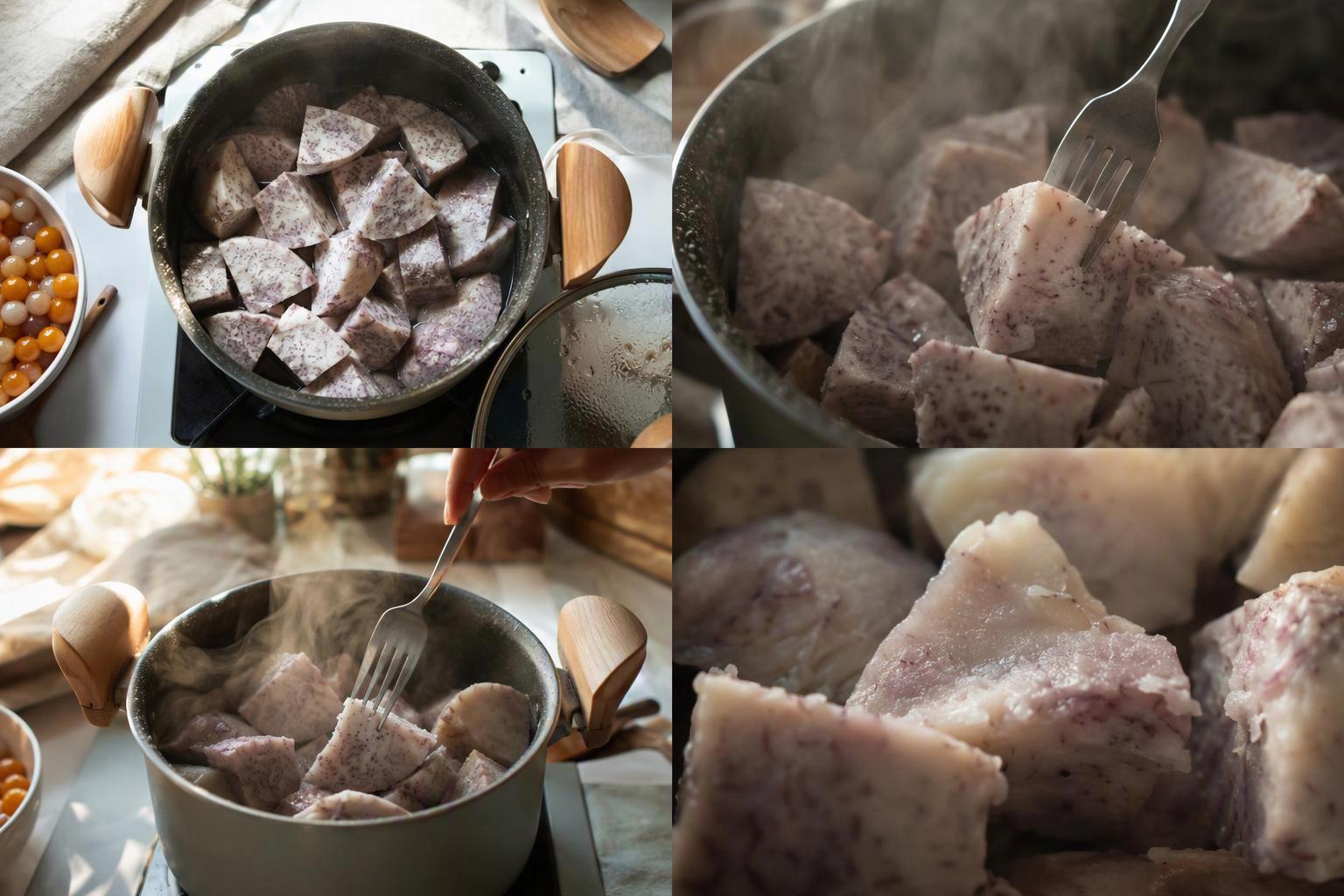
Working from a corm instead, peel and boil or steam it until a fork slides through with no resistance at the center, then mash it while warm. Wear gloves while peeling: the acridity that makes raw taro irritating to eat can also irritate skin, so treat gloves as a practical precaution rather than a rule from a food authority.
The doneness test matters more than a timer. Neither the Hawaiʻi crop sheet nor the 2023 review gives a corm cooking time beyond “a prolonged cooking time is needed” (Taro Roots review, 2023), so judge by texture. A chalky center means keep going; a fork-tender corm with no resistance is done.
What cooking changes is the crystal presentation, not the oxalate count. Steaming taro at 100 °C for 30 minutes shortened the needle-like crystals by about 20%, and 120 minutes cut their length from roughly 50 µm to about 10 µm while total calcium oxalate stayed statistically unchanged (Foods, 2024). Cooking longer does not remove the oxalate; it blunts the irritant.
The acridity itself is most likely due to an allergen protein associating with the raphides, and it is lost with cooking even though the crystals remain intact (PMC9440338, 2022). That is why heat works and why raw taro does not.
- Peel and cube the corm into even 1-inch pieces so they cook at the same rate.
- Boil or steam until fork-tender, testing the thickest piece.
- Mash while warm with a splash of the cooking liquid or milk until smooth.
- Sweeten to taste, then loosen with milk to a pourable consistency.
- Build the drink over ice with brewed tea if you want the caffeinated version, and add cooked pearls.
Your checkpoint: the mash should taste sweet and nutty with no itch or tingle on the tongue. Any numbness means it needs more cooking.
Common Mistakes to Avoid
Adding powder straight to cold milk. The starch clumps and you get the chalky drink you were trying to avoid. Fix: whisk the powder into the hot water first, then add the cold components, as in step 4 of the powder method.
Serving pearls cold or holding them overnight. Tapioca starch firms up when it gets cold (Food Network, tapioca pearls guide), and the pearl maker’s sheet advises against overnight storage and reheating (US Boba Co., TAP001-A spec). Fix: cook them close to serving time and hold at room temperature.
Ordering full sugar on a pre-sweetened mix. The ingredient list on a commercial taro powder puts sugar and glucose ahead of the taro itself (Bossen, current), so 100 percent sweetness stacks sugar on sugar. Fix: ask first, then order 30 or 50 percent.
Baking fresh taro instead of boiling it. Baking concentrates oxalate through water loss (Taro Roots review, 2023). Fix: boil or steam.
Under-cooking the corm. A chalky center means the acridity has not been dealt with. Fix: return it to the pot and test again with a fork.
What Success Looks Like
A successful taro milk tea tastes of taro first and sugar second. The body is thick enough to coat the back of a spoon, the color is either an honest grey-lavender from fresh corm or a deliberate purple from a mix you chose, and the pearls are soft through the center with a slight chew at the edge.
The stretch goal is control. You should be able to say why the drink tastes the way it does: this much powder, this sweetness level, this base. Once you can name the variables, you can move any of them on purpose instead of guessing.
If you buy taro powder in bulk rather than by the single bag, BubbleTeaSuppliers stocks taro powder among its boba supplies, which is worth a look once you know your preferred ratio.
Frequently Asked Questions
How long does taro milk tea with boba keep?
Drink it the day you make it. Cooked tapioca pearls have a short shelf life and should be served immediately or within one day (Food Network, tapioca pearls guide), and the pearl maker’s sheet advises against overnight storage and reheating (US Boba Co., TAP001-A spec). Keep the drink refrigerated and add pearls only when you serve.
Can I make taro milk tea dairy-free?
Yes, and a shop version may already be. Gong cha’s US menu describes its taro drink as a taro plant milk tea with tapioca pearls (Gong cha USA, live menu). At home, swap the dairy milk for oat, soy or coconut milk. Note that commercial taro powders often lead with non-dairy creamer, which is itself dairy-free but adds sweetness and body.
Is taro milk tea caffeine-free?
Only if there is no tea in it. Raw taro contains no caffeine in the USDA nutrient record (USDA FoodData Central, SR Legacy release), so a taro milk drink built on milk is caffeine-free. A taro milk tea built on black tea carries roughly 96 mg per 16 ounces, calculated from Mayo Clinic’s 48 mg per 8 oz figure (Mayo Clinic, reviewed 2024).
How do I fix a chalky taro milk tea?
Chalkiness comes from powder that never fully dissolved. Warm the drink gently and whisk, or pour it back into a blender for a few seconds. Next time, whisk the powder into hot water before any cold liquid goes in, which is the order the commercial recipe card uses (Bossen, current recipe card).
Why does my fresh taro drink taste bitter or make my mouth tingle?
The corm is under-cooked. Acridity is lost with cooking even though the calcium oxalate crystals remain (PMC9440338, 2022), so return the taro to the pot and cook until a fork slides through with no resistance at the center.
A good taro milk tea comes down to three decisions you can name: the base, the sweetness, and how the taro gets into the cup. Order it by asking what the mix is, then setting sweetness against that answer. Make it by whisking powder into hot water before anything cold, or by boiling a fresh corm until a fork slides through cleanly and mashing it warm.
The mistakes are predictable, which is good news. Chalky means clumped powder. Watery means too much liquid for the starch. Too sweet means a pre-sweetened mix ordered at full sugar. Cold, hard pearls mean they were cooked too early or chilled.
Start with the powder method once to learn the ratio, then try a fresh corm when you want the earthier version. Either way, you end up with a drink whose flavor you chose rather than one you have to describe as “chalky.”