


Dairy-free demand is real and growing, but the coconut version of your best-selling milk tea is the drink that splits halfway down the cup, tastes thin next to dairy, and comes out different on every shift. Coconut milk tea is brewed tea plus a coconut-milk base, served hot or iced, with or without tapioca pearls. Plant-based milk is a USD 22.7 billion market growing about 6.7% a year toward USD 37.9 billion by 2033, according to a vendor estimate from Grand View Research, and coconut milk is a listed segment in that report with no published size of its own (Grand View Research, base year 2025). So the demand is documented; the repeatable batch is not.
This guide is for the operator, not the home cook. It covers how to make coconut milk tea at scale: which coconut base to order, the ratio to build a 5 L batch around, why the drink separates and how to stop it, how to hold tea and boba across a service day without breaking food-safety rules, what a cup costs you, and what you can legally print on the menu. The outcome is a batch you can hold across a service day and hand to a two-person bar during the afternoon rush without the drink changing character between open and close.
Which coconut base should a bubble tea shop use — barista carton, canned, or powder?
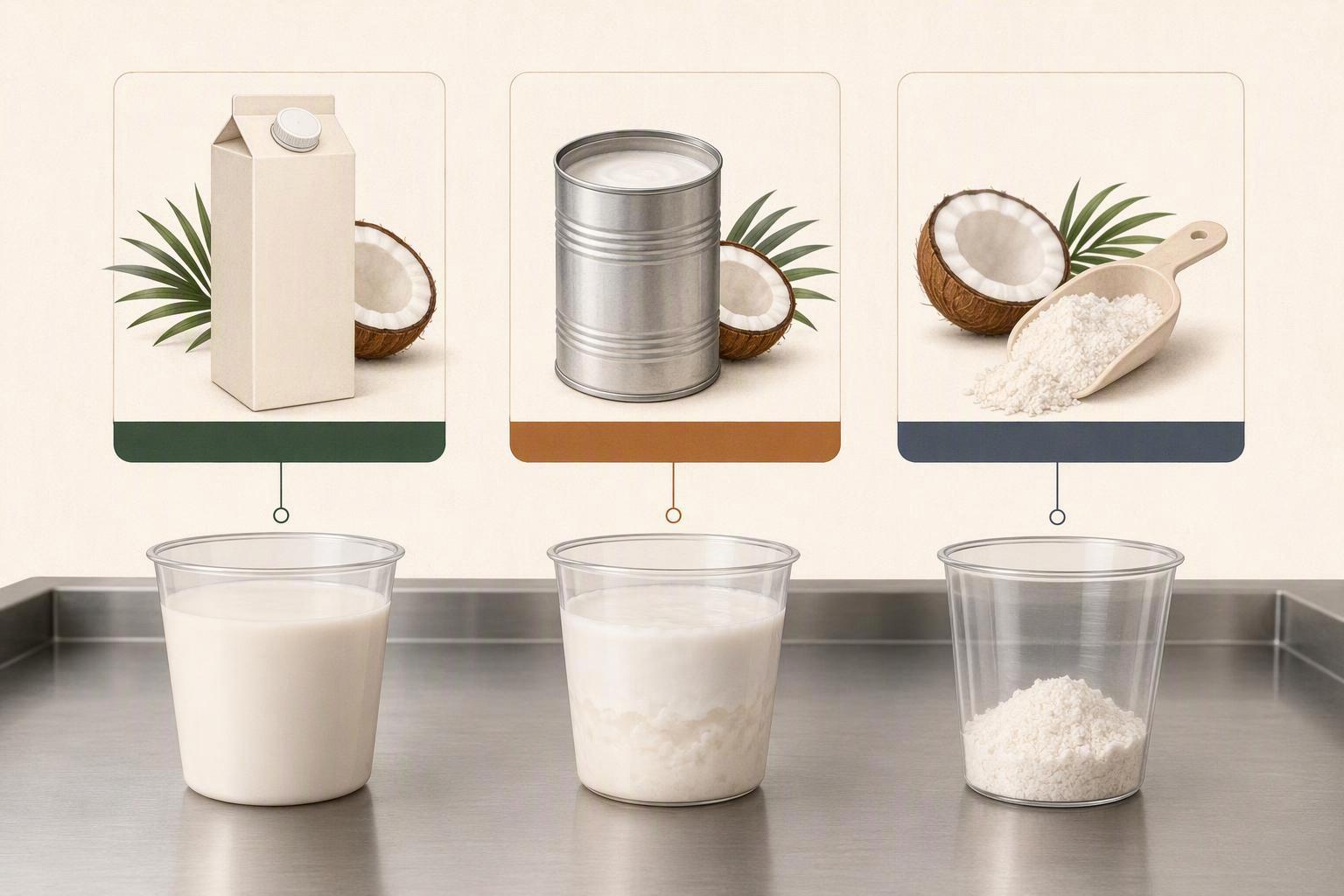
The barista carton is the base to start with, because it is formulated to stay dispersed, and the other two formats are not. Coconut milk is an oil-in-water emulsion, and heat, tea tannins and acidity all destabilise it: tea polyphenols bind milk proteins, which is why the emulsion can break, and milk proteins form conjugates with larger tea polyphenols that aggregate and cream (Piyasena et al., 2025, and protein-polyphenol complex review, 2021). Both papers work in model systems, not foodservice trials, so treat the mechanism as the reason to test rather than a guarantee of behaviour in your cup.
A barista-format carton resists that by carrying an emulsifier and stabiliser system, typically gums such as guar, xanthan or gellan, plus lecithin, mono- and diglycerides or dipotassium phosphate. Gellan gum and similar stabilisers are permitted direct food additives under 21 CFR Part 172, but the regulation tells you what is allowed in food, not what is in the carton in front of you: read the actual label before you commit a menu item to it.
Canned coconut milk is the least stable of the three, because it is essentially coconut fat and water with no stabiliser holding them together, and it will separate in the can before you even open it. Powder mixes back into water on demand and holds well, but the mouthfeel is thinner and the flavour reads flatter than a carton. For the best coconut milk for milk tea, the practical test is a same-day side-by-side: build three identical 16 oz cups, one per format, and check them at open and again four hours later. The format that still looks uniform at hour four is the one your bar can actually hold.
What is the scaled recipe and ratio for coconut milk tea in a shop?
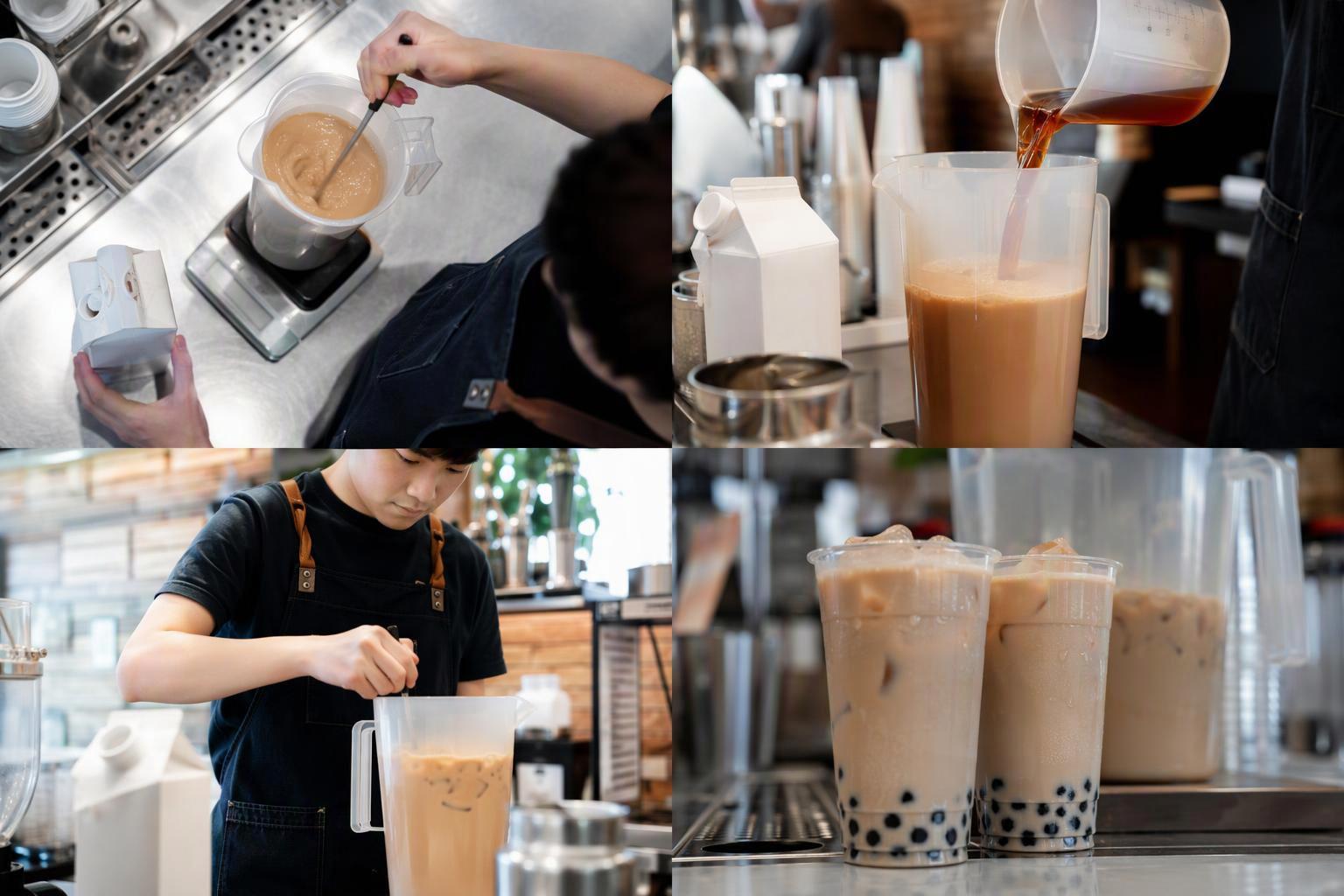
Build the batch around a fixed ratio and weigh it, because a recipe that lives in a barista’s head is the reason every shift tastes different. The starting point below is a shop’s own working ratio, not a researched standard, so treat it as a place to begin testing rather than a number to trust.
| Component | Per 16 oz cup | Per 2 L batch | Per 5 L batch |
|---|---|---|---|
| Brewed tea (strong, cooled) | 6 oz | 750 mL | 1,875 mL |
| Barista coconut base | 4 oz | 500 mL | 1,250 mL |
| Sweetener (syrup or sugar) | 1 to 1.5 oz | 125 to 190 mL | 315 to 470 mL |
| Ice or water to volume | 4 to 5 oz | remainder | remainder |
Brew the tea strong, because the coconut base and the ice both dilute it, and cool it fully before it meets the coconut base. A 5 L batch built this way is roughly 10 to 11 sixteen-ounce cups, which is a sensible first test size for a two-person bar: big enough to see how it holds, small enough to pour out if it fails.
The coconut milk tea recipe is only half the problem. The other half is knowing what the cup costs, and no verified per-serving dollar figure exists for barista coconut milk, dairy milk or milk-tea powder, so the method matters more than a number. Add up everything that goes into one cup: coconut base, tea, sweetener, pearls, cup, lid, straw, and the labour minutes to build it. Divide that fully loaded cup cost by (1 minus your target gross margin). The 75 to 80% gross-margin target that circulates in the industry is a rule of thumb with no audited source behind it, so set your own and check it against your invoices rather than a calculator page.
Why does coconut milk tea separate, and how do you prevent it?
Separation is a temperature and order-of-addition problem, and every fix below is a control you can write into the shift card. The mechanism is the one already established: heat, tea polyphenols and acidity each push the emulsion apart, so the fixes are about keeping those three in check during assembly.
Cool the tea before it meets the coconut base. Adding hot tea to a cold carton shocks the emulsion and starts the fat separating immediately, so brew, cool, then combine. Add the coconut base to the tea, not the tea to the coconut base, so the stabiliser system is already dispersed when the polyphenols arrive. Never hard-boil the mixture after combining; hold it warm if you must, but keep it below a simmer.
Keep acid out of the base. Citrus, fruit purées and acidic syrups belong at assembly, in the cup, not in the batch pitcher, because acid lowers the pH that the emulsion is balanced around. Finally, stir-test before service: pull a sample, let it sit ten minutes, and look for an oily ring or a clear layer at the top. If you see either, the batch is already going and no amount of stirring at the counter will bring it back.
Callout: the three causes of separation
- Heat: cool the tea fully before combining, and never hard-boil the mix.
- Tea polyphenols: add the coconut base to the tea, and brew to a consistent strength.
- Acidity: keep citrus and fruit purées out of the batch and add them at assembly.
How do you hold, chill, and time boba and brewed tea across a service day?
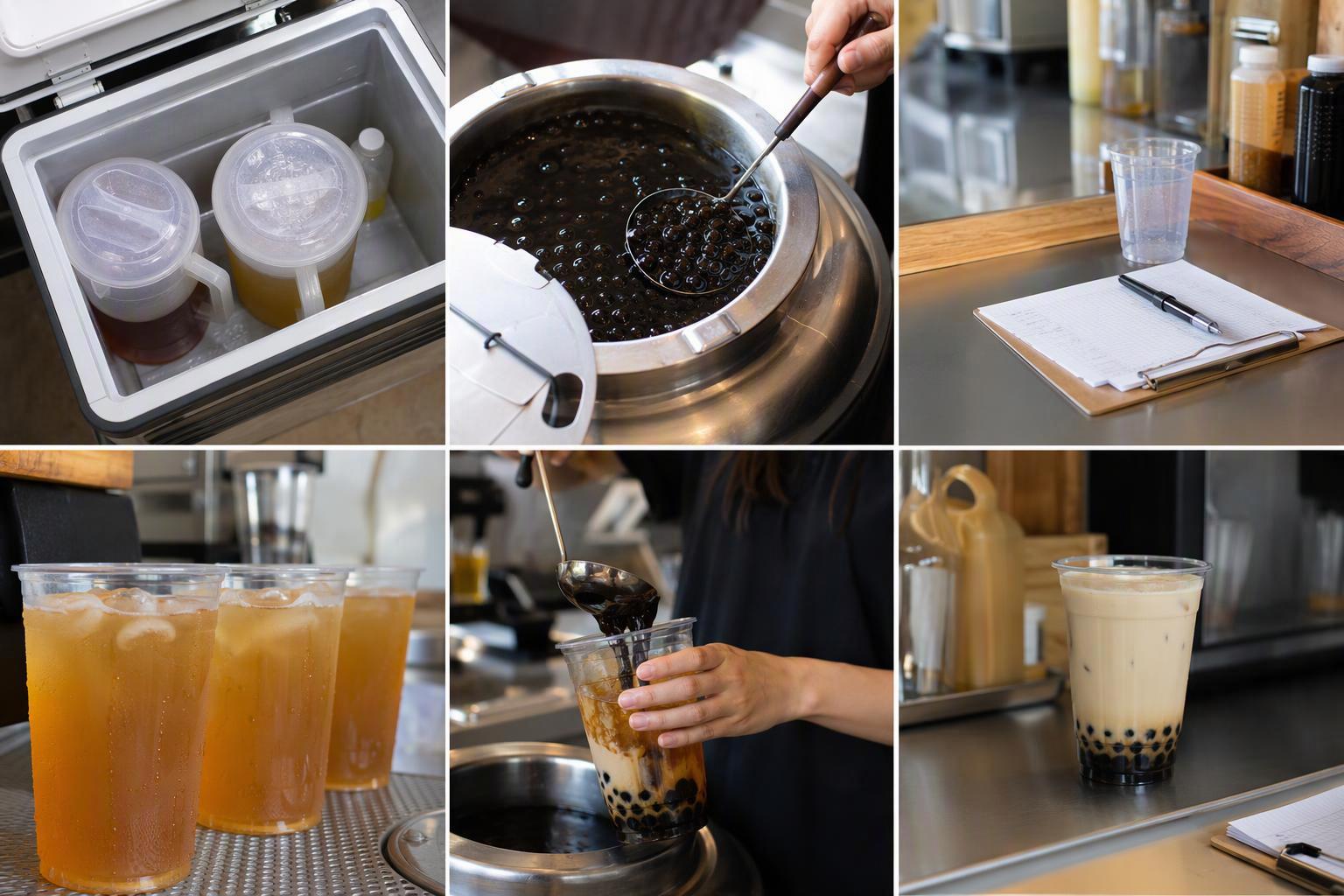
Hold cold tea at 41 °F or below and hot tea at 135 °F or above, because that is the FDA Food Code’s cold-holding limit and its hot-holding counterpart, and it is the rule your local inspector is working from (FDA Food Code 2026, § 3-501.16). The Food Code is a model code adopted by states, not directly binding federal law, so confirm the version your state has adopted before you write a procedure around it.
Anything you prepare and hold more than 24 hours gets date marked, with the day of preparation counted as Day 1 and a seven-day maximum under the 7-day date-marking rule (§ 3-501.17). When you combine ingredients, the container keeps the earliest preparation date, so a pitcher of tea topped up with fresh brew still carries the old date. If you cool a batch, work inside the 3-501.14 cooling window: 135 °F down to 70 °F within two hours, and to 41 °F or below within six hours total (§ 3-501.14).
For a pitcher that sits on the counter through a rush, the time-as-control route for a working supply on the counter lets you hold without temperature control under a written procedure with time marking, with a four-hour maximum in the adopting state codes and a six-hour cold option (§ 3-501.19). A sealed, engineered dispensing unit can instead rely on the provision a sealed dispensing unit relies on, which permits homogeneous liquid held outside temperature control in specially designed equipment (§ 3-501.16(C)). The 2026 edition changed cooling methods, not these limits.
Tapioca pearls are the part with no rule to lean on. No FDA, USDA or peer-reviewed source states a texture window, so the two-to-four-hour figure you see in shop blogs is shop policy, not regulation. Write your own pearl window, hold the pearls as a TCS food under the code, and mark the discard time on the warmer.
What does coconut milk tea cost per serving, and how should a shop price it?
Price from your own invoices, because the market data tells you the category is growing, not what your cup costs. US bubble tea is a USD 511 million market growing near 10% a year toward USD 857 million by 2031, per a vendor estimate from Mordor Intelligence, and that same vendor puts milk-based formulations at 78.48% of US bubble tea share in 2025 with the plant-based segment growing at 11.67% a year through 2031 (Mordor Intelligence, base year 2026). Those two splits come from Mordor alone, so name the vendor if you quote them.
The practical read is that plant-based is the growth side of a market that is still overwhelmingly milk-based, which means a coconut version is a menu addition, not a replacement, and it should carry its own price. No verified per-serving dollar figure exists for barista coconut milk, dairy milk or milk-tea powder, so the only honest number is the one you build from your own costs.
| Input | Cost per unit | Units per cup | Cost per cup |
|---|---|---|---|
| Barista coconut base | |||
| Brewed tea | |||
| Sweetener | |||
| Tapioca pearls | |||
| Cup, lid, straw | |||
| Labour (minutes) | |||
| Fully loaded cup cost | |||
| Price at target margin |
Fill the middle column from your invoices, total the fully loaded cup cost, then divide by (1 minus your target gross margin) to get the price. Run the same worksheet for your dairy milk tea and your powder version, and the three numbers side by side tell you whether the coconut drink can carry its own line on the menu or needs to be priced as a premium.
Is coconut milk tea healthier, and what can a shop legally claim?
Coconut milk tea is not automatically healthier, and the claim you can make depends on the specific product and the specific wording, not on the category. Start with sugar: the FDA counts lactose as total sugars, not added sugars, so the milk itself does not add to the added-sugar line, while every pump of syrup you put in does (21 CFR 101.9). Added sugars are the sugars added during processing or packaged as such, including syrups and honey.
Fat claims have hard thresholds. The FDA’s threshold for a “low fat” claim is 3 g or less of fat per reference amount, “fat free” is under 0.5 g, “reduced fat” is at least 25% less than the reference food, and “low saturated fat” is 1 g or less and no more than 15% of calories from saturated fat (21 CFR 101.62). The rule for calling a drink a “good source of” protein is 10 to 19% of the daily value, and “high” is 20% or more (21 CFR Part 101 Subpart D).
To know whether your drink clears any of those bars, pull the per-100 g values by name from per the USDA’s FoodData Central values for unsweetened coconut milk and for brewed tea, then rebuild the numbers for your actual recipe (USDA FoodData Central). A sweetened coconut beverage or a syrup changes the added-sugar line, so check the product you actually buy.
The naming question is unresolved. The standard of identity that defines what may be called milk sits in 21 CFR Part 131, and nonstandardized foods must carry a common or usual name under 21 CFR 102.5, but FDA has not settled whether a dairy-free drink may be called milk tea. Menus are not labels, so the claim rules above govern labeling rather than your menu board, and the safe move is a descriptive menu name plus a clear allergen and ingredient note.
Common mistakes that ruin a batch
The batch failures cluster around four habits, and each one has a fix you can put on the shift card. The first is combining hot tea with cold coconut base, which starts separation before the drink is even built; cool the tea first. The second is eyeballing the ratio instead of weighing it, which is the direct cause of a drink that tastes different on every shift.
The third is holding the pitcher on the counter with no time mark. A working supply can sit out under the time-as-control route, but only with a written procedure and a marked discard time (§ 3-501.19); an unmarked pitcher is the thing an inspector writes up. The fourth is topping up an old pitcher with fresh brew, which does not reset the clock: combined ingredients keep the earliest preparation date under the date-marking rule (§ 3-501.17).
Callout: the four batch-killers
- Hot tea into cold coconut base: cool the tea first.
- Eyeballed ratios: weigh every batch.
- Unmarked counter pitcher: write the procedure and mark the discard time.
- Topping up an old pitcher: the earliest date still governs.
What success looks like, and how to verify it
Success is a batch that looks the same at close as it did at open, and you verify it with three checks rather than a feeling. The first is a visual check: pull a sample at open and again four hours later, and look for an oily ring or a clear layer. If neither appears, the emulsion held through the window you actually need.
The second is a temperature and time check against the code. Log the cold-hold temperature against the 41 °F limit and the hot-hold temperature against 135 °F (§ 3-501.16), and confirm every container carries a date with Day 1 counted as the day of preparation (§ 3-501.17). If you use time as control, the written procedure and the marked discard time are the evidence.
The third is a cost check: rebuild the worksheet from the invoices you actually paid this month, and confirm the price still clears your target margin. A drink that holds, passes the code check and clears its margin is a menu item. A drink that only passes two of the three is a test batch, and the fix is in whichever check failed.
Callout: the three verification checks
- Visual: no oily ring or clear layer at open and at hour four.
- Code: cold hold at 41 °F or below, hot hold at 135 °F or above, every container date marked.
- Cost: worksheet rebuilt from this month’s invoices still clears the target margin.
A repeatable coconut milk tea comes down to four decisions you make once and then hold: a barista carton as the base, a weighed ratio built around a 5 L batch, a cooled-tea assembly order that keeps the emulsion intact, and a holding procedure written to the Food Code’s 41 °F cold-hold, 135 °F hot-hold and seven-day date-marking rules. None of those requires new equipment, and none of them depends on a number no one can verify.
The parts the evidence does not cover are worth naming plainly. There is no verified per-serving cost for any of the three bases, so the pricing worksheet is yours to fill from your own invoices. There is no FDA, USDA or peer-reviewed texture window for tapioca pearls, so the pearl hold time is your shop policy, written down and marked. And FDA has not settled whether a dairy-free drink may be called milk tea, so keep the menu name descriptive and the ingredient note clear.
The next step is one batch, not a menu launch. Build 5 L on the ratio above, check it at open and again four hours later, log the temperatures and the date, and hand a cup to two staff members and two regulars. If it holds, tastes right and clears your margin, you have a menu item. If it does not, you have lost one batch and learned exactly which of the four decisions needs changing.