


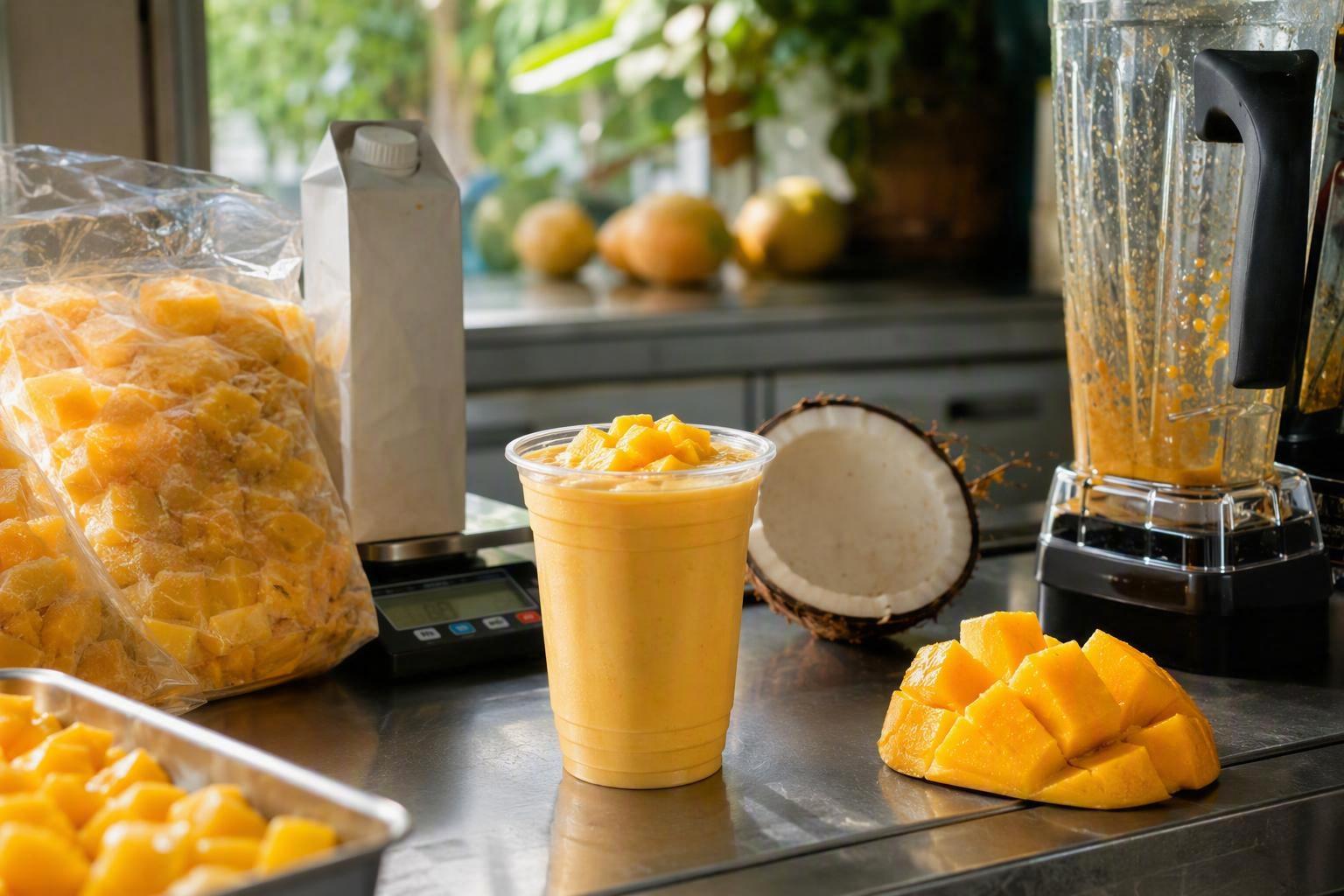
Most drink shops already run a tight shaken-tea line: a shaker, a sealed cup, a rhythm the team can hit without thinking. A blender drink breaks that rhythm. Get the spec wrong and you get a mango coconut smoothie that separates by the second hour, a batch nobody can reproduce on a busy Saturday, and a menu line that quietly eats labor without paying for it.
This guide walks through how to make a mango coconut smoothie as a menu item rather than a home recipe. You’ll finish with a costed, repeatable batch spec for a 16 oz serve: mango format locked, base liquid built, ratio and texture dialed in, prep and build-to-order workflow set, price and hold window decided. Each step ends with a checkpoint you can verify before moving on.
Prerequisites: What You Need Before You Blend
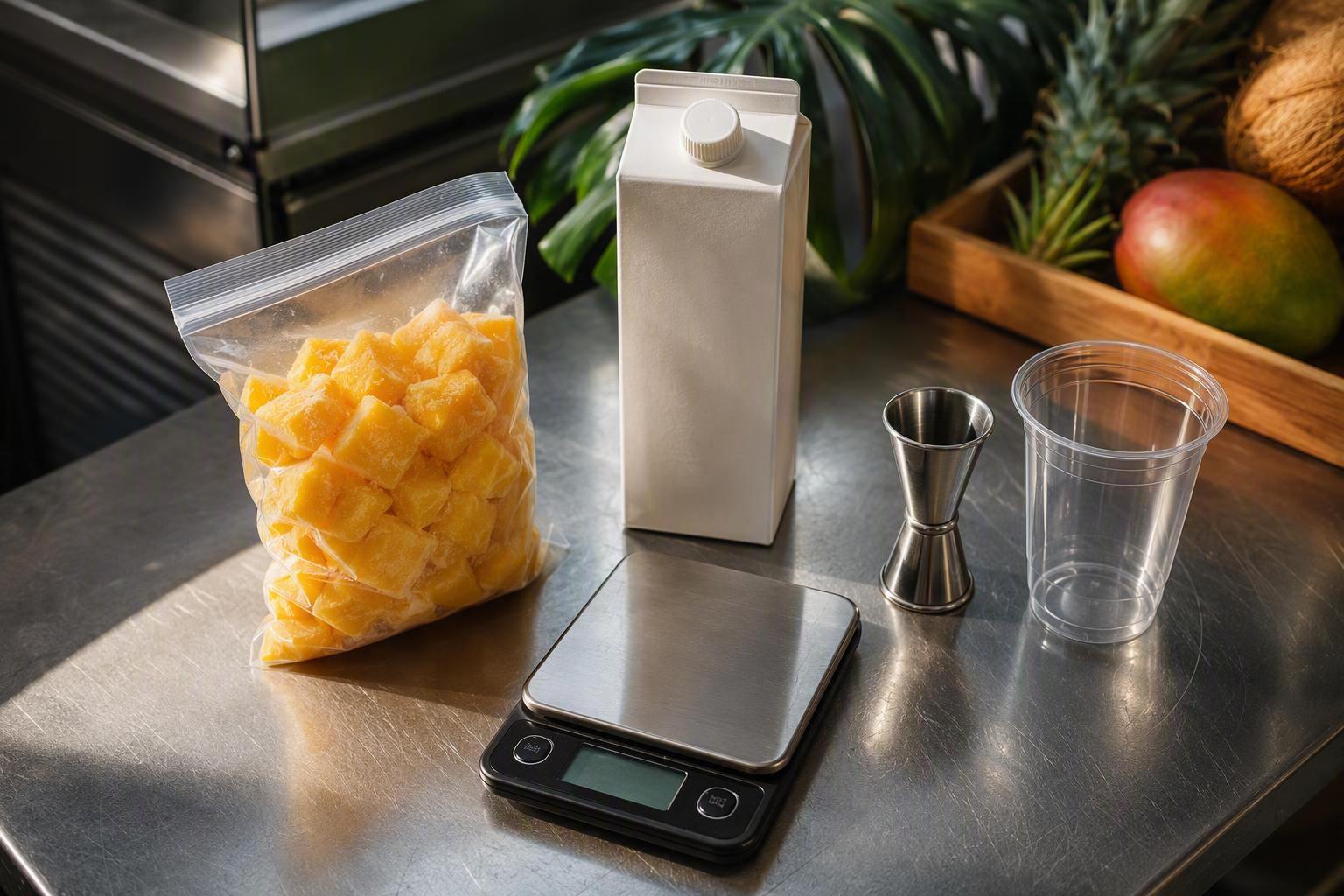
Testing a mango coconut smoothie on your menu takes less new equipment than most operators expect. If your shop already runs a blender station, a freezer, and a scale, you are close. Here is what to have in place before the first batch.
Equipment and space
- Blender capacity. Busy shops typically run 2 to 3 commercial blenders, with the observed range running 2 to 6, according to equipment guides aggregated by Wilprep (retrieved 2026-04-29). Treat that as directional, not a target: one spare unit covers a test batch.
- Freezer space. Frozen mango is stored at or below −18°C with roughly a 24-month shelf life, the spec IQF mango suppliers such as Sinofrost assume (retrieved 2026-04-29). Confirm you have a shelf or bin that holds a bulk carton.
- Cold-holding. Any prepped mixture you hold must stay at 41°F / 5°C or below, the baseline in Bubble Tea Suppliers’ shop SOP (retrieved 2026-04-29). Every later step inherits this line.
Formats to decide
- Mango: frozen IQF, fresh, or purée.
- Coconut: full-fat canned milk, carton coconut milk, or coconut cream.
Station kit
- 16 oz cups, lids, straws
- Digital scale and jigger or portion pump
- POS item created so the test can be rung up
Assumed knowledge: comfortable with batch prep and portion control. Time to first test batch: about 45 minutes. Difficulty: beginner to intermediate.
Step 1: Choose Your Mango Format and Lock the Spec
By the end of this step you’ll have a written mango spec you can hand a supplier, and a mango coconut smoothie that tastes the same in March as it did in July.
| Format | Cost | Consistency | Labor | Freezer footprint | Waste |
|---|---|---|---|---|---|
| Frozen IQF | Lowest per usable ounce | High, if the spec is tight | None beyond opening a carton | Moderate, sealed cartons | Low |
| Fresh whole or pre-cut | Highest, and volatile | Low | Peeling, dicing, daily | High, short shelf life | High |
| Aseptic puree | Mid to high | Highest | None | Low, ambient until opened | Low once opened |
For a repeatable menu line, frozen IQF is the recommendation: it removes prep labor and holds portion cost steady, which matters more than shaving cents off a case.
Lock the spec sheet fields that actually matter: cut format and piece size, Brix range, bulk cartons with PE liners, storage at −18 °C, and roughly a 24-month shelf life (IQF mango product specification, undated). Write the buying risks into the same document: lot-to-lot sweetness drift is the real buying risk, because ripeness, cut tolerance, clumping or glazing from poor individual freezing, and thaw stability all vary between lots (IQF mango product specification, undated).
Price is where shops get pulled off spec. What US shops actually pay for frozen mango imports ranged from $0.50 to $2.80 per kilogram across 2026 sampled weeks (Tridge frozen mango market overview, page updated 2026-09-17; import sampling, not retail or contract price). USDA terminal quotes moved in a similarly wide band, from $16.00 per flat for Mexico Keitt 8s in Chicago to $165.00 per 50 lb carton for Brazil Tommy Atkins 6s (USDA AMS terminal market report, current cycle; the PDF could not be re-read, so treat these as directional). That spread is the argument for a fixed spec plus a fixed supplier rather than chasing the cheapest lot each order.
Verify it: pull one piece from a new lot, taste it, and note the sweetness against your last lot before the carton goes into rotation.
Step 2: Build and Cost the Base Liquid
By the end of this step you have a costed base liquid you can batch ahead and hold at 41°F. Coconut milk, coconut water, and coconut cream differ on body, fat, and hold behavior. Coconut water is thin and separates against ice; coconut cream gives the richest mouthfeel but costs the most per ounce and turns heavy when held cold. Coconut milk sits between them: enough fat for a creamy texture, stable chilled, and the most cost-predictable per batch. For a coconut milk smoothie for bubble tea shops, coconut milk is the default base, with coconut water as a cut-in for a lighter build and coconut cream reserved for a dessert-style variant.
Demand backs that choice. In the 52 weeks ending November 30, 2025, coconut milk grew 23% in units and 27% in dollars while the overall US plant-based milk category fell 2% in dollars (GFI, analysis of SPINS, published 2026). That is a category to ride, not a health claim.
One label trap: dairy-free is not automatically vegan. Honey is the most common exclusion, so check your sweetener and syrups before printing “vegan” (The Fit Cookie, 2024). Unsweetened coconut milk is also your lever for a lower-sugar build, since you control the sweetness instead of inheriting it.
Now the cost math. No source publishes a mango-coconut-specific food cost, so treat this as an illustrative worked example and recompute it with your own invoice prices. The standard target is the 20–30% food-cost band: a $6 drink should cost roughly $1.20 to $1.80 in ingredients, and at $1.50 it runs a 75% gross margin (BobaSync, 2026). Keep the prime-cost ceiling in view too: food plus labor should stay under about 60–65% of sales, and drifting toward 75% leaves nothing (BobaSync, 2026).
Key Takeaway: The 20–30% food-cost target and the 60–65% prime-cost ceiling are the two numbers to hold in your head while costing this drink.
Step 3: Dial In the Ratio and the Texture
By the end of this step you have a ratio that produces the same texture on cup one and cup forty.
For a 16 oz shop serve, start with mango at 6 to 8 oz, coconut milk at 4 to 6 oz, and sweetener at 0 to 1 oz equivalent. That lands near the 2:1 mango-to-coconut ratio most recipes settle on, which is the reference point for any mango coconut smoothie recipe you adapt (The Endless Meal
, historical ratio reference). Mango carries body and color; coconut milk carries richness and aroma; sweetener only rounds the finish. Change one lever at a time and taste against your reference batch.
Texture is where a build-to-order line lives or dies. A smoothie that coats the cup and holds its shape photographs well and drinks thick; one with ice shards reads thin and cheap. To slow separation, cut the ice, thicken the cold base, and add a stabilizer such as banana, yogurt, chia, flax, lecithin, or xanthan. Blend liquids first and avoid overblending, which adds heat and aeration (Royal Kitchen Guru, undated).
Verify your result: the smoothie coats the cup with no ice shards, sweetness matches your reference batch, and a 10-minute counter rest shows how fast it separates.
Your smoothie line inherits the same cost structure as the rest of the menu, so texture decisions are also margin decisions. A healthy boba shop runs roughly 65 to 75% gross margin but only 10 to 20% net (BobaSync, 2026).
Step 4: Set Up Batch Prep and the Build-to-Order Workflow
By the end of this step you have a prep sheet and a station layout that hold up at 2 p.m. on a Saturday.
Work the build-to-order pattern most shops already run: batch-prep the coconut base cold and labeled, portion mango into single-serve bags or cups, then blend each cup to order. Keep the base behind the 41°F cold-holding line shops already run, date every container, and put the scale and jigger where staff can reach them without turning around, so nobody free-pours.
Be honest about the ceiling. Blender drinks are labor-bound, one cup at a time, so peak throughput depends on jar cycling and blender count, not on how fast someone scoops. That is also why 20–28% is the boba labor benchmark rather than a restaurant’s 30–35%, with all-in labor adding 10–15% for payroll tax and workers’ comp on top of gross wage.
Verify it: run a timed mock order at peak pace and record seconds per cup and jars cycled.
Supplier choice has real geographic concentration: US frozen mango imports reached 356.4M kg in 2024, and where US frozen mango volume actually comes from is dominated by Canada, Mexico, and Chile. Worth knowing before you commit to a single mango coconut smoothie supplier.
Step 5: Price It, Position It, and Decide the Hold Window
By the end of this step you have three decisions locked: a menu price, a positioning frame, and a hold rule your staff can follow without asking.
Price against two anchors. The first is the band 16 oz drinks already sit in at comparable shops, roughly $6 to $8, a snippet-level observation from menu listings rather than a measured survey, so treat it as directional. The second is the food-cost target from Step 2. A build costing $1.80 per 16 oz serving at a 25% target points to $7.20, inside the band and needing no defense.
Positioning is a menu-calendar decision. Launch before the summer rush, run it as a limited-time line, then decide from sales data whether it earns a permanent slot. Seasonal framing belongs on the calendar, never on purchasing pressure. For mango coconut smoothie menu ideas, the strongest frame is the one your customers already recognize.
Key Takeaway: Six in ten US households bought a plant-based product in 2025, and dairy alternatives reach about 43% of households in the West (PBFA / PBFI 2025 Regional Insights, reported 2026). Use that on the menu board as positioning, not as a health claim.
Name the real risk plainly: menu bloat, not the recipe. The objections operators raise are choice overload, longer waits, staff errors, and storage cost, and no published sales-impact number exists for any of them (Fokus Inc on boba menu strategy, 2026).
The hold rule has no hedge in it. A served smoothie does not hold: guidance converges on immediate service or a brief re-blend, and dairy-containing builds should be served within 24 hours (storage guidance, undated). Blend to order, or hold the base cold and finish at the cup.
Verify it: run a two-week POS test with a sampling sheet at the counter. Track units sold, the hour they sell, and what customers say. That gives you your own evidence instead of a borrowed claim.
Common Mistakes to Avoid
The most common first mistake with a mango coconut smoothie is buying mango on price instead of spec, which produces lot-to-lot sweetness drift that no amount of blending can fix. Check the spec sheet fields that actually matter, including variety, °Brix, and ripeness stage, before you commit to a supplier.
Overblending for smoothness. Running the blender longer to chase a silkier texture adds heat and aeration, and both speed up separation. Fix it by blending to a set time and speed rather than a visual target, and use the texture checks in Step 3 to catch separation early.
Free-pouring instead of portioning. Eyeballing the mango, base, and ice breaks the cost math you built in Step 2, so your margin drifts with every cup. Fix it with a marked pitcher or a scale at the station.
Batching the whole drink instead of the base. A fully built smoothie does not hold, because the blended ice and fruit collapse within minutes. Fix it by batching only the base and building to order, as covered in Step 4.
Adding the line without a menu-bloat decision. Every new item lengthens waits and invites staff errors during a rush. Fix it by cutting or rotating something out before you add the mango coconut smoothie, since menu bloat is the real risk, not the recipe.
Results: What a Working Menu Line Looks Like
If everything went correctly, you now hold six artifacts, not a drink: a written mango spec, a costed base liquid at or under your 20-30% food-cost target, a ratio that reproduces texture across a shift, a prep sheet with a timed seconds-per-cup figure, a menu price inside the band you observed, and a stated hold rule. A working mango coconut smoothie line is one where those numbers exist on paper before the first cup is sold.
Check four metrics against your own measurements. Food cost as a percent of price tells you whether the drink earns its menu slot. Seconds per cup at peak tells you whether one blender station can absorb the order volume without stalling the queue. Jars cycled per hour tells you whether your batch prep keeps pace. Separation time on a 10-minute counter rest tells you whether the build holds long enough to survive a rush, a delivery pickup, or a customer who photographs before sipping.
One stretch goal: build a second flavor on the same base liquid and the same prep sheet. The added menu line then costs almost no new labor, since only the fruit and the finish change.
Frequently Asked Questions
Should a shop use frozen or fresh mango?
Frozen is the safer default. Fresh mango varies in ripeness by delivery, so every batch needs tasting and adjustment, while frozen chunks thaw to a predictable result. Choose fresh only with steady access to ripe fruit and staff who can judge it. The spec sheet fields that actually matter are variety, sugar level, and pack format.
Which coconut product belongs in the base?
Coconut milk carries the body and mouthfeel the drink is sold on. Coconut water thins it into a lighter cup; coconut cream pushes richness but can coat the palate. Most builds land on the 2:1 mango-to-coconut ratio most recipes land on, with coconut milk as the base and coconut cream used sparingly, if at all.
Why does the smoothie separate before the customer finishes it?
Separation is normal: fruit pulp and fat settle out once the drink stops moving. Serve it cold, keep the cup full to reduce surface exposure, and have counter staff swirl the cup before handing it over. For how to keep a smoothie from separating on the counter, a slightly thicker base holds longer than a thin one.
How long can a prepped base be held?
Hold any prepped base at or below the 41°F cold-holding line shops already run, and treat that as the limit rather than a target. Quality falls before safety does, so pull a base that has visibly separated or thinned. No independent test data on mango-coconut base hold times was found, so set your own window by tasting at intervals and logging it.
Is a smoothie line worth the labor?
It depends on your station and volume. Check the new line against why 20–28% is the boba labor benchmark: it is the range shops already plan around, so the line has to fit inside it rather than add to it. If the build takes one person off the bar for more than a few seconds per cup at peak, it costs more than it earns.
How do I price it without a published cost-per-serving figure?
No source publishes a mango-coconut-specific cost per serving, so build your own from invoice prices: mango, coconut, sweetener, cup, lid, and straw. Then apply the 20–30% food-cost target, which sets the price band once your true cost per cup is known. Cost one batch, divide by the cups it yields, and price from that number.
Conclusion
You now have everything needed to put a mango coconut smoothie on the menu: a locked mango spec, a costed base liquid, a tested ratio, a batch prep sheet, a price built from your own invoice numbers, and a hold rule that tells you when to stop serving. The value of that work is not the recipe itself but the two figures you measured while building it, your food cost per 16 oz cup and your seconds per cup at the blender station. Those are the numbers that decide whether the line earns its place on the board.
The next step is a two-week POS test. Ring the drink as its own item, cost out one batch with your current invoice prices, and track cups sold against prep time. Your own sales data, not this guide, should decide whether the line stays.