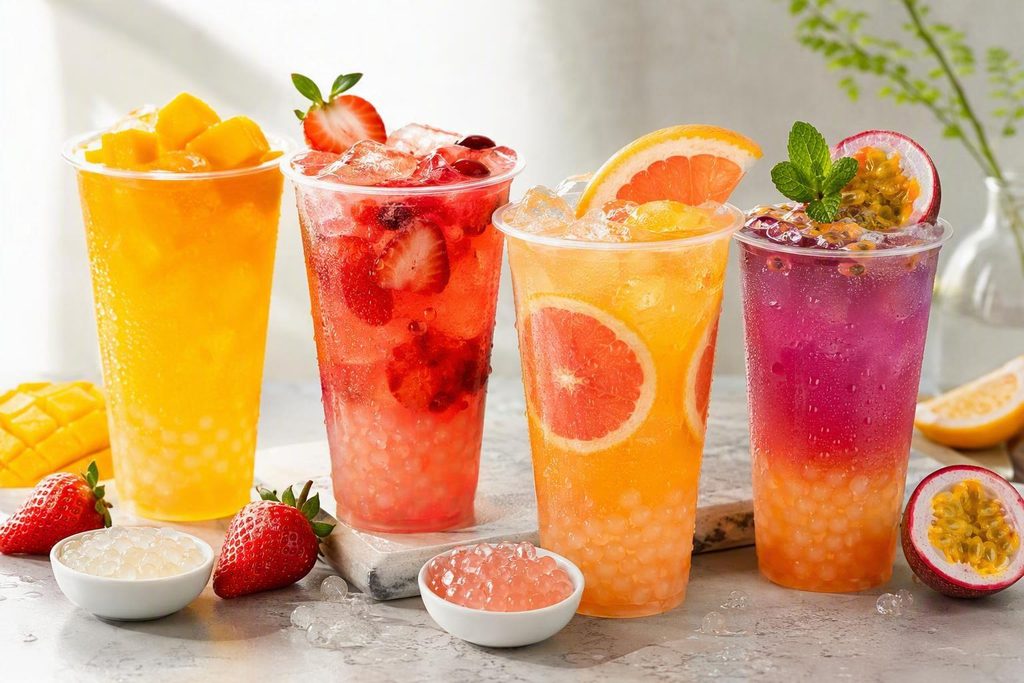
If you’ve watched competitor menus this year, you’ve probably noticed the same thing: the drinks getting the most attention aren’t milky anymore. They’re bright, layered, and fruit-forward — a mango-and-green-tea gradient in one cup, a ruby citrus number in the next. That shift isn’t a passing fad. Fruit flavor is the biggest flavor segment in bubble tea, and customers increasingly order fruit-flavor tea over milky options, so it pays to understand which fruit flavors carry weight and how to pair them so your line stays tight and profitable.
This guide is written for boba shop owners and managers deciding what to run next. We’ll cover the fruit flavors worth your menu space and how to turn them into fruit-flavor tea SKUs in 2025 and 2026, a simple tea-base pairing system, how to build a small core fruit-tea line without bloating prep, and how to rotate seasonally so regulars always have a reason to come back.
Why fruit-flavored tea is now a must-have category
Fruit-flavor tea has become a defining fruit tea trend in the US, and the category keeps taking a bigger share of sales. In the US bubble-tea market, Grand View Research put the fruit-flavored portion at roughly 38% of revenue as far back as 2023, and industry trackers report it as the dominant flavor today. That large, growing base matters if you’re an operator: it means the demand is proven, not experimental.
What’s behind the numbers? Consumers are reaching for drinks that feel lighter and less dessert-like than a sweet milk tea. US fruit tea trend coverage
points to younger customers leaning toward lower-sugar, naturally flavored, caffeine-optional beverages, and iced tea already dwarfs hot tea in the US. Fruit teas check those boxes: they’re bright on camera, easy to customize by sweetness, and flexible enough to go dairy-free.
For a boba shop, fruit tea is also one of the most efficient lines to add. It shares tea bases across multiple flavors, lifts your average ticket with popular toppings, and gives you a visually distinct menu tier that photographs well for social media. The first decision, though, is not how to build it — it’s which fruit flavors to build with.
The best fruit flavors for bubble tea menus in 2025 and 2026
Trend lists can be overwhelming, so it helps to split fruit flavors into demand tiers rather than chase everything at once.
The evergreen tropical core. Mango, passion fruit, and lychee are the workhorses you can build a fruit-tea program on. Mango is repeatedly the top-selling fruit bubble-tea flavor and pairs effortlessly with green or jasmine bases. Passion fruit adds the tartness that keeps a sweet drink from feeling heavy, which is why it shows up across menus. Lychee brings a clean floral-sweet note that reads as premium without needing much help.
Berries and stone fruit — where the growth is. On a US menu, it’s hard to go wrong with strawberry, which works hot or cold and is one of the country’s most familiar fruit profiles. Beyond the classics, peach (especially white peach) and lighter stone-fruit notes are the ones most 2026 trend reports call out as rising. Peach pairs easily with oolong or green tea and gives your menu a juicy, sophisticated option that sits between citrus and tropical.
Bright citrus for a “refresher” tier. Yuzu, calamansi, grapefruit, blood orange, and lemon are moving from juice bars into tea because they read clean, functional, and photogenic. A citrus note is the fastest way to make a fruit tea feel like a light refresher rather than a dessert, and citrus teas are especially easy to show off with a thin wheel garnish.
Botanical-fruit hybrids for differentiation. If you want something that sets you apart without testing your supply chain, look at a floral-accented fruit blend — hibiscus with berry, elderflower with citrus, or a lychee-rose idea. These carry a “premium and experimental” signal that drives curiosity on social media and justify limited-time positioning.
A practical takeaway: most operators should build around a tropical core with one or two berry or stone-fruit flagships, keep a zero-additive citrus “refresher,” and save the botanical hybrids for seasonal specials rather than permanent space.
Pair each fruit flavor tea with the right tea base
Good tea base pairing is where a fruit flavor tea menu comes together or falls apart. The rule of thumb is to match the tea leaf to the fruit’s weight, acidity, and aroma: delicate teas carry bright or light fruit, while fuller-bodied teas support heavier or darker fruit.
Tea base
Best fruit partners
Why it works
Jasmine green
mango, lychee, passion fruit, peach, citrus
Clean floral base; industry-standard for fruit tea and the default workhorse
Green tea
watermelon, green apple, pineapple, strawberry
Light and refreshing; lets juicy fruit lead instead of competing
Oolong
white peach, guava, mango
Buttery, low-astringency “bridge” that suits rich, juicy or creamy-fruit builds
Black tea
ruby grapefruit, navel orange, dark berry
Full body and tannic structure stand up to intense citrus
White / herbal (hibiscus, rooibos)
melon, light citrus, berry
Delicate or caffeine-free; an easy zero-caffeine option
A useful mental model is to keep one caffeine-free herbal base in each flavor family you run — citrus, berry, and tropical — so there’s always a no-caffeine pick for evening customers and for anyone avoiding caffeine on principle. Commercial fruit-tea menus often look to jasmine green for over 80% of their fruit builds precisely because its orchard-floral note flatters both tropical and citrus fruit without fighting them.
How to build a tight fruit-flavor tea core (without bloating prep)
Once you know your flavors and bases, resist the urge to add twenty SKUs. A focused fruit-tea line is easier to keep fast, consistent, and profitable.
Start with two or three shared tea bases and build several flavors on top of them. If your jasmine-green batch carries a mango, a lychee, and a citrus refresher, one brew run supports three menu items and you waste far less at the end of a hold window. Think of your tea as a modular base rather than a separate recipe for every drink.
Decide your fruit format first, because it changes your prep and your food cost. Commercial fruit tea sourcing guidance generally frames it as a trade-off: syrup or concentrate is the speed and consistency play — simple to portion and inventory, and the usual baseline; puree reads more natural and premium but costs more, handles thicker, and needs stricter portioning; powder is shelf-stable and easy to store but usually tastes less fresh than syrup or puree. Most scaled fruit-tea lines use a hybrid: a standardized puree or syrup shaken with the tea for consistent flavor, plus a few fresh fruit slices in the cup for that fresher, premium look.
Standardize sweetness and portioning in grams and milliliters so every cup matches the menu photo. Typical 16 oz fruit-tea specs run around 200–220 ml of chilled tea, roughly 30–45 ml of fruit syrup (or a bit more if you use puree), a defined ice fill, and a topping portion of about 40–60 g. Build a sweetness ladder from zero to full so customers can customize without the bar improvising.
Keep your toppings to a short, cold-stable set — popping boba, crystal (agar) boba, and a jelly are the common trio. Traditional brown-sugar tapioca pearls are less ideal in cold acidic fruit tea because they can turn soft and lose texture, so treat fruit tea as its own topping world. Offer two or three core toppings and expand only when sales data justifies it.
Pro Tip: If every new fruit tea uses a base, a fruit format, and a topping you already stock, you can add real menu variety with almost no additional prep — that cross-utilization is what keeps a small shop fast and profitable.
Rotate your fruit tea menu without bloating the lineup
Fruit flavor trends are seasonal by nature, which is a gift: you can refresh the menu with limited-time specials instead of permanently widening your SKU list.
Summer is the tropical and citrus season. Lean into light “refresher” positioning with mango, watermelon, pineapple, peach, and bright citrus, served on jasmine-green, green, or white tea. Push lower-sweetness options and clean presentation — this is when photos of gradient fruit teas travel furthest.
Fall turns orchard and darker. Swap toward apple, pear, cranberry, blackberry, plum, and pomegranate, with tea choices moving to oolong or black tea. Trend reports for fall 2026 show fruit moving beyond the classics toward fig, banana, and warming berry blends — still orchard-leaning but with more storytelling and depth.
The cleanest structure for an operator is a small permanent core plus a rotating limited spot. Keep one or two evergreen hero fruit teas your regulars can count on in every season, then cycle a seasonal special every four to eight weeks to create urgency and social buzz. That way you stay on-trend without retraining staff on a completely new menu every few months.
When you retire a seasonal drink, use the sales data from your POS to decide which flavors earn a permanent slot next season and which were one-hit wonders. Over a couple of seasons you’ll have a shortlist that is genuinely local to your customers, not just copied from a trend report.
Frequently asked questions
What’s the difference between fruit tea and a fruit-flavored milk tea? Fruit tea is typically a non-dairy, fruit-forward iced drink built on brewed tea or a caffeine-free herbal base, shaken with fruit and finished with toppings. A fruit-flavored milk tea adds a milk or creamer component over that same fruit. If you’re building a lighter, lower-sugar halo category, plain fruit tea does that job better.
Which tea base is best for fruit tea? Jasmine green is the industry workhorse because its clean floral note suits most tropical and citrus fruit. Choose green tea for very light, juicy fruit; oolong for rich plum or stone-fruit profiles; and black tea for intense citrus or dark berry that needs body.
Is there a caffeine-free fruit tea option? Yes. Build at least one on an herbal or fruit-infusion base such as hibiscus, rooibos, or a berry tisane. It gives you a no-caffeine option in each flavor family and widens your evening customer base.
Should I use syrup, puree, or powder? It’s a trade-off. Syrup is fastest and most consistent; puree reads more natural and premium but costs more and needs tighter portioning; powder is shelf-stable but reads least fresh. Many shops use a puree or syrup shaken in and a few fresh slices for looks.
Build the fruit-tea line your menu is ready for
Fruit-flavored tea is no longer a side note on a boba menu — it’s the category customers are asking for, and it’s built for shops that want a lighter, colorful, profitable tier without adding heavy prep. Start with the flavors that reliably sell, match them to tea bases that let the fruit shine, lock in a small core of shared-base SKUs, and use seasonal drops to stay current.
To turn these ideas into specs your staff can execute, explore BubbleTeaSuppliers’ fruit tea guides and commercial recipes for flavor profiles, tea-base pairing examples, and a ready-to-scale build like a commercial fruit tea recipe. And when you’re ready to stock the fruit syrups, purees, and tea bases behind a great fruit-tea line, browse the wholesale catalog to compare options for your shop.
{"email":"Email address invalid","url":"Website address invalid","required":"Required field missing"}